

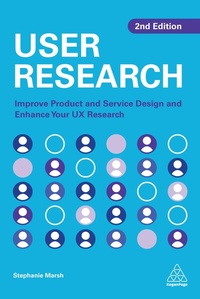
User Research
Improve Product and Service Design and Enhance Your UX Research
2nd Edition
Published on 3. February 2022
Book
Hardback
344 pages
978-1-3986-0360-8 (ISBN)
Description
Despite businesses often being based on creating desirable experiences, products and services for consumers, many fail to consider the end user in their planning and development processes. This book is here to change that.
User experience research, also known as UX research, focuses on understanding user behaviours, needs and motivations through a range of observational techniques, task analysis and other methodologies.
User Research
is a practical guide that shows readers how to use the vast array of user research methods available. Written by one of the UK's leading UX research professionals, readers can benefit from in-depth knowledge that explores the fundamentals of user research.
Covering all the key research methods including face-to-face user testing, card sorting, surveys, A/B testing and many more, the book gives expert insight into the nuances, advantages and disadvantages of each, while also providing guidance on how to interpret, analyze and share the data once it has been obtained. Now in its second edition,
User Research
provides a new chapter on research operations and infrastructure as well as new material on combining user research methodologies.
Reviews / Votes
"This book offers a comprehensive overview of how to be a great user researcher and explains exactly how to plan, run and debrief impactful user research. This new edition is right up to date with modern research needs for ethical data handling, and operationalising research. An essential handbook for new and experienced researchers to keep by their side!"More details
Other editions
New editions
Book
12/2025
3rd Edition
Kogan Page Ltd
€68.40
Shipment within 10-20 days
Additional editions
Book
02/2022
2nd Edition
Kogan Page Ltd
€41.50
Available immediately
Person
Author
Stephanie Marsh (she/they) is a leading UX research professional and currently UX Research Operations Lead at Springer Nature. They are the former Head of User Research and Analysis for the UK Government Digital Service and former Head of Digital Strategy for the UK Ministry of Defence. She was also previously a consultant at Bunnyfoot, a leading UX consultancy in the UK. They have contributed chapters to a range of peer-reviewed texts in related fields and has delivered talks on UX Research, Research Operations and UX strategies at a range of conferences and industry events. She is based in London.
Content
-
- Chapter - 01: Introduction - Why is user research so important?;
- Section - ONE: The fundamentals - What good research looks like;
-
- Chapter - 02: Planning, objectives and legalities in user research;
- Chapter - 03: Best practice in user research - Who, what, why and how;
- Chapter - 04: Managing user research logistics - Agencies, facilities and contracts;
- Section - TWO: Selecting and using user research methods;
-
- Chapter - 05: Usability testing - Observing people doing things;
- Chapter - 06: Content testing - What do people think your content means?;
- Chapter - 07: Card sorting - Understanding how people group and relate things;
- Chapter - 08: Surveys - How to gauge a widespread user response;
- Chapter - 09: User interviews - Understanding people's experience through talking to them;
- Chapter - 10: Diary studies - How to capture user research data over time;
- Chapter - 11: Information architecture validation - Does the structure of your information work for your users?;
- Chapter - 12: Ethnography - Observing how people behave in the real world;
- Chapter - 13: Contextual inquiry - Interviewing people in their own environment;
- Chapter - 14: A/B Testing - A technique to compare different options;
- Chapter - 15: Getting the best out of stakeholder workshops;
- Chapter - 16: Guerrilla research - Running fast-paced research in the real world;
- Chapter - 17: How to combine user research methodologies;
- Section - THREE: Analyzing and presenting your data;
-
- Chapter - 18: Content analysis - A method of coding and making sense of your qualitative data;
- Chapter - 19: Affinity diagramming - Understand your data through identifying its themes;
- Chapter - 20: Prioritizing issues and user needs - What's important and what to work on next;
- Chapter - 21: Making recommendations - How to make your research findings actionable;
- Chapter - 22: Creating executive summaries and detailed reports to present results;
- Chapter - 23: Using video playback to present your research results;
- Chapter - 24: Using personas to communicate user characteristics and behaviours;
- Chapter - 25: Using mental models to visualize how users think and identify opportunities;
- Chapter - 26: Using journey and experience maps to visualize user research data;
- Chapter - 27: Using scenarios and storyboards to represent the user journey;
- Chapter - 28: Using infographics to translate numerical and statistical data;
- Chapter - 29: How to recommend changes to visual, interaction and information design;
- Chapter - 30: Conclusion