

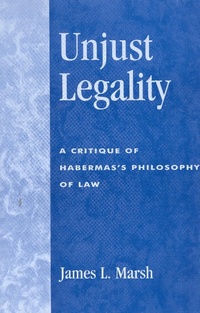
Unjust Legality
A Critique of Habermas's Philosophy of Law
Will be published approx. on 16. October 2001
Book
Paperback/Softback
224 pages
978-0-7425-1261-0 (ISBN)
Description
This book is an interpretation and critique of Habermas's philosophy of law in his Between Facts and Norms. The main point is that, while Habermas is insightful in laying out a new conceptual and methodological foundation for the philosophy of law, the book is flawed by a fundamental contradiction: that between the notion of a democracy ruled by law and capitalism. Because capitalism is essentially undemocratic both in its internal economic workings and its intended, structural effect on culture and politics, it must adversely affect the most important institutions in western democratic society, the legislature, judiciary, state administration, and public sphere. As a result, instead of a nation effectively "of, by, and for the people," there exists one that is essentially "of, by, and for capital."
Reviews / Votes
Professor Marsh, a self-styled 'disillusioned Habermasian,' offers a careful, somber 'reality check' to the comparatively favorable vision of contemporary society that Habermas presents in his significant work, Between Facts and Norms. At the sametime, the ultimate, and in fact quite successful, aim of Marsh's analysis is the positive one of reworking Habermas' own best insights back in the direction of a genuinely critical theory of modern society.... -- William L. McBride, Purdue University Marsh has produced an outstanding and accessible text that provides a badly needed left critique of Habermas' philosophy of law. * Science & Society * Marsh displays an impressive mastery of Habermas's texts that few others have attained. His commentary on Between Facts and Norms is exceptionally clear and jargon-free, not to mention chock full of illuminating examples and references to the real world. Above all, its sympathetic treatment of the basic project of Habermas's masterpiece is judiciously balanced by a critique of Habermas's failure to consistently carry that project through to the end.... -- David Ingram, Loyola University, Chicago Marsh displays an impressive mastery of Habermas's texts that few others have attained. His commentary on Between Facts and Norms is exceptionally clear and jargon-free, not to mention chock full of illuminating examples and references to the real world. Above all, its sympathetic treatment of the basic project of Habermas's masterpiece is judiciously balanced by a critique of Habermas's failure to consistently carry that project through to the end. -- David Ingram, Loyola University, Chicago Professor Marsh, a self-styled 'disillusioned Habermasian,' offers a careful, somber 'reality check' to the comparatively favorable vision of contemporary society that Habermas presents in his significant work, Between Facts and Norms. At the same time, the ultimate, and in fact quite successful, aim of Marsh's analysis is the positive one of reworking Habermas' own best insights back in the direction of a genuinely critical theory of modern society. -- William L. McBride, Purdue UniversityMore details
Series
Language
English
Place of publication
United States
Publishing group
Bloomsbury Publishing Plc
Product notice
Paperback (trade)
Unsewn / adhesive bound
Dimensions
Height: 229 mm
Width: 149 mm
Thickness: 13 mm
Weight
295 gr
ISBN-13
978-0-7425-1261-0 (9780742512610)
Copyright in bibliographic data and cover images is held by Nielsen Book Services Limited or by the publishers or by their respective licensors: all rights reserved.
Schweitzer Classification
Person
James L. Marsh is professor of philosophy at Fordham University in Bronx, New York. He is the author of several books such as Modernity and Its Discontents and Critique, Action, and Liberation.
Content
Chapter 1 Preface
Chapter 2 Toward a Critique of Habermas's Philosophy of Law
Chapter 3 The Tension between Facticity and Validity
Chapter 4 On Mediating Private and Public Autonomy: The Genesis of Rights
Chapter 5 The Genesis of the State
Chapter 6 Law and Jurisprudence
Chapter 7 Deliberative Politics and Administrative Social Power
Chapter 8 The Public Sphere, Civil Society, and the Rule of Capital
Chapter 9 The Different Paradigms of Law and the Difference They Make
Chapter 10 The Achievement and Limits of Habermas's Philosophy of Law
Chapter 2 Toward a Critique of Habermas's Philosophy of Law
Chapter 3 The Tension between Facticity and Validity
Chapter 4 On Mediating Private and Public Autonomy: The Genesis of Rights
Chapter 5 The Genesis of the State
Chapter 6 Law and Jurisprudence
Chapter 7 Deliberative Politics and Administrative Social Power
Chapter 8 The Public Sphere, Civil Society, and the Rule of Capital
Chapter 9 The Different Paradigms of Law and the Difference They Make
Chapter 10 The Achievement and Limits of Habermas's Philosophy of Law