

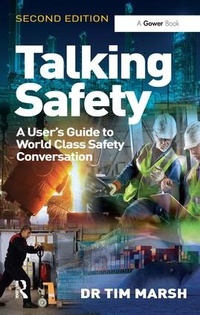
Talking Safety
A User's Guide to World Class Safety Conversation
2nd Edition
Published on 3. June 2013
Book
Paperback/Softback
152 pages
978-1-4094-6655-0 (ISBN)
Description
Talking Safety summarises in a short user-friendly read the key element of safety leadership - the management and supervisor 'walk and talk'. Safety standards are set by a combination of three things: first, the basic systems: risk assessments, procedures, training, inductions and maintenance; second, the amount of objective learning about the inevitable weaknesses in these systems achieved from a 'Just Culture' perspective; and third, the quality of 'transformational' safety leadership which means coaching not telling, praising not criticising, leading by example and maximising front-line ownership and involvement. A good 'walk and talk' is the only methodology that covers all of these issues and really should be embedded as 'part of the way we do things around here'. It is the centrepiece of any world class safety culture. Although covering all the key safety research findings by academics including Sidney Dekker, Andrew Hopkins and James Reason as well as latest influencing skills techniques from recent advances such as 'nudge' theory it is written in an accessible style using everyday examples and case studies. You can use any of the five simple steps it outlines to make a difference day to day. Employ its advice fully and it will help you embed safety thinking, transform your safety culture and make safety part of 'the way we do things around here'.
Reviews / Votes
'The missing factor for most senior managers is not the desire to do something to improve health and safety, rather it is a lack of knowledge of what they practically need to do to make a difference. Talking Safety for most people is the missing piece of the jigsaw, the piece that brings realisation and helps them to "get it". Key to this success is the light hearted and yet impactful style of the book which makes the techniques which have been developed through hard won experience immediately accessible.' Neil Budworth, former President of IOSH 'Tim brings psychology to the world of safety in a manner which inspires workforce and directors alike and delivers real results'. Heather Beach EHS Director, Barbour 'This book will quickly become the walk and talk standard from Europe's own safety leadership guru.' Jim McKerron HSEQ Director EnterpriseMore details
Edition
2nd New edition
Language
English
Place of publication
Oxford
United Kingdom
Publishing group
Taylor & Francis Ltd
Target group
Professional and scholarly
Edition type
New edition
Dimensions
Height: 216 mm
Width: 138 mm
Weight
244 gr
ISBN-13
978-1-4094-6655-0 (9781409466550)
Copyright in bibliographic data and cover images is held by Nielsen Book Services Limited or by the publishers or by their respective licensors: all rights reserved.
Schweitzer Classification
Other editions
New editions
Book
10/2021
3rd Edition
Routledge
€53.20
Shipment within 10-20 days
Additional editions
Book
06/2017
2nd Edition
Routledge
€237.70
Withdrawn from sale
Person
Tim Marsh was one of the team leaders of the original UK research into behavioural safety in the early 1990s and is a Chartered Psychologists and a Chartered Fellows of IOSH. He has worked with more than 400 organisations around the world since including the European Space Agency and the BBC. He now specialises in safety leadership and organisational culture assessment and change. Tim runs open courses on Behavioural Safety and Safety Culture for IOSH, was awarded a President's Commendation in 2008 by the International Institute of Risk and Safety Management and was selected to be their first ever 'Specialist Fellow' in 2010. The author of several bestselling books Tim is a regular contributor to magazines including the Safety and Health Practitioner and Health and Safety at Work.
Content
Contents: Section 1 A Little Theory: Why bother?; Safety excellence and leading safe practice. Section 2 Safety Contacts: Introduce yourself and set the tone; Analysis; Coaching; Eliciting a promise (?); Close out. Conclusion; Appendices; References and further reading.