

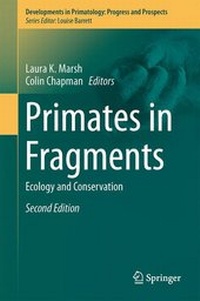
Primates in Fragments
Complexity and resilience
2nd Edition
Published on 31. August 2013
Book
Hardback
XV, 485 pages
978-1-4614-7665-8 (ISBN)
Description
This book is number two in a series for Primates in Fragments. In this volume, ten years after the first, we continue to address issues regarding primates within a fractured landscape. There are seven sections based on specific categories of primates in fragments. In the Introductory section, authors discuss the issues surrounding primates in remnant habitats as well as encourage discussion about what we mean by fragmentation on a landscape scale. In the Long-Term and Regional Studies section, authors present information on changes that have occurred during longer studies as well as changes that have occurred over regions. In the Landscape, Metapopulations and the Matrix section, authors cover topics from dry to moist forests, and from metapopulations to single species use of multiple fragments locations. In Feeding and Behavioral Ecology, authors take a closer look at the flexibility and responsiveness of primates in fragments in terms of their food choices, resource use, and behavioral changes. In Endemic, Endangered, and Nocturnal Primates authors uncover details involving critical primates living in major city centers to the heights of the Himalayas. In Genetics, Disease and Parasites authors cover topics including population viability, disease and parasite transmission between primates in fragments and humans. Finally, in the Conservation and Ecology: Threats and Management section, we synthesize information in this volume and make recommendations for the future of work in this field and the survivability of primates in fragments.
More details
Series
Language
English
Place of publication
Boston, MA
United States
Publishing group
Springer Netherlands
Target group
Professional and scholarly
Research
Illustrations
XV, 485 p. 92 illus., 56 illus. in color., 36 s/w Abbildungen, 56 farbige Abbildungen, 20 s/w Tabellen
Dimensions
Height: 235 mm
Width: 155 mm
ISBN-13
978-1-4614-7665-8 (9781461476658)
DOI
10.1007/978-1-4614-7666-5
Schweitzer Classification
Other editions
Previous edition
Book
02/2003
Kluwer Academic/Plenum Publishers
€85.59
Article exhausted; check for reprint
Content
[Dedications by: LKM and CAC] [Preface: Laura K. Marsh] [Foreword: Thomas Lovejoy] [Author Correspondence Information] SECTION I: INTRODUCTION [1] Because Conservation Counts: Primates and FragmentationLaura K. Marsh [2] Assessing Habitat Fragmentation Effects for Primates: The Importance of Evaluating Questions at the Correct Scale Víctor Arroyo-Rodríguez, Eddaly Cuesta-del Moral, Salvador Mandujano, Colin A. Chapman, Rafael Reyna-Hurtado and Lenore Fahrig SECTION II: LONG-TERM AND REGIONAL STUDIES Long-Term and Regional Studies SummaryLaura K. Marsh [3] One Hundred Years of Solitude: Effects of Long-Term Forest Fragmentation on the Primate Community of Java, IndonesiaVincent Nijman [4] A Region-Wide Review of Mesoamerican Primates: Prioritizing for ConservationErnesto Rodríguez-Luna, Aralisa Shedden, Brenda Solórzano-García [5] Primates of the Biological Dynamics of Forest Fragments Project: A HistorySarah A. Boyle, Bryan B. Lenz, Kellen A. Gilbert, Wilson R. Spironello, Marcela, Santamaría Gómez, Eleonore Z. F. Setz, Alaercio Marajó dos Reis, Osmaildo Ferreira da Silva, Alexine Keuroghlian, Flávia Pinto [6] Lessons From Los Tuxtlas: 30 Years of Research Into Primates in Fragments Jurgi Cristobal- Azkarate and Jacob C. Dunn [7] Going, Going, Gone: A 15-year History of the Decline of Primates in Forest Fragments Near National Park, UgandaColin A. Chapman, Ria Ghai, Aerin Jacob, Sam Mugume Koojo, Rafael Reyna-Hurtado, Jessica M. Rothman, Dennis Twinomugisha, Michael D. Wasserman and Tony L. Goldberg SECTION III: LANDSCAPE, METAPOPULATIONS, AND THE MATRIX Landscape, Metapopulations, and the Matrix Summary Laura K. Marsh [8] Primate Populations in Fragmented Tropical Dry Forest Landscapes in Southwestern NicaraguaKimberly Williams-Guillén, Suzanne Hagell, Sarah Otterstrom, Stephanie Spehar and Claudia Gómez [9] Living on the Edge: Habitat Fragmentation at the Interface of the Semi-Arid Zone of the Brazilian NortheastStephen F. Ferrari, Eduardo M. Santos Junior, Evellyn B. Freitas, Joao Pedro Souza-Alves, Leandro Jerusalinsky, Raone B. Mendes, Renata R.D. Chagas, Renato R. Hilário, and Shirley A.A. Baião [10] Do Patch Size and Dispersal Distance Influence the Distribution of Brown Howler Monkeys (Alouatta guariba clamitans) in a Fragmented Landscape in South Brazil?Felipe E. Silva and Júlio César Bicca-Marques [11] Status Monitoring of Isolated Populations of Macaques and Other Non-Human Primates in ThailandN. Aggimarangsee [12] An Eight-Year Life History of a Primate Community in Fragments in Colombian LlanosXyomara Carretero-Pinzón [13] A Critically-Endangered Capuchin (Sapajus apella margaritae) Living in Mountain Forest Fragments on Isla de Margarita, VenezuelaNatalia Ceballos-Mago and David J. Chivers SECTION IV: FEEDING AND BEHAVIORAL ECOLOGY Feeding and Behavioral Ecology Summary Laura K. Marsh [14] "Specialist" Primates Can Be Flexible In Response To Habitat AlterationKatarzyna Nowak & Phyllis C. Lee [15] Fragments and Food: Red-tailed Monkey Abundance in Privately Owned Forest Fragments of Central UgandaDeborah Baranga, Colin A. Chapman, Patrick Mucunguzi, and Rafael Reyna-Hurtado [16] Fragment-Adaptive Behavioral Strategies and Intersite Variation in the Ring-Tailed Lemurs of South-Central Madagascar Alex Cameron and Lisa Gould [17] The Simplified Novel Diet of the Blond Capuchin in the Vanishing Pernambuco Endemism CentreAlexandre de Jesus Rodrigues Malta and Antonio Rossano Mendes Pontes [18] Effects of Habitat Alteration on Resting Behaviour of the Sahamalza Sportive Lemur in Northwest MadagascarMelanie Seiler, Marc Holderied, and Christoph Schwitzer SECTION V: ENDEMIC, ENDANGERED, AND NOCTURNAL PRIMATES Endemic, Endangered, and Nocturnal Primates Summary Laura K. Marsh [19] Multi-Level and Multi-Disciplinary Approaches to Understanding Endangered Primates in Complex Landscapes: Golden-headed Lion Tamarins in Southern Bahia, BrazilKristel M. De Vleeschouwer and Becky E. Raboy [20] A Critically-Endangered Capuchin Monkey (Sapajus xanthosternos) Living in a Highly-Fragmented HotspotGustavo Rodrigues Canale, Maria Cecília Martins Kierulff, and David John Chivers [21] Coping with Fragmented Forests: The Critically Endangered Tonkin Snub-Nosed Monkeys (Rhinopithecus avunculus) in VietnamRamesh Boonratana and Le Xuan Canh [22] Fragmented Primates of Nepal Mukesh K. Chalise [23] The Challenges of Survival in a Concrete Jungle: Conservation of the Pied Tamarin in the Urban Landscape of Manaus, BrazilMarcelo Gordo, Fabiano O. Calleia, Sâmia A. Vasconcelos, José J.F. Leite, Stephen F. Ferrari [24] Where Are They? Quantification, Distribution, and Microhabitat Use of Fragments by the Red Slender Loris in Sri LankaK.A.I. Nekaris and Carrie J. Stengel SECTION VI: GENETICS, DISEASE, AND PARASITES Genetics, Disease, and Parasites Summary Laura K. Marsh [25] Molecular Genetic Tools for Evaluating the Consequences of Habitat FragmentationLeslie Knapp [26] Kinship and Dispersal Patterns in Alouatta caraya Inhabiting Continuous and Fragmented Habitats of ArgentinaLuciana Oklander and Daniel Corach [27] The Mona Monkeys of Grenada, São Tomé and Príncipe: Long-term Persistence of a Guenon in Permanent Fragments and Implications for the Survival of Forest Primates in Protected AreasMary E. Glenn and Keith J. Bensen[28] Landscape Attributes Affecting the Natural Hybridization of Mexican Howler MonkeysPedro Américo D. Dias, Diego Alvarado-Serrano, Ariadna Rangel-Negrín, Domingo Canales-Espinosa, and Liliana Cortés-Ortiz [29] Preliminary Evaluation of the Effects of Habitat Fragmentation on Habitat Use and Genetic Diversity of Pygmy Marmosets in EcuadorStella de la Torre, Pablo Yépez, Diego Nieto, Hernán Payaguaje [30] Interacting Roles of Diet, Cortisol Levels, and Parasites in Determining Population Density of Belizean Howler Monkeys in a Hurricane Damaged Forest FragmentAlison M. Behie and Mary S.M. Pavelka SECTION VII: CONSERVATION AND ECOLOGY: THREATS AND MANAGEMENT Conservation and Ecology: Threats and Management Summary Laura K. Marsh [31] Fragmentation and Its Significance on Proboscis Monkey (Nasalis larvatus) Conservation in the Lower Kinabatangan, Sabah (North Borneo) Ramesh Boonratana [32] Potential Distribution of Primates in the Yucatan Peninsula, Mexico Under Current and Climate Change ScenariosGabriel Ramos-Fernandez, Celene Espadas-Manrique and Juan Carlos Serio-Silva [33] Conservation Challenges Facing Two Threatened Endemic Titi Monkeys in a Naturally Fragmented Bolivian ForestRobert B. Wallace, Jesus Martinez, Heidy Lopez-Strauss, Julia Barreta, Ariel Reinaga and Lesly Lopez [34] Primates in Fragments Ten Years Later: Once and Future Goals Laura K. Marsh, Colin A. Chapman, Victor Arroyo-Rodríguez, A.K. Cobden, Jacob C. Dunn, D. Gabriel, Ria R. Ghai, Vincent Nijman, Rafael Reyna-Hurtado, Juan Carlos Serio-Silva, G. Silva-Lopez, and Michael D. Wasserman