

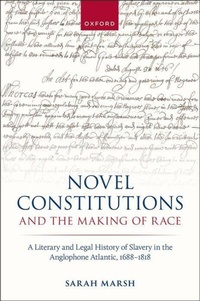
Novel Constitutions and the Making of Race
A Literary and Legal History of Slavery in the Anglophone Atlantic, 1688-1818
Will be published approx. on 8. October 2026
Book
Hardback
304 pages
978-0-19-791786-2 (ISBN)
Description
Novel Constitutions and the Making of Race argues that Anglo-American racial slavery emerged from a constitutional crisis in seventeenth-century England between divine-right absolutism of the Stuart kings, and their people's claims to an 'ancient constitution': an immemorial, heritable protection of life, liberty, and property under the common law. As Stuart imperial expansion transported these conflicts overseas, Crown jurists and colonial lawmakers developed new procedures for the absolute mastery of human labour that severed kinship ties, alienated labour, and ultimately converted people of African descent into perpetual, inheritable property, while simultaneously transforming some English subjects into colonial slavocrats. These English slaveholders, like the Stuart kings, asserted absolute power over their human subjects.
Sarah Marsh argues that contemporary racial categories in the United States of America took shape through these legal improvisations, which this study names 'novel constitutions': practices that inserted absolutist power into the very constitutional idioms meant to restrain tyranny, turning an old set of English constitutional safeguards into a rationale for owning human beings, and setting that rationale upon the arbitrary logic of human skin colour.
Early modern literary texts are essential to perceiving this history because, in real time, they recorded this constitutional contest between the rights of the king and the rights of the people. Novels, autobiographies, petitions, and even mathematics disclose the moral drama, political conflict, and spiritual struggle through which modern American conceptions of slavery and antislavery were brought into being--often showing, with unmatched nuance, how race was developed at law, challenged, and ultimately exposed as a legal fiction. Reading these texts alongside statutes, slave codes, charters, and landmark legal decisions, Novel Constitutions reframes slavery and antislavery as competing constitutional impulses that shaped the American founding and continue to inflect its unfinished claims to liberty and equality.
Sarah Marsh argues that contemporary racial categories in the United States of America took shape through these legal improvisations, which this study names 'novel constitutions': practices that inserted absolutist power into the very constitutional idioms meant to restrain tyranny, turning an old set of English constitutional safeguards into a rationale for owning human beings, and setting that rationale upon the arbitrary logic of human skin colour.
Early modern literary texts are essential to perceiving this history because, in real time, they recorded this constitutional contest between the rights of the king and the rights of the people. Novels, autobiographies, petitions, and even mathematics disclose the moral drama, political conflict, and spiritual struggle through which modern American conceptions of slavery and antislavery were brought into being--often showing, with unmatched nuance, how race was developed at law, challenged, and ultimately exposed as a legal fiction. Reading these texts alongside statutes, slave codes, charters, and landmark legal decisions, Novel Constitutions reframes slavery and antislavery as competing constitutional impulses that shaped the American founding and continue to inflect its unfinished claims to liberty and equality.
More details
Series
Language
English
Place of publication
Oxford
United Kingdom
Illustrations
4 b&w illustrations
Dimensions
Height: 234 mm
Width: 156 mm
ISBN-13
978-0-19-791786-2 (9780197917862)
Copyright in bibliographic data and cover images is held by Nielsen Book Services Limited or by the publishers or by their respective licensors: all rights reserved.
Schweitzer Classification
Person
Sarah Marsh is Associate Professor of English at Seton Hill University. A scholar of anglophone literature and culture of the long eighteenth century, she focuses on the western Atlantic histories of race, slavery, and antislavery. Her work explores how eighteenth-century writing confronted the moral, spiritual, and political crises of human slavery, and how literary forms helped shape emerging ideas about freedom, equality, personhood, and human flourishing.