

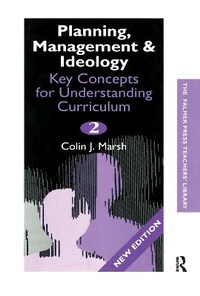
Key Concepts for Understanding the Curriculum
1st Edition
Published on 11. March 1997
Book
Hardback
336 pages
978-0-7507-0684-1 (ISBN)
Description
Each chapter of this book is devoted to a separate concept, which is analyzed in terms of its major features. Follow-up questions at the end of each chapter are designed to challenge the reader to reflect further on the specific issues raised.
More details
Language
English
Place of publication
London
United Kingdom
Publishing group
Taylor & Francis Ltd
Target group
Adult education
College/higher education
Professional and scholarly
Dimensions
Height: 234 mm
Width: 156 mm
Weight
453 gr
ISBN-13
978-0-7507-0684-1 (9780750706841)
Copyright in bibliographic data and cover images is held by Nielsen Book Services Limited or by the publishers or by their respective licensors: all rights reserved.
Schweitzer Classification
Other editions
Additional editions
Colin J. Marsh
Key Concepts for Understanding the Curriculum
E-Book
10/2018
Routledge
€211.99
Available for download
Colin J. Marsh
Key Concepts for Understanding the Curriculum
E-Book
10/2018
Routledge
€211.99
Available for download

Colin J. Marsh
Key Concepts for Understanding the Curriculum
Book
1st Edition
Routledge Falmer
€37.13
The article will not be published
Person
Colin J. Marsh
Content
Curriculum frameworks; school audits, situational analysis and needs assessment; aims, goals and objectives; selection of method; profiles, records of achievement and portfolios; using textbooks; curriculum and integration; technology and a school subject; Tyler's planning model; Walker's deliberative approach to planning; centrally-based curriculum development; decentralized and school-based curriculum development; curriculum implementation; assessment, grading and testing; innovation and planned change; leadership and the school principal; self-managing schools; performance indidcators and effective schools; school evaluations/reviews; curriculum history; school subjects; curriculum theorizing and the reconceptualists; sociology of knowledge and the curriculum; feminist pedagogy; postmodernism and the curriculum.