

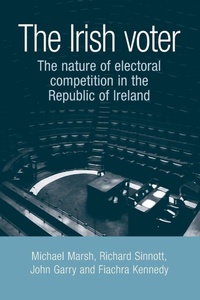
The Irish Voter
The Nature of Electoral Competition in the Republic of Ireland
Published on 1. March 2008
Book
Paperback/Softback
328 pages
978-0-7190-7732-6 (ISBN)
Description
This pioneering analysis uses the results from the first ever Irish election study to provide a comprehensive survey of the motives, outlook and behaviour of voters in the Republic of Ireland. Building on the foundations laid down by previous work on comparative electoral behaviour, it explores long-term influences on vote choice, such as party loyalties and enduring values, as well as short-term ones, such as the economy, the party leaders and the candidates themselves. It also examines how people use their vote and why so many people do not vote at all.
Many features of Irish elections make such a detailed study particularly important. The single transferable vote system allows voters an unusual degree of freedom to pick the candidates they prefer, while electoral trends observed elsewhere can be found in a more extreme form in Ireland. For example, attachment to parties is very low, differences between them are often obscure, candidate profiles are very high and turnout is falling rapidly. However, Irish elections defy international trends in other respects, most notably in the degree of personal contact parties and candidates make with their voters.
Findings are presented in a manner that is highly accessible to anyone with an interest in elections, electoral systems and electoral behaviour. The book is essential reading for anyone interested in Irish politics and is an important text for students of European Politics, Parties and Elections, Comparative Politics and Political Sociology. -- .
Many features of Irish elections make such a detailed study particularly important. The single transferable vote system allows voters an unusual degree of freedom to pick the candidates they prefer, while electoral trends observed elsewhere can be found in a more extreme form in Ireland. For example, attachment to parties is very low, differences between them are often obscure, candidate profiles are very high and turnout is falling rapidly. However, Irish elections defy international trends in other respects, most notably in the degree of personal contact parties and candidates make with their voters.
Findings are presented in a manner that is highly accessible to anyone with an interest in elections, electoral systems and electoral behaviour. The book is essential reading for anyone interested in Irish politics and is an important text for students of European Politics, Parties and Elections, Comparative Politics and Political Sociology. -- .
More details
Language
English
Place of publication
Manchester
United Kingdom
Target group
College/higher education
Illustrations
Tables, black & white|Line drawings, unspecified
Dimensions
Height: 234 mm
Width: 156 mm
Thickness: 18 mm
Weight
494 gr
ISBN-13
978-0-7190-7732-6 (9780719077326)
Copyright in bibliographic data and cover images is held by Nielsen Book Services Limited or by the publishers or by their respective licensors: all rights reserved.
Schweitzer Classification
Persons
Michael Marsh is Associate Professor of Political Science at Trinity College Dublin. Richard Sinnott is Professor of Politics at University College Dublin. John Garry is Lecturer in Politics at Queen's University Belfast. Fiachra Kennedy is Research Fellow in the Geary Institute, University College Dublin -- .
Content
List of tables
List of figures
1. Introduction
2. How people voted
3. The evidence for cleavage politics
4. The extent and meaning of party attachment
5. Credit and blame for the 'Celtic Tiger'
6. Leaders and their parties
7. Grassroots campaigning
8. Parties or candidates?
9. Adding it all up
10. Voter turnout: the need for facilitation and mobilisation
11. Conclusion
References
Appendix I: Details of the survey
Appendix II: The Electoral System
Appendix III: Table for Chapter 9
Appendix III: Questionnaire with frequency distributions
Index -- .
List of figures
1. Introduction
2. How people voted
3. The evidence for cleavage politics
4. The extent and meaning of party attachment
5. Credit and blame for the 'Celtic Tiger'
6. Leaders and their parties
7. Grassroots campaigning
8. Parties or candidates?
9. Adding it all up
10. Voter turnout: the need for facilitation and mobilisation
11. Conclusion
References
Appendix I: Details of the survey
Appendix II: The Electoral System
Appendix III: Table for Chapter 9
Appendix III: Questionnaire with frequency distributions
Index -- .