

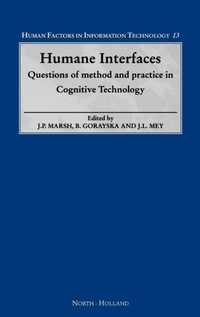
Humane Interfaces: Volume 13
Questions of Method and Practice in Cognitive Technology
Published on 7. April 1999
Book
Hardback
391 pages
978-0-444-82874-3 (ISBN)
Description
Ever since the first successful International Cognitive Technology (CT) Conference in Hong Kong in August 1995, a growing concern about the dehumanising potential of machines, and the machining potential of the human mind, has pervaded the organisers' thinking. When setting up the agenda for the Second International CT Conference in Aizu, Japan, in August of 1997, they were aware that a number of new approaches had seen the light, but that the need to integrate them within a human framework had become more urgent than ever, due to the accelerating pace of technological and commercialised developments in the computer related fields of industry and researchWhat the present book does is re-emphasize the importance of the 'human factor' - not as something that we should 'also' take into account, when doing technology, but as the primary driving force and supreme aim of our technological endeavours. Machining the human should not happen, but humanising the machine should. La Humacha should replace the Hemachine in our thinking about these matters.
More details
Series
Language
English
Place of publication
United States
Publishing group
Elsevier Science & Technology
Target group
Professional and scholarly
Product notice
Laminated cover
Dimensions
Height: 234 mm
Width: 156 mm
Thickness: 24 mm
Weight
748 gr
ISBN-13
978-0-444-82874-3 (9780444828743)
Copyright in bibliographic data and cover images is held by Nielsen Book Services Limited or by the publishers or by their respective licensors: all rights reserved.
Schweitzer Classification
Other editions
Additional editions
J. P. Marsh | B. Gorayska | J. L. Mey
Humane Interfaces
Questions of Method and Practice in Cognitive Technology
E-Book
04/1999
Elsevier
€137.00
Available for download
Persons
Editor
Centre for the Advancement of University Teaching, The University of Hong Kong, Hong Kong Special Administrative Region, PRC
Department of Computer Science, City University of Hong Kong, Hong Kong Special Administrative Region, PRC
Institute of Language and Communication, Odense University, Odense, Denmark
Content
Introduction. Methods and Practice in Cognitive Technology: A question of questions (B. Gorayska, J. Marsh, J. Mey).
Theoretical Perspectives. Mind Change or changed minds? Commentary and chapter summaries. Investigations in Cognitive Technology: Questioning perspective (B. Gorayska, J. Marsh). Can We Change Our Minds? The Impact of Computer Technology on Human Cognition (R. Lindsay). Computers and Psychosis (R. Janney). The Natural and the Artificial in Language and Technology (H. Haberland). Understanding Users: The knowledge-level of analysis (A. Vera). Augmentation, Mediation, Integration?
Commentary and chapter summaries. The Cyborg's Dilemma: Progressive embodiment in virtual environments (F. Biocca). Cognitive Tools Reconsidered: From augmentation to mediation (K. Kuutti). The Meeting Place of Cognition and Technology (B. Karpatschof). Honesty of Affordance (W. Fitzgerald, E. Goldstein). The Design of Cognitive Tools (S.D. Tripp).
Cyberspace Bionics (J. Vidal). Cognitive Space (M. Krueger).
Applied Methods.How do we convert principles into valid and validated applied methods? Commentary and chapter summaries.
On Why the Blind Leading the Blind is a Good Idea (D.Good).
Between the Idea and the Reality: The case for qualitative
Research in education (I. Hart). Computer Environments Designed to Promote Cognitive Change through the Development of Well Reasoned Recommendations (A. Kass, J. Herman). Evolution of Man's Needs and Technological Progression: Pragmatic foundations for a relational coupling (C.T. Schmidt, P. Ruch). Successful Technology Must Enable People to Utilise Existing
Cognitive Skills (M. Kitajima).
Palmtop Reminding Devices: Capabilites and limitations (D. Herrmann, C. Yoder, V. Sheets, J. Wells, B. Brubaker). A User Designed Contextualisation Method for an Argumentation Support Tool (J. Sillince). Cognition Oriented Software Verification (W. Halang). Index.
Theoretical Perspectives. Mind Change or changed minds? Commentary and chapter summaries. Investigations in Cognitive Technology: Questioning perspective (B. Gorayska, J. Marsh). Can We Change Our Minds? The Impact of Computer Technology on Human Cognition (R. Lindsay). Computers and Psychosis (R. Janney). The Natural and the Artificial in Language and Technology (H. Haberland). Understanding Users: The knowledge-level of analysis (A. Vera). Augmentation, Mediation, Integration?
Commentary and chapter summaries. The Cyborg's Dilemma: Progressive embodiment in virtual environments (F. Biocca). Cognitive Tools Reconsidered: From augmentation to mediation (K. Kuutti). The Meeting Place of Cognition and Technology (B. Karpatschof). Honesty of Affordance (W. Fitzgerald, E. Goldstein). The Design of Cognitive Tools (S.D. Tripp).
Cyberspace Bionics (J. Vidal). Cognitive Space (M. Krueger).
Applied Methods.How do we convert principles into valid and validated applied methods? Commentary and chapter summaries.
On Why the Blind Leading the Blind is a Good Idea (D.Good).
Between the Idea and the Reality: The case for qualitative
Research in education (I. Hart). Computer Environments Designed to Promote Cognitive Change through the Development of Well Reasoned Recommendations (A. Kass, J. Herman). Evolution of Man's Needs and Technological Progression: Pragmatic foundations for a relational coupling (C.T. Schmidt, P. Ruch). Successful Technology Must Enable People to Utilise Existing
Cognitive Skills (M. Kitajima).
Palmtop Reminding Devices: Capabilites and limitations (D. Herrmann, C. Yoder, V. Sheets, J. Wells, B. Brubaker). A User Designed Contextualisation Method for an Argumentation Support Tool (J. Sillince). Cognition Oriented Software Verification (W. Halang). Index.