

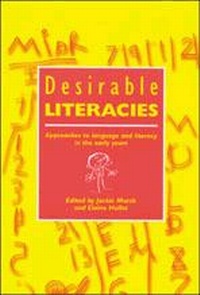
Desirable Literacies
Approaches to Language and Literacy in the Early Years
1st Edition
Published on 29. April 1999
Book
Hardback
256 pages
978-1-85396-446-6 (ISBN)
Description
A new edition of this book is available at: http:/www.uk.sagepub.com/textbooksProdDesc.nav?prodId=Book232567
`The book demonstrates the importance of providing meaningful, purposeful opportunities for children to develop, explore and enjoy the full range of literacy experiences and offers plenty of practical ideas for how this can be achieved... offers a very stimulating and even inspiring read to anyone involved in early years education' - Literacy and Language
`The range of topics and authors is both extensive and impressive; the book includes chapters on oral language development, early reading, early writing, the involvement of parents and developing literacy with bilingual children. The importance of non-verbal language, so often by-passed in books of this kind, is emphasized in a number of chapters, which focus on a broader interpretation of literacy. These include the use of drama, puppets, costuming and even "hot-seating". Several of the chapters extend these ideas for language and literacy development beyond the confines of the classroom or even the school, adding a cautionary note that too often previously competent young language users become responders rather than initiators the minute they walk through the door of the classroom' - Child Language Teaching and Therapy
`The range of topics and authors is both extensive and impressive; the book includes chapters on oral language development, early reading, early writing, the involvement of parents and developing literacy with bilingual children. The importance of non-verbal language, so often by-passed in books of this kind, is emphasized in a number of chapters, which focus on a broader interpretation of literacy. These include the use of drama, puppets, costuming and even hot seating. Several of the chapters extend these ideas for language and literacy development beyond the confines of the classroom or even the school, adding a cautionary note that too often previously competent young language users become responders rather than initiators the minute they walk through the door of the classroom' - Child Language Teaching and Therapy
This book will help develop professional knowledge and expertise in the area of language and literacy in the early years. It relates current practices to relevant research and theory in a range of areas. It provides a framework for the planning and delivery of an early years language and literacy curriculum, with references to the Desirable Outcomes.
The authors take a broad approach to the concept of literacy and acknowledge the impact that developments in technology have on children's interaction with language and texts. The book recognises the wide variety of experiences that children have had before entering under 5's settings and incorporates work on cultural and linguistic diversity.
`The book demonstrates the importance of providing meaningful, purposeful opportunities for children to develop, explore and enjoy the full range of literacy experiences and offers plenty of practical ideas for how this can be achieved... offers a very stimulating and even inspiring read to anyone involved in early years education' - Literacy and Language
`The range of topics and authors is both extensive and impressive; the book includes chapters on oral language development, early reading, early writing, the involvement of parents and developing literacy with bilingual children. The importance of non-verbal language, so often by-passed in books of this kind, is emphasized in a number of chapters, which focus on a broader interpretation of literacy. These include the use of drama, puppets, costuming and even "hot-seating". Several of the chapters extend these ideas for language and literacy development beyond the confines of the classroom or even the school, adding a cautionary note that too often previously competent young language users become responders rather than initiators the minute they walk through the door of the classroom' - Child Language Teaching and Therapy
`The range of topics and authors is both extensive and impressive; the book includes chapters on oral language development, early reading, early writing, the involvement of parents and developing literacy with bilingual children. The importance of non-verbal language, so often by-passed in books of this kind, is emphasized in a number of chapters, which focus on a broader interpretation of literacy. These include the use of drama, puppets, costuming and even hot seating. Several of the chapters extend these ideas for language and literacy development beyond the confines of the classroom or even the school, adding a cautionary note that too often previously competent young language users become responders rather than initiators the minute they walk through the door of the classroom' - Child Language Teaching and Therapy
This book will help develop professional knowledge and expertise in the area of language and literacy in the early years. It relates current practices to relevant research and theory in a range of areas. It provides a framework for the planning and delivery of an early years language and literacy curriculum, with references to the Desirable Outcomes.
The authors take a broad approach to the concept of literacy and acknowledge the impact that developments in technology have on children's interaction with language and texts. The book recognises the wide variety of experiences that children have had before entering under 5's settings and incorporates work on cultural and linguistic diversity.
Reviews / Votes
`The book demonstrates the importance of providing meaningful, purposeful opportunities for children to develop, explore and enjoy the full range of literacy experiences and offers plenty of practical ideas for how this can be achieved... offers a very stimulating and even inspiring read to anyone involved in early years education' - Literacy and Language`The range of topics and authors is both extensive and impressive; the book includes chapters on oral language development, early reading, early writing, the involvement of parents and developing literacy with bilingual children. The importance of non-verbal language, so often by-passed in books of this kind, is emphasized in a number of chapters, which focus on a broader interpretation of literacy. These include the use of drama, puppets, costuming and even "hot-seating". Several of the chapters extend these ideas for language and literacy development beyond the confines of the classroom or even the school, adding a cautionary note that too often previously competent young language users become responders rather than initiators the minute they walk through the door of the classroom' - Child Language Teaching and Therapy
More details
Edition
First Edition
Language
English
Place of publication
London
United Kingdom
Publishing group
Sage Publications Ltd
Target group
College/higher education
Professional and scholarly
Dimensions
Height: 234 mm
Width: 156 mm
Weight
533 gr
ISBN-13
978-1-85396-446-6 (9781853964466)
Copyright in bibliographic data and cover images is held by Nielsen Book Services Limited or by the publishers or by their respective licensors: all rights reserved.
Schweitzer Classification
Other editions
New editions
Jackie Marsh | Elaine Hallet
Desirable Literacies
Approaches to Language and Literacy in the Early Years
Book
11/2008
2nd Edition
SAGE Publications Ltd
€233.23
Shipment within 15-20 days
Persons
Jackie Marsh is Professor of Education at the University of Sheffield, UK, where she conducts research on young children's play and digital literacy practices in homes, communities and early years settings and primary schools. Her most recent publications include Changing Play: Play, Media and Commercial Culture from the 1950s to the Present Day (with Bishop, 2014) and Handbook of Early Childhood Literacy (edited with Larson, 2013). Jackie is an editor of the Journal of Early Childhood Literacy.
Dr Elaine Hallet has been involved in educating children, practitioners, educators, teachers and students over a career of thirty-six years and during this time has developed an understanding of how to nurture, scaffold and support children's and adults' learning and professional practice through meaningful contexts. She has worked as an early years teacher, advisory teacher and leader in a range of schools and nurseries, as a lecturer and leader with students in further and higher education, teaching on a range of early years initial training, post-qualifying, undergraduate, postgraduate, doctoral programmes and sector-endorsed professional awards in early years and integrated centre leadership.
Elaine's research includes, foundation degree graduates' continuing professional development through work-based reflective learning, the development of professional identity, the role of graduate early years leaders in the leadership of learning. She is committed to continuing professional learning for development of professional practice and to supporting practitioners, educators and teachers on their reflective learning journeys of knowledge, understanding and discovery.
Elaine has recently retired from her role as Lecturer in Early Childhood at the Institute of Education: University College London. With a background in early years education and practice, Elaine is an established author, with a special interest in the education of young children and, practitioners, educators and teachers' reflective continuing professional learning.
Dr Elaine Hallet has been involved in educating children, practitioners, educators, teachers and students over a career of thirty-six years and during this time has developed an understanding of how to nurture, scaffold and support children's and adults' learning and professional practice through meaningful contexts. She has worked as an early years teacher, advisory teacher and leader in a range of schools and nurseries, as a lecturer and leader with students in further and higher education, teaching on a range of early years initial training, post-qualifying, undergraduate, postgraduate, doctoral programmes and sector-endorsed professional awards in early years and integrated centre leadership.
Elaine's research includes, foundation degree graduates' continuing professional development through work-based reflective learning, the development of professional identity, the role of graduate early years leaders in the leadership of learning. She is committed to continuing professional learning for development of professional practice and to supporting practitioners, educators and teachers on their reflective learning journeys of knowledge, understanding and discovery.
Elaine has recently retired from her role as Lecturer in Early Childhood at the Institute of Education: University College London. With a background in early years education and practice, Elaine is an established author, with a special interest in the education of young children and, practitioners, educators and teachers' reflective continuing professional learning.
Content
Introduction - Jackie Marsh and Elaine Hallet
Learning to Talk, Talking to Learn - Jim McDonagh and Sue McDonagh
`I Can Tell Lots of Punjabi' - Eithne Dodwell
Developing Language and Literacy with Bilingual Children
The Literacies and Language of Poetry and Rhyme - Suzi Clipson-Boyles
Signs and Symbols - Elaine Hallet
Environmental Print
Early Reading Development - Guy Merchant
Devloping Writing - Ann Browne
Young Children, Play and Literacy - Nigel Hall
Engagement in Realistic Uses of Literacy
Drama - Jacki Rowley
Computer Literacy - Moira Monteith
Teletubby Tales - Jackie Marsh
Popular Culture and Media Education
`I Like it When My Mum Comes to School to Work With Me' - Carol Taylor
Family Literacy
Desirable Planning for Language and Literacy - Mary Brailsford, Diane Hetherington and Evelyn Abram
Level 3 and the Ringling Tingling Man - Fran Paffard
Assessing Language and Literacy
Learning to Talk, Talking to Learn - Jim McDonagh and Sue McDonagh
`I Can Tell Lots of Punjabi' - Eithne Dodwell
Developing Language and Literacy with Bilingual Children
The Literacies and Language of Poetry and Rhyme - Suzi Clipson-Boyles
Signs and Symbols - Elaine Hallet
Environmental Print
Early Reading Development - Guy Merchant
Devloping Writing - Ann Browne
Young Children, Play and Literacy - Nigel Hall
Engagement in Realistic Uses of Literacy
Drama - Jacki Rowley
Computer Literacy - Moira Monteith
Teletubby Tales - Jackie Marsh
Popular Culture and Media Education
`I Like it When My Mum Comes to School to Work With Me' - Carol Taylor
Family Literacy
Desirable Planning for Language and Literacy - Mary Brailsford, Diane Hetherington and Evelyn Abram
Level 3 and the Ringling Tingling Man - Fran Paffard
Assessing Language and Literacy