

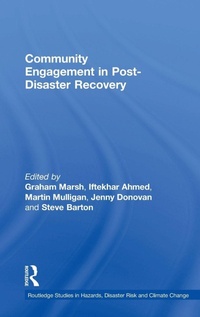
Community Engagement in Post-Disaster Recovery
1st Edition
Published on 13. September 2017
Book
Hardback
220 pages
978-1-138-69165-0 (ISBN)
Description
Community Engagement in Post-Disaster Recovery reflects a wide array of practical experiences in working with disaster-affected communities internationally. It demonstrates that widely held assumptions about the benefits of community consultation and engagement in disaster recovery work need to be examined more critically because poorly conceived and hastily implemented community engagement strategies have sometimes exacerbated divisions within affected communities and/or resulted in ineffective use of aid funding. It is equally demonstrated that well-crafted, creative and thoughtful programming is possible.
The wide collection of case studies of practical experience from around the world is presented to help establish ways of working with communities experiencing great challenges. The book offers practical suggestions on how to give more substance to the rhetoric of community consultation and engagement in these areas of work. It suggests the need to work with a dynamic understanding of community formation that is particularly relevant when people experience unforeseen challenges and traumatic experiences. This title interrogates the concept of community through an extensive review of the literature and explores the ways of working with communities in transition and particularly in their recovery phases through an array of case studies in a range of socioeconomic and political contexts.
Focused on the concept of community in post-disaster recovery solutions-an aspect which has received little critical interrogation in the literature-this book will be a valuable resource to students and scholars in disaster management as well as humanitarian agencies.
The wide collection of case studies of practical experience from around the world is presented to help establish ways of working with communities experiencing great challenges. The book offers practical suggestions on how to give more substance to the rhetoric of community consultation and engagement in these areas of work. It suggests the need to work with a dynamic understanding of community formation that is particularly relevant when people experience unforeseen challenges and traumatic experiences. This title interrogates the concept of community through an extensive review of the literature and explores the ways of working with communities in transition and particularly in their recovery phases through an array of case studies in a range of socioeconomic and political contexts.
Focused on the concept of community in post-disaster recovery solutions-an aspect which has received little critical interrogation in the literature-this book will be a valuable resource to students and scholars in disaster management as well as humanitarian agencies.
More details
Series
Language
English
Place of publication
London
United Kingdom
Publishing group
Taylor & Francis Ltd
Target group
College/higher education
Illustrations
55 s/w Abbildungen, 41 s/w Photographien bzw. Rasterbilder, 14 s/w Zeichnungen, 12 s/w Tabellen
12 Tables, black and white; 14 Line drawings, black and white; 41 Halftones, black and white; 55 Illustrations, black and white
Dimensions
Height: 240 mm
Width: 161 mm
Thickness: 18 mm
Weight
531 gr
ISBN-13
978-1-138-69165-0 (9781138691650)
Copyright in bibliographic data and cover images is held by Nielsen Book Services Limited or by the publishers or by their respective licensors: all rights reserved.
Schweitzer Classification
Other editions
Additional editions
Graham Marsh | Iftekhar Ahmed | Martin Mulligan
Community Engagement in Post-Disaster Recovery
Book
09/2017
1st Edition
Routledge
€68.30
Shipment within 10-20 days
Graham Marsh | Iftekhar Ahmed | Martin Mulligan
Community Engagement in Post-Disaster Recovery
E-Book
09/2017
Routledge
€61.99
Available for download
Graham Marsh | Iftekhar Ahmed | Martin Mulligan
Community Engagement in Post-Disaster Recovery
E-Book
09/2017
Routledge
€61.99
Available for download
Persons
Graham Marsh is a Visiting Research Fellow in Disaster Management at the School of Energy, Construction and Environment, Faculty of Engineering, Environment and Computing at Coventry University, UK.
Iftekhar Ahmed is a Senior Lecturer in the School of Architecture and Built Environment, University of Newcastle, Australia.
Martin Mulligan is an Associate Professor in the Sustainability and Urban Planning section of the School of Global, Urban and Social Studies at RMIT University and a former Director of RMIT's Globalism Research Centre, Australia.
Jenny Donovan is the Principal of Melbourne-based urban design practice Inclusive Design, Australia.
Steve Barton is a humanitarian training facilitator and freelance consultant working for agencies such as the Red Cross and the UN and is also founder and director of the Recovery Resource Centre.
Iftekhar Ahmed is a Senior Lecturer in the School of Architecture and Built Environment, University of Newcastle, Australia.
Martin Mulligan is an Associate Professor in the Sustainability and Urban Planning section of the School of Global, Urban and Social Studies at RMIT University and a former Director of RMIT's Globalism Research Centre, Australia.
Jenny Donovan is the Principal of Melbourne-based urban design practice Inclusive Design, Australia.
Steve Barton is a humanitarian training facilitator and freelance consultant working for agencies such as the Red Cross and the UN and is also founder and director of the Recovery Resource Centre.
Content
List of figures
List of tables
Notes on contributors
Foreword by Professor John Twigg
Preface Graham Marsh, Iftekhar Ahmed, Martin Mulligan, Jenny Donovan and Steve Barton
Rethinking the meaning of 'community' in community-based disaster management - Martin Mulligan
Rebuilding lessons from bushfire-affected communities in Victoria, Australia - Greg Ireton and Iftekhar Ahmed
A partnership-based community engagement approach to recovery of flood-affected communities in Bangladesh - Iftekhar Ahmed
Public engagements in forward looking recovery efforts following the 2013 floods in High River and Calgary, Canada - Eva Bogdan, Amber Bennett and Lilia Yumagulova
How the Chinese government responded to the Wenchuan earthquake - Yung-Fang Chen
Participation for disaster resilience: A life cycle approach to reconstruction projects in India - Mittul Vahanvati
A duty of care: Disaster recovery, community and social responsibility in Indonesia - David O'Brien, Catherine Elliott and Brendon McNiven
The role of community engagement in post-disaster reconstruction: The cases of L'Aquila and Emilia Romagna, Italy - Lorenza Lazzati
Facts on the ground: Affirming community identity through placemaking projects in West Bank villages - Jenny Donovan
Women and their roles in peace building in conflict vulnerable areas of Mindanao, Philippines - Beau B. Beza, Mary Johnson and Anne Shangrila Y. Fuentes
Community and conflict: The case of Rwanda - Marion E. MacLellan
Beneficiary Driven Recovery (BDR): An example from the Solomon Islands - Steve Barton
From short-term relief to the revival of community in post-tsunami Sri Lanka and India - Martin Mulligan
Community Recovery and the role of emergent organizations in post-disaster home buyouts: A case study of Oakwood Beach, New York, United States of America - Alex Greer and Sherri Brokopp Binder
15. Conclusions: Emerging lessons on community engagement in post-disaster recovery Graham Marsh, Iftekhar Ahmed, Martin Mulligan, Jenny Donovan and Steve Barton
Index
List of tables
Notes on contributors
Foreword by Professor John Twigg
Preface Graham Marsh, Iftekhar Ahmed, Martin Mulligan, Jenny Donovan and Steve Barton
Rethinking the meaning of 'community' in community-based disaster management - Martin Mulligan
Rebuilding lessons from bushfire-affected communities in Victoria, Australia - Greg Ireton and Iftekhar Ahmed
A partnership-based community engagement approach to recovery of flood-affected communities in Bangladesh - Iftekhar Ahmed
Public engagements in forward looking recovery efforts following the 2013 floods in High River and Calgary, Canada - Eva Bogdan, Amber Bennett and Lilia Yumagulova
How the Chinese government responded to the Wenchuan earthquake - Yung-Fang Chen
Participation for disaster resilience: A life cycle approach to reconstruction projects in India - Mittul Vahanvati
A duty of care: Disaster recovery, community and social responsibility in Indonesia - David O'Brien, Catherine Elliott and Brendon McNiven
The role of community engagement in post-disaster reconstruction: The cases of L'Aquila and Emilia Romagna, Italy - Lorenza Lazzati
Facts on the ground: Affirming community identity through placemaking projects in West Bank villages - Jenny Donovan
Women and their roles in peace building in conflict vulnerable areas of Mindanao, Philippines - Beau B. Beza, Mary Johnson and Anne Shangrila Y. Fuentes
Community and conflict: The case of Rwanda - Marion E. MacLellan
Beneficiary Driven Recovery (BDR): An example from the Solomon Islands - Steve Barton
From short-term relief to the revival of community in post-tsunami Sri Lanka and India - Martin Mulligan
Community Recovery and the role of emergent organizations in post-disaster home buyouts: A case study of Oakwood Beach, New York, United States of America - Alex Greer and Sherri Brokopp Binder
15. Conclusions: Emerging lessons on community engagement in post-disaster recovery Graham Marsh, Iftekhar Ahmed, Martin Mulligan, Jenny Donovan and Steve Barton
Index