

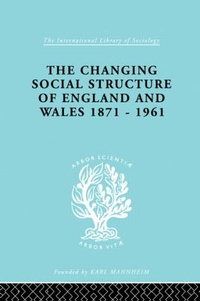
The Changing Social Structure of England and Wales
1st Edition
Published on 29. January 1998
Book
Hardback
288 pages
978-0-415-17616-3 (ISBN)
Description
This is Volume I of twenty-one in the Class, Race and Social Structure Series. Originally published in 1958, this is the second edition of a study that now focuses on the changing social structure of England and Wales between 1871 and 1961. The main object of this book, therefore, as it was in the first edition, is to introduce the student and the general reader to the maze of social statistics, which have become available, concerning the social structure of England and Wales. The emphasis throughout is on applied or descriptive statistics and a knowledge of statistical techniques therefore those (and they seem to be many) who have an instinctive dislike of mathematics need not be deterred from following the attempt which has been made to analyse the changing social structure with the aid of social statistics.
More details
Series
Language
English
Place of publication
London
United Kingdom
Publishing group
Taylor & Francis Ltd
Target group
College/higher education
Dimensions
Height: 216 mm
Width: 138 mm
Weight
690 gr
ISBN-13
978-0-415-17616-3 (9780415176163)
Copyright in bibliographic data and cover images is held by Nielsen Book Services Limited or by the publishers or by their respective licensors: all rights reserved.
Schweitzer Classification
Other editions
Additional editions
Book
07/2016
1st Edition
Routledge
€71.20
Shipment within 10-20 days
E-Book
08/2013
1st Edition
Routledge
€64.49
Available for download
E-Book
08/2013
1st Edition
Routledge
€64.49
Available for download
Person
David. C. Marsh
Content
Introduction; Chapter 1 The Patterns of Population Growth In England and Wales; Chapter 2 The Sex, Age and Marital Distribution of the Population; Chapter 3 The Family; Chapter 4 Regional Variations in the Composition and Distribution of the Population; Chapter 5 The Industrial and Occupational Distribution of the Population; Chapter 6 Occupational and other Associations; Chapter 7 Social Classes and Educational Opportunities; Chapter 8 The Changing Patterns of Social Problems; conc Conclusion;