

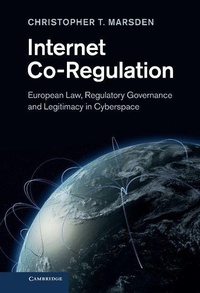
Internet Co-Regulation
European Law, Regulatory Governance and Legitimacy in Cyberspace
1st Edition
Published on 18. August 2011
Book
Hardback
310 pages
978-1-107-00348-4 (ISBN)
Description
Chris Marsden argues that co-regulation is the defining feature of the Internet in Europe. Co-regulation offers the state a route back into questions of legitimacy, governance and human rights, thereby opening up more interesting conversations than a static no-regulation versus state regulation binary choice. The basis for the argument is empirical investigation, based on a multi-year, European Commission-funded study and is further reinforced by the direction of travel in European and English law and policy, including the Digital Economy Act 2010. He places Internet regulation within the regulatory mainstream, as an advanced technocratic form of self- and co-regulation which requires governance reform to address a growing constitutional legitimacy gap. The literature review, case studies and analysis shed a welcome light on policymaking at the centre of Internet regulation in Brussels, London and Washington, revealing the extent to which states, firms and, increasingly, citizens are developing a new type of regulatory bargain.
Reviews / Votes
'... this work is to be commended as a scholarly and genuine attempt to offer a pragmatic and reasoned solution to a fraught debate where options have too often been limited to a stark binary choice between state regulation or self management.' Martina Gillen, International Journal of Law and Information Technology 'This ambitious work is a broad yet comprehensive analysis of the challenges and technical and legal complexities involved in the co-regulation of cyberspace within the EU ... Marsden's research, both evidence-based and cutting-edge, provides a broad and theoretical though clear overview of the complex legal and technical issues involved in the regulation of the Internet. In particular, this book is an invaluable source of information for those interested in regulatory reform and the ongoing challenges posed by Internet co-regulation.' The Cambridge Law JournalMore details
Language
English
Place of publication
Cambridge
United Kingdom
Target group
Professional and scholarly
College/higher education
Illustrations
17 b/w illus. 23 tables
23 Tables, black and white; 17 Line drawings, unspecified
Dimensions
Height: 235 mm
Width: 157 mm
Thickness: 21 mm
Weight
602 gr
ISBN-13
978-1-107-00348-4 (9781107003484)
Copyright in bibliographic data and cover images is held by Nielsen Book Services Limited or by the publishers or by their respective licensors: all rights reserved.
Schweitzer Classification
Other editions
Additional editions
Christopher T. Marsden
Internet Co-Regulation
European Law, Regulatory Governance and Legitimacy in Cyberspace
E-Book
12/2011
1st Edition
Cambridge University Press
€116.99
Available for download
Christopher T. Marsden
Internet Co-Regulation
European Law, Regulatory Governance and Legitimacy in Cyberspace
E-Book
08/2011
Cambridge University Press
€97.49
Available for download
Person
Christopher T. Marsden LL.B., LL.M., Ph.D. is Senior Lecturer in Law, University of Essex (2007-). In addition to this book, he is author of Net Neutrality: Towards a Co-regulatory Solution (2010) and three other edited or co-authored books. His research concerns socio-legal regulation, internet law and policy, and has appeared in peer-reviewed articles and reports for the European Commission, European governments, the OSCE and the Council of Europe, and national regulators and foundations. (See http://ssrn.com/author=220925 for more information). He was senior analyst, RAND Europe (2005-7), Lecturer at Warwick University (1997-2000) and a regulatory director/general counsel at ISPs and start-ups between 2000 and 2003. He was Research Fellow at Harvard University's Kennedy School (1999), Industrial Policy Fellow at the Cambridge University Computer Lab (2006-8) and has been a visiting fellow at law schools in the UK, US, Japan and Australia.
Content
1. States, firms and legitimacy of regulation; 2. Internet co-regulation and constitutionalism; 3. Self-organisation and social networks; 4. Standards, domain names and government; 5. Content regulation and the internet; 6. Private ISP censorship; 7. Analyzing case studies; 8. Internet co-regulation as part of the broader regulatory debate.