

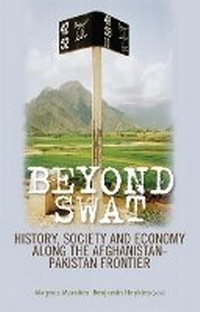
Beyond Swat
History, Society and Economy Along the Afghanistan-Pakistan Frontier
Will be published approx. on 27. March 2013
Book
Hardback
352 pages
978-1-84904-206-2 (ISBN)
Description
Beyond Swat readdresses Fredrik Barth's seminal work Political Leadership among Swat Pathans, and the reactions it sparked, in relationship to contemporary developments in Swat and the wider Afghanistan-Pakistan frontier region. It explores the relevance of these scholarly debates to understanding the key dynamics affecting the region and its people today. Written by anthropologists and historians with long-standing research experience in Afghanistan and Pakistan, as well as expertise in one or more of the region's languages, each chapter explores varying yet interconnected dimensions of the region's culture, society and politics over a broad span of history and their relevance to wider debates about the dynamics shaping this and other comparable 'frontier' spaces. The parallels the authors make cross temporal, as well as spatial boundaries and, in doing so, open up theoretically innovative lines of scholarly enquiry about the Afghanistan-Pakistan Frontier, the nature of Islamic militancy, its connections to ethnicity, class and transformations in the nature of state power, and, more generally, the relationship between anthropology and history.
Reviews / Votes
Easily readable and enjoyable, this book offers fresh and theoretically rich perspectives on a number of concerns that go well beyond Swat. Exemplary. -- Marta Bolognani Beyond Swat is a must-read. Its contributors offer original insight into the region's changing relations to economy, faith, language, and the contested meanings of loyalty and belonging. This volume shatters received wisdom and joins the specifics of the regional history and ethnography of the Afghanistan-Pakistan frontier to the main currents of social thought. -- Dale F. Eickelman, author of 'The Middle East and Central Asia: An Anthropological Approach This is an impressive volume, important for its focus on the dangerous, and all too pervasive, tendency of journalists and academics to sideline class and politics in favour of cultural stereotypes. Instead, these deeply informed articles by expert historians and anthropologists confirm over and over the importance of taking into account, as the editors put it, 'the common human modes of behaving' that are characteristic of the Afghanistan-Pakistan region, both historically and in the present. -- Barbara D. Metcalf, author of Husain Ahmad Madani: Islam and the Jihad for India's Freedom and editor of Islam in South Asia in Practice This is a most comprehensive study of the world's most notable flashpoint - Afghanistan and its neighbouring region. Using the 1959 seminal study by Fredrik Barth as a counterpoint, this collection of essays brings classical anthropological and historical portrayals into conversation with fresh research conducted in today's world. Rich in detail, this volume is a nuanced and genuinely insightful study into the most salient themes of this region: the relationship of the Taliban and Islam; the problematic notion of 'tribe'; relations between class, patronage and the State; the importance of trade in creating new moral and cultural worlds; and the continuity and change that this part of the world has witnessed over the past 200 years. If you want genuine understanding and erudition about Pashtuns and Afghanistan, this book is for you. -- Mukulika BanerjeeMore details
Language
English
Place of publication
London
United Kingdom
Target group
College/higher education
Illustrations
Illustrations
Dimensions
Height: 225 mm
Width: 145 mm
ISBN-13
978-1-84904-206-2 (9781849042062)
Copyright in bibliographic data and cover images is held by Nielsen Book Services Limited or by the publishers or by their respective licensors: all rights reserved.
Schweitzer Classification
Persons
Benjamin Hopkins is Assistant Professor of History and International Affairs, George Washington University, author of The Making of Modern Afghanistan, and co-editor, with Magnus Marsden, of Fragments of the Afghan Frontier. Magnus Marsden is Senior Lecturer in Social Anthropology with Reference to South and Central Asia, at the School of Oriental and African Studies, London. He has spent 15 years conducting research in both Afghanistan and Pakistan. His publications include Living Islam: Muslim Religious Experience in Pakistan's North-West Frontier (2005) and, as co-editor with Benjamin Hopkins, Fragments of the Afghan Frontier.