

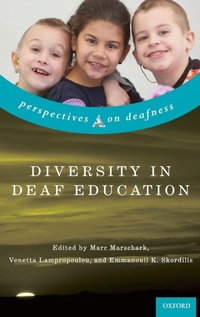
Diversity in Deaf Education
Published on 28. June 2016
Book
Hardback
568 pages
978-0-19-049307-3 (ISBN)
Description
Deaf children are not hearing children who can't hear. Beyond any specific effects of hearing loss, as a group they are far more diverse than hearing peers. Lack of full access to language, incidental learning, and social interactions as well as the possibility of secondary disabilities means that deaf learners face a variety of challenges in academic domains. Technological innovations such as digital hearing aids and cochlear implants have improved hearing and the
possibility of spoken language for many deaf learners, but parents, teachers, and other professionals are just now coming to recognize that there are cognitive, experiential, and social-emotional differences between deaf and hearing students likely to affect academic outcomes. Sign languages and
schools and programs for deaf learners thus remain an important part of the continuum of services needed for this diverse population. Understanding such diversity and determining ways in which to accommodate them must become a top priority in educating deaf learners.
Through the participation of an international, interdisciplinary set of scholars, Diversity in Deaf Education takes a broad view of learning and academic progress, considering "the whole child" in the context of the families, languages, educational settings in which they are immersed. In adopting this perspective, the complexities and commonalities in the social, emotional, cognitive, and linguistic mosaic of which the deaf child is a part, are captured. It is only through such a
holistic consideration of diverse children developing within diverse settings that we can understand their academic potentials.
possibility of spoken language for many deaf learners, but parents, teachers, and other professionals are just now coming to recognize that there are cognitive, experiential, and social-emotional differences between deaf and hearing students likely to affect academic outcomes. Sign languages and
schools and programs for deaf learners thus remain an important part of the continuum of services needed for this diverse population. Understanding such diversity and determining ways in which to accommodate them must become a top priority in educating deaf learners.
Through the participation of an international, interdisciplinary set of scholars, Diversity in Deaf Education takes a broad view of learning and academic progress, considering "the whole child" in the context of the families, languages, educational settings in which they are immersed. In adopting this perspective, the complexities and commonalities in the social, emotional, cognitive, and linguistic mosaic of which the deaf child is a part, are captured. It is only through such a
holistic consideration of diverse children developing within diverse settings that we can understand their academic potentials.
Reviews / Votes
"Diversity in Deaf Education is a treasure chest for every scholar, and every person working in the field of deaf education. The book addresses many of the most urgent topics in current discussions on deaf education. I enjoyed reading it because each chapter gives the reader both an overview on the current state of art and recent empirical data from the contributors' own studies. This book is a must-read!" --Manfred Hintermair, Professor, University of Education, Heidelberg"Diversity in Deaf Education is a paean to the concept of diversity in deaf education. Yes, it focuses on the types of diversity most familiar to many of us. But not only that, the book alerts us to the multiple layers of diversity that being deaf or hard of hearing brings to the fore... This book highlights the mantra that there is no 'one size fits all' solution because of all the complexities emanating from the multiple diverse aspects manifested in deaf children. Despite the lack of simplistic solutions, this book reveals the passion of its contributors in continuing to explore possibilities that will create deaf and hard-of-hearing children and adults who are fully able to maximize their potential in life." --Irene W. Leigh, Professor Emerita, Gallaudet University"This impressive volume takes a direct approach in a new way--rather than advocate one or another position, it makes the powerful point that great diversity exists (and always has) among deaf learners in terms of their needs and the techniques which will enable them to respond to fulfill their individual potentials; there can be no one best way for all. Growing from a series of presentations at the 2015 International Congress on Education of the Deaf (ICED) in Athens, Greece, the book encompasses a wide range of factors which comprise global diversity among deaf learners today-psychological, linguistic, ethnic, cognitive, and much more. The work is inspired by the continuing significant research work and leadership of Prof. Marc Marschark, who has assembled international experts in many topics; together they have produced what should become a watershed publication in the field for years to come." --David S. Martin, Professor/Dean Emeritus, Gallaudet UniversityMore details
Other editions
Additional editions
Marc Marschark | Venetta Lampropoulou | Emmanouil K. Skordilis
Diversity in Deaf Education
E-Book
05/2016
1st Edition
OUP eBook
€88.49
Available for download
Marc Marschark | Venetta Lampropoulou | Emmanouil K. Skordilis
Diversity in Deaf Education
E-Book
05/2016
1st Edition
OUP eBook
€88.49
Available for download
Persons
Marc Marschark is a Professor at the National Technical Institute for the Deaf, a college of Rochester Institute of Technology, where he directs the Center for Education Research Partnerships. His primary interest is in relations among language, learning, and cognition; current research focuses on such relations among deaf children and adults in formal and informal educational settings. He was founding editor of the Journal of Deaf Studies and Deaf Education.
Venetta Lampropoulou is a Professor of deaf education, founder and director of the Deaf Studies Unit of the University of Patras, Greece. Her research includes subjects related to literacy and the learning environments of deaf students, the families with deaf members, the use of technology by deaf people, and the linguistics of Greek sign language.
Emmanouil K Skordilis is an Associate Professor in Adapted Physical Activity (APA) within the School of Physical Education and Sport Science, in the National and Kapodistrian University of Athens, Greece. He received his undergraduate degree in the National and Kapodistrian University of Athens, Greece, and his Master's and Doctorate degrees from Springfield College. He has been an active researcher with more than 40 publications in the field during the last
decade.
Venetta Lampropoulou is a Professor of deaf education, founder and director of the Deaf Studies Unit of the University of Patras, Greece. Her research includes subjects related to literacy and the learning environments of deaf students, the families with deaf members, the use of technology by deaf people, and the linguistics of Greek sign language.
Emmanouil K Skordilis is an Associate Professor in Adapted Physical Activity (APA) within the School of Physical Education and Sport Science, in the National and Kapodistrian University of Athens, Greece. He received his undergraduate degree in the National and Kapodistrian University of Athens, Greece, and his Master's and Doctorate degrees from Springfield College. He has been an active researcher with more than 40 publications in the field during the last
decade.
Editor
ProfessorProfessor, National Technical Institute for the Deaf, Rochester Institute of Technology
Professor of Deaf Education; Director of the Deaf Studies Unit of the Department of Primary EducationProfessor of Deaf Education; Director of the Deaf Studies Unit of the Department of Primary Education, University of Patras, Greece
Associate ProfessorAssociate Professor, National and Kapodistrian University of Athens