

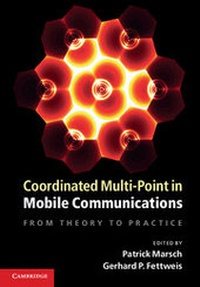
Coordinated Multi-Point in Mobile Communications
From Theory to Practice
Will be published approx. on 21. July 2011
Book
Hardback
508 pages
978-1-107-00411-5 (ISBN)
Description
A self-contained guide to coordinated multi-point (CoMP), this comprehensive book covers everything from theoretical basics to practical implementation. Addressing a wide range of topics, it highlights the potential gains of CoMP, the fundamental degrees of freedom involved and the key challenges of using CoMP in practice. The editors and contributors bring unique real-world experience from running the world's first and largest test beds for LTE-Advanced, and recent field trial results from these tests are presented. With detailed insight into the realistic potential of CoMP as a key technology for LTE-Advanced and beyond, this is a must-read resource for professionals and students who want the big picture on CoMP or require in-depth knowledge of how to build cellular communication systems for the future.
Reviews / Votes
'Interference is the limiting factor in cellular communications and smart coordination of transmission can lead to significant improvements in quality of service. This book provides a strong outline and lays out some of the fundamental assumptions and theoretical models to treat the subject and supports the theory with result from system-level test benches and field measurements. I recommend this book to everyone interested in the topic.' Siavash M. Alamouti, Vodafone Group R&D Director 'Coordinated Multi-Point in Mobile Communications is a must read for system engineers, students, and wireless [operators] in the important emerging area of CoMP. It is a comprehensive effort that balances the underlying theory with the practical guidelines in all aspects of the technology from theory to field test.' Gee Rittenhouse, Head of Research, Bell LabsMore details
Language
English
Place of publication
Cambridge
United Kingdom
Target group
Professional and scholarly
Illustrations
19 Tables, black and white; 5 Halftones, unspecified; 153 Line drawings, unspecified
Dimensions
Height: 254 mm
Width: 175 mm
Thickness: 25 mm
Weight
1130 gr
ISBN-13
978-1-107-00411-5 (9781107004115)
Copyright in bibliographic data and cover images is held by Nielsen Book Services Limited or by the publishers or by their respective licensors: all rights reserved.
Schweitzer Classification
Other editions
Additional editions
Patrick Marsch | Gerhard P. Fettweis
Coordinated Multi-Point in Mobile Communications
From Theory to Practice
E-Book
12/2011
1st Edition
Cambridge University Press
€118.99
Available for download
Persons
Patrick Marsch was the technical project coordinator of the research project EASY-C, where the world's largest research test beds for LTE-Advanced were established and the first live demonstrations of CoMP were performed. He received his Dr-Ing degree from Technische Universitaet Dresden, where he later headed the system level group at the Vodafone Chair, focusing on optimizing spectral efficiency and energy efficiency in heterogeneous cellular deployments. He currently heads a radio research team within Nokia Siemens Networks in Wroclaw, Poland. Gerhard P. Fettweis is the Vodafone Chair Professor at Technische Universitaet Dresden, with 20 companies from around the world currently sponsoring his research on wireless transmission and chip design. An IEEE Fellow, he runs the world's largest cellular research test beds, coordinated the EASY-C project and has received numerous awards. He began his career at IBM Research and has since developed nine start-up companies.
Content
Part I. Motivation and Basics: 1. Introduction Patrick Marsch and Gerhard Fettweis; 2. An operator's point of view Ralf Irmer; 3. Information-theoretic basics Patrick Marsch and David Tse; 4. Gains and trade-offs of multi-cell joint signal processing Patrick Marsch; Part II. Practical CoMP Schemes: 5. CoMP schemes based on interference-aware transceivers or interference coordination Lars Thiele, Thomas Wirth, Malte Schellmann, Thomas Haustein, Volker Jungnickel, Philipp Frank, Andreas Mueller, Heinz Droste, Chan-Byoung Chae, Ramya Bhagavatula, Doru Calin and Robert W. Heath, Jr; 6. CoMP schemes based on multi-cell joint signal processing Chenyang Yang, Yafei Tian, Andreas F. Molisch, Xinning Wei, Tobias Weber, Lars Thiele, Thomas Haustein, Volker Jungnickel, Wolfgang Zirwas, Federico Boccardi, David Gesbert and Randa Zakhour; Part III. Challenges Connected to CoMP: 7. Clustering Patrick Marsch, Stefan Brueck, Andrea Garavaglia, Matthias Schulist, Ralf Weber and Armin Dekorsy; 8. Synchronization D. Richard Brown III, Andrew G. Klein, Vincent Kotzsch, Gerhard Fettweis and Malte Schellmann; 9. Channel knowledge Wolfgang Zirwas, Lars Thiele, Tobias Weber, Nico Palleit, Volker Jungnickel, Guido Dietl and Wolfgang Utschick; 10. Efficient and robust algorithm implementation Joerg Holfeld, Gerhard Fettweis, Udo Wachsmann, Rainer Bachl and Stefan Mueller-Weinfurtner; 11. Scheduling, signaling and adaptive usage of CoMP Tarcisio Maciel, Ricardo B. dos Santos, Anja Klein, Christian Hoymann, Laetitia Falconetti, Michael Grieger, Patrick Marsch and Gerhard Fettweis; 12. Backhaul I-Hsiang Wang, David Tse, Christian Hoymann, Laetitia Falconetti, Patrick Marsch, Thorsten Fahldieck and Mark Doll; Part IV. Performance Assessment: 13. Field trial results Uwe Doetsch, Johannes Koppenborg, Patrick Marsch, Michael Grieger, Gerhard Fettweis, Volker Jungnickel, Andreas Forck, Stephan Jaeckel, Sander Wahls, Lars Thiele, Thomas Haustein, Wolfgang Zirwas, Heinz Droste, Gerhard Kadel, Joerg Holfeld, Erik Fischer, Vincent Kotzsch and Hans-Peter Mayer; 14. Performance prediction of CoMP in large cellular systems Thorsten Wild, Andreas Weber, Richard Fritzsche, Jens Voigt, Christian Schneider, Stefan Jaeckel, Carsten Jandura, Laetitia Falconetti, Christian Hoymann, Andreas Mueller, Philipp Frank, Jochen Giese, M. Awais Amin, Stefan Brueck, Mark Doll, Lars Thiele and Michael Olbrich; Part V. Outlook and Conclusions: 15. Outlook Armin Dammann, Christian Mensing, Stephan Sand, Peter Rost, Jens Voigt, Albrecht Fehske, Patrick Marsch and Gerhard Fettweis; 16. Summary and conclusions Patrick Marsch and Gerhard Fettweis.