

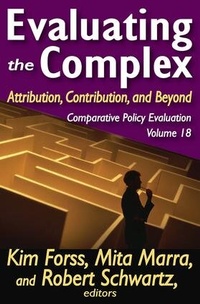
Evaluating the Complex
Attribution, Contribution and Beyond
1st Edition
Published on 15. August 2011
Book
Hardback
362 pages
978-1-4128-1846-9 (ISBN)
Description
In the economic atmosphere following the crisis of 2008, not only have governments reacted by creating more complex policy initiatives, but they have also promised that all of these initiatives will be evaluated. Due to the complexity of many of the initiatives, the ways of evaluating are becoming equally complex.
The book begins with a theoretical and conceptual explanation of the process and shows how this translates into the practice of evaluation. The chapters cover a wide variety of subjects, such as poverty, homelessness, smoking prevention, HIV/AIDS, and child labor. The use of case studies sheds light on the conceptual ideas at work in organizations addressing some of the world's largest and most varied problems.
The evaluation process seeks a balance between order and chaos. The interaction of four elements-simplicity, inventiveness, flexibility, and specificity-allows complex patterns to emerge. The case studies illustrate this framework and provide a number of examples of practical management of complexity, in light of contingency theories of the evaluation process itself. These theories in turn match the complexity of evaluated policies, strategies, and programs. The evaluation process is examined for its impact on policy outcomes and choices.
The book begins with a theoretical and conceptual explanation of the process and shows how this translates into the practice of evaluation. The chapters cover a wide variety of subjects, such as poverty, homelessness, smoking prevention, HIV/AIDS, and child labor. The use of case studies sheds light on the conceptual ideas at work in organizations addressing some of the world's largest and most varied problems.
The evaluation process seeks a balance between order and chaos. The interaction of four elements-simplicity, inventiveness, flexibility, and specificity-allows complex patterns to emerge. The case studies illustrate this framework and provide a number of examples of practical management of complexity, in light of contingency theories of the evaluation process itself. These theories in turn match the complexity of evaluated policies, strategies, and programs. The evaluation process is examined for its impact on policy outcomes and choices.
More details
Series
Language
English
Place of publication
New York
United States
Publishing group
Taylor & Francis Inc
Target group
College/higher education
Dimensions
Height: 229 mm
Width: 152 mm
Weight
589 gr
ISBN-13
978-1-4128-1846-9 (9781412818469)
Copyright in bibliographic data and cover images is held by Nielsen Book Services Limited or by the publishers or by their respective licensors: all rights reserved.
Schweitzer Classification
Other editions
Additional editions
Book
07/2017
1st Edition
Routledge
€94.27
Shipment within 10-20 days
E-Book
07/2017
Routledge
€78.99
Available for download
E-Book
07/2017
Routledge
€78.99
Available for download
Person
Mita Marra, Kim Forss, Robert Schwartz
Content
1. Introduction 2. Implications of Complicated and Complex Characteristics for Key Tasks in Evaluation 3. Contribution Analysis: Addressing Cause and Effect 4. Micro, Meso, and Macro Dimensions of Change: A New Agenda for the Evaluation of Structural Policies 5. Coping with the Evaluability Barrier: Poverty Impact of European Support at Country Level 6. Monitoring and Evaluation of a Multi-Agency Response to Homelessness: An Australian Case Study 7. Evaluating a Complex Policy in a Complex Context: Th e Elusive Success of the Swiss Smoking Prevention Policy. Evaluating the Complex 8. Intervention Path Contribution Analysis (IPCA) for Complex Strategy Evaluation: Evaluating the Smoke-Free Ontario Strategy 9. Responding to a Global Emergency and Evaluating That Response-Th e Case of HIV/AIDS 10. Evaluating Complex Strategic Development Interventions: Th e Challenge of Child Labor 11. Challenges in Impact Evaluation of Development Interventions: Randomized Experiments and Complexity 12. Some Insights from Complexity Science for the Evaluation of Complex Policies