

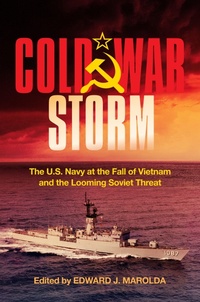
Cold War Storm
The U.S. Navy at the Fall of Vietnam and the Looming Soviet Threat
Will be published approx. on 12. November 2026
Book
Hardback
264 pages
979-8-89241-010-6 (ISBN)
Description
This expertly curated volume explores how the U.S. Navy transformed in the wake of Vietnam, from dramatic evacuation operations in Southeast Asia to Cold War recalibration against the Soviet threat. Cold War Storm offers a compelling look at how naval leaders redefined doctrine, strategy, and institutional culture to meet the demands of a rapidly changing global order.
The end of the Vietnam War in April 1975 marked a turning point in the modern history of the U.S. Navy.?During the final months of the conflict, naval forces carried out large-scale evacuations of Americans and Vietnamese under extraordinary conditions. The fall of Saigon not only closed the long war in Southeast Asia, but also forced the service to reassess its purpose, structure, and global responsibilities. ?
In the aftermath, the Navy faced a different kind of challenge. The Soviet Union's expanding naval power demanded a new strategy, new ships, and a redefined mission.?Cold War Storm details how Adm. Elmo R. Zumwalt Jr. and Adm. James L. Holloway III worked to reshape the fleet and the institution itself. The book traces how these efforts shaped doctrine, command, and culture in the years that followed. The first part of the book provides new insights into the U.S. evacuations from South Vietnam and Cambodia, the Mayaguez international crisis, and the Navy's role in those cataclysmic events. The latter chapters deal with broader postwar issues ranging from the debate within the intelligence community on the Soviet Navy's war plans, the evolution of U.S. strategy considering international developments, the U.S. Sixth Fleet's involvement in Vietnam-era crises in the Mediterranean, and the Navy's revolutionary personnel reforms.
With chapters written by leading naval historians, this volume offers a detailed study of the U.S. Navy redefining itself not as a static force, but as an institution learning, adapting, and confronting the realities of global power in the late twentieth century.
The end of the Vietnam War in April 1975 marked a turning point in the modern history of the U.S. Navy.?During the final months of the conflict, naval forces carried out large-scale evacuations of Americans and Vietnamese under extraordinary conditions. The fall of Saigon not only closed the long war in Southeast Asia, but also forced the service to reassess its purpose, structure, and global responsibilities. ?
In the aftermath, the Navy faced a different kind of challenge. The Soviet Union's expanding naval power demanded a new strategy, new ships, and a redefined mission.?Cold War Storm details how Adm. Elmo R. Zumwalt Jr. and Adm. James L. Holloway III worked to reshape the fleet and the institution itself. The book traces how these efforts shaped doctrine, command, and culture in the years that followed. The first part of the book provides new insights into the U.S. evacuations from South Vietnam and Cambodia, the Mayaguez international crisis, and the Navy's role in those cataclysmic events. The latter chapters deal with broader postwar issues ranging from the debate within the intelligence community on the Soviet Navy's war plans, the evolution of U.S. strategy considering international developments, the U.S. Sixth Fleet's involvement in Vietnam-era crises in the Mediterranean, and the Navy's revolutionary personnel reforms.
With chapters written by leading naval historians, this volume offers a detailed study of the U.S. Navy redefining itself not as a static force, but as an institution learning, adapting, and confronting the realities of global power in the late twentieth century.
Reviews / Votes
"Edward J. Marolda has assembled an all-star cast of authors and put together what will become the "go-to" book on the U.S. Navy's transition from the Vietnam War to the era of the Maritime Strategy." - Rear Admiral Thomas A. Brooks, USN (Ret.), former Director of Naval Intelligence"For 250 years, the U.S. Navy and its men and women have compiled a record of acts of bravery, initiative, leadership and compassion. This book adds significantly to that storied chronicle. Moreover, for many who served in Vietnam in the 1960s and early 70s, experiences in that war would influence their contribution to The Maritime Strategy concepts and operations of the late 70s and 1980s. And victory in the Cold War. As William Faulkner presciently wrote: 'The past is never dead. It's not even past.' " - Captain Peter M. Swartz, USN (Ret.)
"Cold War Storm preserves a sorely needed record of achievement by our Navy and Marine Corps during those under-reported, but critical years between Vietnam and simultaneously can serve as a guide to those sailing and maintaining a presence today." - Vice Admiral Robert F. Dunn, USN (Ret.)
"In this volume, Dr. Edward J. Marolda, the preeminent historian of the Navy's role in the Vietnam War, has assembled a distinguished team of scholars to explore these and other pivotal developments marking the Navy's postwar evolution. This collection is essential reading for anyone seeking to understand the challenges and transformations that reshaped the U.S. Navy during the later Cold War period and beyond." - John Sherwood, naval historian
"Venerable naval historian Edward J. Marolda has gathered an all-star cast of fellow scholars to put together this superb post-Vietnam anthology of the U.S. Navy during a critical period of the Cold War."- John T. Kuehn, U.S. Army Command and General Staff College
More details
Language
English
Place of publication
Annopolis
United States
Target group
Professional and scholarly
Product notice
Cloth over boards
Illustrations
3 Maps, 30 B-W Photos
Dimensions
Height: 228 mm
Width: 152 mm
ISBN-13
979-8-89241-010-6 (9798892410106)
Copyright in bibliographic data and cover images is held by Nielsen Book Services Limited or by the publishers or by their respective licensors: all rights reserved.
Schweitzer Classification
Person
Edward J. Marolda served as Director of Naval History (Acting) and Senior Historian of the Navy. He has authored, coauthored, or edited twenty works on the U.S. Navy's nineteenth- and twentieth-century history, including World War II, the Korean War, the Vietnam War, and the Persian Gulf War. He currently resides in Montclair, VA.