

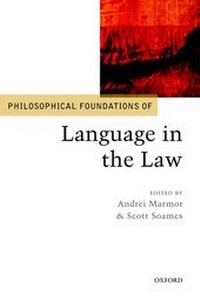
Philosophical Foundations of Language in the Law
Published on 31. January 2013
Book
Paperback/Softback
288 pages
978-0-19-967370-4 (ISBN)
Description
This collection brings together the best contemporary philosophical work in the area of intersection between philosophy of language and the law. Some of the contributors are philosophers of language who are interested in applying advances in philosophy of language to legal issues, and some of the participants are philosophers of law who are interested in applying insights and theories from philosophy of language to their work on the nature of law and legal interpretation. By making this body of recent work available in a single volume, readers will gain both a general overview of the various interactions between language and law, and also detailed analyses of particular areas in which this interaction is manifest.
The contributions to this volume are grouped under three main general areas: The first area concerns a critical assessment, in light of recent advances in philosophy of language, of the foundational role of language in understanding the nature of law itself. The second main area concerns a number of ways in which an understanding of language can resolve some of the issues prevalent in legal interpretation, such as the various ways in which semantic content can differ from law's assertive content; the contribution of presuppositions and pragmatic implicatures in understanding what the law conveys; the role of vagueness in legal language, for example. The third general topic concerns the role of language in the context of particular legal doctrines and legal solutions to practical problems, such as the legal definitions of inchoate crimes, the legal definition of torture, or the contractual doctrines concerning default rules.
Together, these three key issues cover a wide range of philosophical interests in law that can be elucidated by a better understanding of language and linguistic communication.
The contributions to this volume are grouped under three main general areas: The first area concerns a critical assessment, in light of recent advances in philosophy of language, of the foundational role of language in understanding the nature of law itself. The second main area concerns a number of ways in which an understanding of language can resolve some of the issues prevalent in legal interpretation, such as the various ways in which semantic content can differ from law's assertive content; the contribution of presuppositions and pragmatic implicatures in understanding what the law conveys; the role of vagueness in legal language, for example. The third general topic concerns the role of language in the context of particular legal doctrines and legal solutions to practical problems, such as the legal definitions of inchoate crimes, the legal definition of torture, or the contractual doctrines concerning default rules.
Together, these three key issues cover a wide range of philosophical interests in law that can be elucidated by a better understanding of language and linguistic communication.
Reviews / Votes
I believe this book is of tremendous interest and it is to the credit of OUP that it published it, thus allowing further dissemination of knowledge. * Alessandro Capone, Australian Journal of Linguistics *More details
Series
Language
English
Place of publication
Oxford
United Kingdom
Target group
Professional and scholarly
Dimensions
Height: 234 mm
Width: 161 mm
Thickness: 16 mm
Weight
436 gr
ISBN-13
978-0-19-967370-4 (9780199673704)
Copyright in bibliographic data and cover images is held by Nielsen Book Services Limited or by the publishers or by their respective licensors: all rights reserved.
Schweitzer Classification
Other editions
Additional editions
Andrei Marmor | Scott Soames
Philosophical Foundations of Language in the Law
Book
06/2011
1st Edition
Oxford University Press
€155.10
Shipment within 15-20 days
Persons
Andrei Marmor was Professor at Tel Aviv University from 1990 to 2000 and has been professor of philosophy and professor of law at the University of Southern California since 2003. He is the Director of the USC Center for Law and Philosophy and Editor in chief of the Journal of Ethics & Social Philosophy. He has authored and edited numerous books, including Law in the Age of Pluralism (OUP, 2007), Interpretation and Legal Theory (2nd ed., Hart Publishing, 2005), and Positive Law & Objective Values (OUP, 2001).
Scott Soames is the Director of the School of Philosophy at the University of Southern California, and was formerly Professor of Philosphy at Princeton University for 24 years. He is the Editor-in-Chief of The Princeton Series in the Foundatiions of Contemporary Philosophy and serves on the advisory boards of Analytica and Philosophical Perspectives. His works include Beyond Rigidity: The Unfinished Semantic Agenda of 'Naming and Necessity' (OUP, 2002), Reference and Description: The Case against Two-Dimensionalism (Princeton University Press, 2005), and the two-volume Philosophical Analysis in the Twentieth Century (Princeton University Press, 2003).
Scott Soames is the Director of the School of Philosophy at the University of Southern California, and was formerly Professor of Philosphy at Princeton University for 24 years. He is the Editor-in-Chief of The Princeton Series in the Foundatiions of Contemporary Philosophy and serves on the advisory boards of Analytica and Philosophical Perspectives. His works include Beyond Rigidity: The Unfinished Semantic Agenda of 'Naming and Necessity' (OUP, 2002), Reference and Description: The Case against Two-Dimensionalism (Princeton University Press, 2005), and the two-volume Philosophical Analysis in the Twentieth Century (Princeton University Press, 2003).
Content
1. Introduction ; 2. The Value of Vagueness ; 3. What Vagueness and Inconsistency Tell Us about Interpretation ; 4. Vagueness and the Guidance of Action ; 5. Can the Law Imply More Than It Says? On Some Pragmatic Aspects of Strategic Speech ; 6. Textualism and the Discovery of Rights ; 7. Textualism, Intentionalism, and the Law of Contracts ; 8. Modeling Legal Rules ; 9. Trying to Kill the Dead: De Dicto and De Re Intention in Attempted Crimes ; 10. Legislation As Communication? Legal Interpretation and the Study of Linguistic Communication