

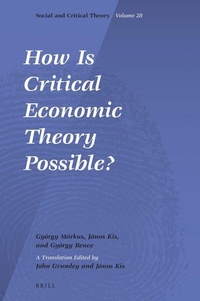
How Is Critical Economic Theory Possible?
Published on 26. August 2022
Book
Hardback
328 pages
978-90-04-51847-6 (ISBN)
Description
This book is a masterpiece of critical theory. It provides an illuminating and original meta-theoretical account of Marx's general views of critical economic theory. Sympathetic to the general aims of Marx, it also excavates the internal contradictions of the Marxian theory with unparalleled care. Written in Hungarian in the early 1970s, it was censored by the communist authorities immediately after its completion. Its belated publication in English signifies a major boon for research scholars in a range of disciplines, including philosophy, political economy, Marxism, intellectual history, and Eastern European studies.
More details
Series
Language
English
Place of publication
Leiden
Netherlands
Target group
Professional and scholarly
Product notice
sewn/stitched
Cloth over boards
Dimensions
Height: 235 mm
Width: 155 mm
Thickness: 26 mm
ISBN-13
978-90-04-51847-6 (9789004518476)
Copyright in bibliographic data and cover images is held by Nielsen Book Services Limited or by the publishers or by their respective licensors: all rights reserved.
Schweitzer Classification
Persons
Gyoergy Markus (1934-2016) taught at the Budapest University of Sciences between 1957 and 1965. He was a research scholar at the Institute of Philosophy of the Hungarian Academy of Science from 1958 until 1973, when he was expelled for co-authoring this book. He left Hungary in 1977 and settled in Sydney, Australia, where he taught history of philosophy, Marxism, and Aesthetics. His book Culture, Science, Society was published in 2011 by Brill.
Janos Kis (born 1943) worked as a researcher at the Institute of Philosophy of the Hungarian Academy of Science from 1967 until 1973, when he was expelled for co-authoring this book. As a leader of the Hungarian dissident movement, he participated in the 1989 Roundtable negotiations that prepared the ground for democratic transition. He taught political philosophy at Central European University from 1992 onwards. His book Politics as a Moral Problem was published in 2008 by CEU Press.
Gyoergy Bence (1941-2006) was a researcher at the Institute of Philosophy of the Hungarian Academy of Science from 1966 until 1973, when he was expelled for co-authoring this book. In the 1970s, he was a leading member of the Hungarian dissident movement. From 1989 until his death, he worked as a professor of philosophy at the Budapest University of Science (ELTE), where he taught history of philosophy and political theory.
John Grumley (editor) is an Honorary Associate Professor in the Department of Philosophy at Sydney University. He has published two monographs, more than fifty single-authored papers and five edited and co-edited books and journal issues with Pauline Johnson and Harriet Johnson. He also co-edits the Markus Archive with Harriet Johnson.
Janos Kis (born 1943) worked as a researcher at the Institute of Philosophy of the Hungarian Academy of Science from 1967 until 1973, when he was expelled for co-authoring this book. As a leader of the Hungarian dissident movement, he participated in the 1989 Roundtable negotiations that prepared the ground for democratic transition. He taught political philosophy at Central European University from 1992 onwards. His book Politics as a Moral Problem was published in 2008 by CEU Press.
Gyoergy Bence (1941-2006) was a researcher at the Institute of Philosophy of the Hungarian Academy of Science from 1966 until 1973, when he was expelled for co-authoring this book. In the 1970s, he was a leading member of the Hungarian dissident movement. From 1989 until his death, he worked as a professor of philosophy at the Budapest University of Science (ELTE), where he taught history of philosophy and political theory.
John Grumley (editor) is an Honorary Associate Professor in the Department of Philosophy at Sydney University. He has published two monographs, more than fifty single-authored papers and five edited and co-edited books and journal issues with Pauline Johnson and Harriet Johnson. He also co-edits the Markus Archive with Harriet Johnson.
Content
Foreword????
John?? ??Grumley???????
Preface????
J?a?nos??? ?Kis???????
Acknowledgements??
Abbreviations??
1???Introduction: Marxist Economics Divided??
2???The Antinomies of the Concept of Use-Value??
3???Socialism in the World History of Economic Formations??
4???Difficulties with the Idea of a Centralized Labour-Time Economy??
5???Scarcity and Abundance??
6???Is Critical Economic Theory Possible at All???
7???The Problem of Radical Needs??
8???Is It Possible to Realise the "Association of Free Producers"???
Appendices??
?Appendix (A)?The Place of Critical Economic Theory in the Development of Marx's Thought
?Appendix (B)?Historical Types of the Bourgeois Critique of Marxian Economic Theory
Annotated Notes??
References??
Index??
John?? ??Grumley???????
Preface????
J?a?nos??? ?Kis???????
Acknowledgements??
Abbreviations??
1???Introduction: Marxist Economics Divided??
2???The Antinomies of the Concept of Use-Value??
3???Socialism in the World History of Economic Formations??
4???Difficulties with the Idea of a Centralized Labour-Time Economy??
5???Scarcity and Abundance??
6???Is Critical Economic Theory Possible at All???
7???The Problem of Radical Needs??
8???Is It Possible to Realise the "Association of Free Producers"???
Appendices??
?Appendix (A)?The Place of Critical Economic Theory in the Development of Marx's Thought
?Appendix (B)?Historical Types of the Bourgeois Critique of Marxian Economic Theory
Annotated Notes??
References??
Index??