

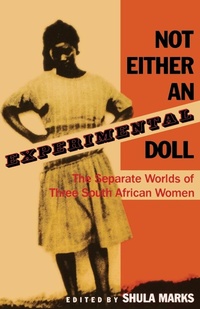
Not Either an Experimental Doll
The Separate Worlds of Three South African Women
Published on 22. December 1988
Book
Paperback/Softback
256 pages
978-0-253-28640-6 (ISBN)
Description
" . . . remarkable . . . " -Foreign Affairs
" . . . illuminates the workings of institutionalized racism through the correspondence of three South African women in the 1940s and '50s." -Feminist Bookstore News
"The history of a place and time is made vivid by the combination of the rich personal record of the letters and the theoretically framed analytic discussion. The result is new insight into the history of black education in South Africa, and a revealing study of the dynamics of women's relations under colonialism across the lines of race, age and power." -Susan Greenstein, The Women's Review of Books
"A riveting and revealing book-one in which few of the characters wear hats that are spotlessly white." -Third World Resources
"This rich collection of letters deserves its own reading, as do Shula Marks's bracketing essays. They are invaluable for clarifying the myriad ramifications that the letters raise for African women." -International Journal of African Historical Studies
" . . . powerful and perceptive. . . .speak[s] eloquently to a Western audience that is poised to deal with the political and personal lives of South African women in an intimate holistic fashion." -Belles Lettres
The roots of modern Apartheid are exposed through the painful and revealing correspondence of three very different South African women-two black and one "liberal" white-from 1949 to 1951. Although the letters speak for themselves, the editor has written an introduction and epilogue which tell of the tragic ending to this riveting story.
" . . . illuminates the workings of institutionalized racism through the correspondence of three South African women in the 1940s and '50s." -Feminist Bookstore News
"The history of a place and time is made vivid by the combination of the rich personal record of the letters and the theoretically framed analytic discussion. The result is new insight into the history of black education in South Africa, and a revealing study of the dynamics of women's relations under colonialism across the lines of race, age and power." -Susan Greenstein, The Women's Review of Books
"A riveting and revealing book-one in which few of the characters wear hats that are spotlessly white." -Third World Resources
"This rich collection of letters deserves its own reading, as do Shula Marks's bracketing essays. They are invaluable for clarifying the myriad ramifications that the letters raise for African women." -International Journal of African Historical Studies
" . . . powerful and perceptive. . . .speak[s] eloquently to a Western audience that is poised to deal with the political and personal lives of South African women in an intimate holistic fashion." -Belles Lettres
The roots of modern Apartheid are exposed through the painful and revealing correspondence of three very different South African women-two black and one "liberal" white-from 1949 to 1951. Although the letters speak for themselves, the editor has written an introduction and epilogue which tell of the tragic ending to this riveting story.
Reviews / Votes
" ... remarkable ..." Foreign Affairs " ... illuminates the workings of institutionalized racism through the correspondence of three South African women in the 1940s and '50s." Feminist Bookstore News "The history of a place and time is made vivid by the combination of the rich personal record of the letters and the theoretically framed analytic discussion. The result is new insight into the history of black education in South Africa, and a revealing study of the dynamics of women's relations under colonialism across the lines of race, age and power." Susan Greenstein, The Women's Review of Books "A riveting and revealing book one in which few of the characters wear hats that are spotlessly white." Third World Resources "This rich collection of letters deserves its own reading, as do Shula Marks's bracketing essays. They are invaluable for clarifying the myriad ramifications that the letters raise for African women." International Journal of African Historical Studies " ... powerful and perceptive...speak[s] eloquently to a Western audience that is poised to deal with the political and personal lives of South African women in an intimate holistic fashion." Belles LettresMore details
Language
English
Place of publication
Bloomington, IN
United States
Target group
Professional and scholarly
Product notice
Paperback (trade)
Illustrations
26 b&w photos
Dimensions
Height: 216 mm
Width: 140 mm
Thickness: 13 mm
Weight
322 gr
ISBN-13
978-0-253-28640-6 (9780253286406)
Copyright in bibliographic data and cover images is held by Nielsen Book Services Limited or by the publishers or by their respective licensors: all rights reserved.
Schweitzer Classification
Person
edited by Shula Marks
Content
List of Illustrations
Foreword
Acknowledgments
Introduction
The Correspondence
Epilogue
Index
Foreword
Acknowledgments
Introduction
The Correspondence
Epilogue
Index