

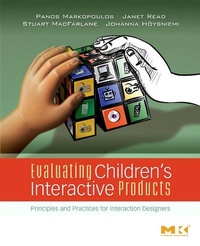
Evaluating Children's Interactive Products
Principles and Practices for Interaction Designers
Published on 24. May 2008
Book
Paperback/Softback
400 pages
978-0-12-374111-0 (ISBN)
Description
Evaluating Children's Interactive Products directly addresses the need to ensure that interactive products designed for children - whether toys, games, educational products, or websites - are safe, effective, and entertaining. It presents an essential background in child development and child psychology, particularly as they relate to technology; captures best practices for observing and surveying children, training evaluators, and capturing the child user experience using audio and visual technology; and examines ethical and legal issues involved in working with children and offers guidelines for effective risk management.
Based on the authors' workshops, conference courses, and own design experience and research, this highly practical book reads like a handbook, while being thoroughly grounded in the latest research. Throughout, the authors illustrate techniques and principles with numerous mini case studies and highlight practical information in tips and exercises and conclude with three in-depth case studies.
This book is recommended for usability experts, product developers, and researchers in the field.
Based on the authors' workshops, conference courses, and own design experience and research, this highly practical book reads like a handbook, while being thoroughly grounded in the latest research. Throughout, the authors illustrate techniques and principles with numerous mini case studies and highlight practical information in tips and exercises and conclude with three in-depth case studies.
This book is recommended for usability experts, product developers, and researchers in the field.
Reviews / Votes
"Evaluating Children's Interactive Products provides numerous practical suggestions based on the authors' considerable experience and wisdom. The authors present a powerful case for the importance of beginning the evaluation process by spending time with children and attempting to see the world through their eyes. The emphasis on the often overlooked aspects of evaluation, ,is refreshing and makes this book a "must read? for anyone truly dedicated to providing valuable insight on behalf of children and improving the products intended for their use." --Kristin Alexander, Group Research Manager, Microsoft"Evaluating Children's Interactive Products gives a great introduction to a wide range of methods for working with children. It is an excellent resource for students and researchers alike." --Dr Judy Robertson, Lecturer, Computer Science, Heriot-Watt University."There is nothing more important than improving the lives of children. This book offers a way for industry professionals and academic researchers to understand the needs of young people, which can lead the way to better new technologies. There is a wealth of information, experience, and inspiration that the authors share that will ask you to first consider, or spend some time re-examining, what is possible and important for children." --Allison Druin, Director, Human-Computer Interaction Lab, Associate Professor, University of Maryland"Evaluating Children's Interactive Products fills a void in the literature by providing practical advice based on the authors' experience, a thorough survey of evaluation methods, as well as valuable real world examples. It brings together valuable information and experiences that would have previously required reading dozens of papers and several books. The authors have been heavily involved in the interaction design and children research community and it shows in the breadth and depth of topics covered, and in the content being up-to-date. This is a useful book for people in industry and for researchers in academia who are interested in conducting evaluations of technologies for children. The writing style is easy to follow and appropriate for native speakers of English as well as for those who are fluent in English but for whom English is a second language." --Juan Pablo Hourcade, Assistant Professor, Department of Computer Science, University of IowaMore details
Series
Language
English
Place of publication
San Francisco
United States
Publishing group
Elsevier Science & Technology
Target group
Professional and scholarly
Professionals and students who are working on the design of a product whose intended audience is children. This market includes usability experts, product developers of web sites, software--whether games or educational or both--and researchers who are building or evaluating products in the lab for R&D or prototype/projects.
Three of the four authors are academics and teach courses on this, and one school, the University of Central Lancashire has a degree program in this area. So there are some limited opportunities for adoptions but there are some.
Product notice
Paperback (trade)
Unsewn / adhesive bound
Illustrations
Approx. 110 illustrations (100 in full color)
Dimensions
Height: 236 mm
Width: 193 mm
Thickness: 23 mm
Weight
894 gr
ISBN-13
978-0-12-374111-0 (9780123741110)
Copyright in bibliographic data and cover images is held by Nielsen Book Services Limited or by the publishers or by their respective licensors: all rights reserved.
Schweitzer Classification
Other editions
Additional editions
Panos Markopoulos | Janet C. Read | Stuart MacFarlane
Evaluating Children's Interactive Products
Principles and Practices for Interaction Designers
E-Book
05/2008
Morgan Kaufmann
€43.95
Available for download
Persons
Content
PART 1 CHILDREN AND TECHNOLOGY1 WHAT IS A CHILD2 CHILDREN AND INTERACTIVE TECHNOLOGY 3 THE INTERACTIVE PRODUCT LIFECYCLE PART 2 EVALUATING WITH AND FOR CHILDREN4 ETHICAL PRACTICE IN EVALUATIONS 5 PLANNING THE EVALUATION STUDY 6 BEFORE THE EVALUATION 7 DURING THE EVALUATION 8 AFTER THE EVALUATION PART 3 METHODS OF EVALUATION9 RECORDING AND LOGGING 10 OBSERVATION METHODS 11 VERBALIZATION METHODS 12 THE WIZARD OF OZ METHOD 13 SURVEY METHODS 14 DIARIES 15 INSPECTION METHODS PART 4 CASE STUDIES16 CASE STUDY 1: GAME-CONTROLLING GESTURES ININTERACTIVE GAMES 17 CASE STUDY 2: EMBEDDING EVALUATION IN THEDESIGN OF A PERVASIVE GAME CONCEPT 18 CASE STUDY 3: USING SURVEY METHODS AND EFFICIENCY METRICS