

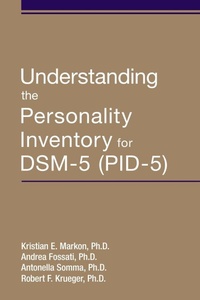
Understanding the Personality Inventory for DSM-5 (PID-5)
Published on 29. March 2024
Book
Paperback/Softback
234 pages
978-1-61537-511-0 (ISBN)
Description
Released in 2012 as a free, easily administered measure of
personality pathology domains and traits as described in the DSM-5
Alternative Model for Personality Disorders, the Personality Inventory for
DSM-5 (PID-5) has spawned interest-and a considerable amount of
research-since its publication. Rather than trying to match an individual's
personal experience to preestablished diagnostic categories, use of the
PID-5 in assessment calls for something of a paradigm shift-developing a
profile unique to each patient and their experiences and behaviors. This new
book delves into the background of the PID-5 and provides clinical and
research guidance on its application. After reviewing the blossoming
literature on the PID-5 and evidence for its use, the authors examine
* The validity of the PID-5 in different populations, including
adults, children, and non-U.S. populations
* Special applications of
the PID-5, including its relation to ICD-11 and use in forensic constructs
* The relationship of the PID-5 with other measures, such as the Five
Factor Model measures and the Personality Assessment Inventory
* The
role of the PID-5 in developing tailored interventions and prevention
strategies, both psychotherapeutic and pharmacological
Standout
features of this guide include numerous and easily referenced tables
throughout, clinical vignettes that help illustrate the PID-5 personality
profiles, and an appendix with norms and scoring reference materials.
Particularly useful for both clinical psychologists and research
psychiatrists, Understanding the Personality Inventory for DSM-5
(PID-5) is a concise, convenient, and indispensable resource for all
those interested in an individualized approach to the management and
treatment of personality pathologies.
personality pathology domains and traits as described in the DSM-5
Alternative Model for Personality Disorders, the Personality Inventory for
DSM-5 (PID-5) has spawned interest-and a considerable amount of
research-since its publication. Rather than trying to match an individual's
personal experience to preestablished diagnostic categories, use of the
PID-5 in assessment calls for something of a paradigm shift-developing a
profile unique to each patient and their experiences and behaviors. This new
book delves into the background of the PID-5 and provides clinical and
research guidance on its application. After reviewing the blossoming
literature on the PID-5 and evidence for its use, the authors examine
* The validity of the PID-5 in different populations, including
adults, children, and non-U.S. populations
* Special applications of
the PID-5, including its relation to ICD-11 and use in forensic constructs
* The relationship of the PID-5 with other measures, such as the Five
Factor Model measures and the Personality Assessment Inventory
* The
role of the PID-5 in developing tailored interventions and prevention
strategies, both psychotherapeutic and pharmacological
Standout
features of this guide include numerous and easily referenced tables
throughout, clinical vignettes that help illustrate the PID-5 personality
profiles, and an appendix with norms and scoring reference materials.
Particularly useful for both clinical psychologists and research
psychiatrists, Understanding the Personality Inventory for DSM-5
(PID-5) is a concise, convenient, and indispensable resource for all
those interested in an individualized approach to the management and
treatment of personality pathologies.
Reviews / Votes
This book is excellent because it describes the PID-5 indetail, in terms of administration and interpretation. It provides clinical
vignettes that are very helpful for learning profile analysis. The PID-5 has
good psychometric properties, so it is very useful in understanding
personality dynamics. Readers will not be disappointed with this fine volume
from the American Psychiatric Association. -- Gary B Kaniuk, PsyD * Doody *
More details
Language
English
Place of publication
VA
United States
Target group
Professional and scholarly
US School Grade: College Graduate Student and over
Product notice
Paperback (trade)
Illustrations
7 Line drawings, black and white; 32 Tables, unspecified
Dimensions
Height: 153 mm
Width: 233 mm
Thickness: 14 mm
Weight
392 gr
ISBN-13
978-1-61537-511-0 (9781615375110)
Copyright in bibliographic data and cover images is held by Nielsen Book Services Limited or by the publishers or by their respective licensors: all rights reserved.
Schweitzer Classification
Other editions
Additional editions
Kristian E. Markon | Andrea Fossati | Antonella Somma
Understanding the Personality Inventory for DSM-5 (PID-5)
E-Book
01/2024
American Psychiatric Association Publishing
€56.99
Available for download
Persons
Kristian E. Markon, Ph.D., is Research Scientist in
the Department of Psychology at the University of Iowa in Iowa
City.
Andrea Fossati, Ph.D., is Faculty in the School of
Psychology at Vita-Salute San Raffaele University in Milan,
Italy.
Antonella Somma, Ph.D., is Assistant Professor of
Psychometrics in the School of Psychology at Vita-Salute San Raffaele
University in Milan, Italy.
Robert F. Krueger, Ph.D., is
Distinguished McKnight University Professor in the Department of Psychology
at the University of Minnesota in Minneapolis, Minnesota; Co-Editor of the
Journal of Personality Disorders; and Chairperson of the U.S. NIH/CSR
Social, Personality and Interpersonal Processes study section.
the Department of Psychology at the University of Iowa in Iowa
City.
Andrea Fossati, Ph.D., is Faculty in the School of
Psychology at Vita-Salute San Raffaele University in Milan,
Italy.
Antonella Somma, Ph.D., is Assistant Professor of
Psychometrics in the School of Psychology at Vita-Salute San Raffaele
University in Milan, Italy.
Robert F. Krueger, Ph.D., is
Distinguished McKnight University Professor in the Department of Psychology
at the University of Minnesota in Minneapolis, Minnesota; Co-Editor of the
Journal of Personality Disorders; and Chairperson of the U.S. NIH/CSR
Social, Personality and Interpersonal Processes study section.
Content
Chapter 1. Development and Origins of the PID-5
Chapter 2. Basic Measurement Properties and Validity of the PID-5
Across Populations
Chapter 3. The PID-5s: Different Versions for
Different Needs
Chapter 4. PID-5 Response Validity Assessment and
Validity Scales
Chapter 5. Special Applications of the
PID-5
Chapter 6. The PID-5 in Relationship With Other Measures
Chapter 7. Interpreting PID-5 Profiles
Chapter 8. Prevention and
Intervention
Appendix: Normative Score Distributions: Background and
Methods
Chapter 2. Basic Measurement Properties and Validity of the PID-5
Across Populations
Chapter 3. The PID-5s: Different Versions for
Different Needs
Chapter 4. PID-5 Response Validity Assessment and
Validity Scales
Chapter 5. Special Applications of the
PID-5
Chapter 6. The PID-5 in Relationship With Other Measures
Chapter 7. Interpreting PID-5 Profiles
Chapter 8. Prevention and
Intervention
Appendix: Normative Score Distributions: Background and
Methods