

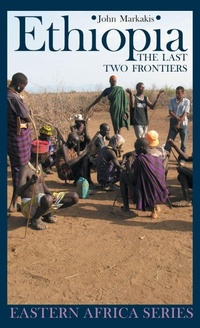
Ethiopia
The Last Two Frontiers
Published on 16. June 2011
Book
Hardback
399 pages
978-1-84701-033-9 (ISBN)
Description
An historical overview of Ethiopia's transformation from a multicultural empire into a modern nation state.
Provides the gist of one scholar's knowledge of this country acquired over several decades. The author of numerous works on Ethiopia, Markakis presents here an overarching, concise historical profile of a momentous effort to integrate a multicultural empire into a modern nation state. The concept of nation state formation provides the analytical framework within which this process unfolds and the changes of direction it takes under different regimes, as well as a standard for assessing its progress and shortcomings at each stage.
Over a century old, the process is still far from completion and its ultimate success is far from certain. In the author's view, there are two majorobstacles that need to be overcome, two frontiers that need to be crossed to reach the desired goal. The first is the monopoly of power inherited from the empire builders and zealously guarded ever since by a ruling class of Abyssinian origin. The descendants of the people subjugated by the empire builders remain excluded from power, a handicap that breeds political instability and violent conflict. The second frontier is the arid lowlands on the margins of the state, where the process of integration has not yet reached, and where resistance to it is greatest. Until this frontier is crossed, the Ethiopian state will not have the secure borders that a mature nation state requires.
John Markakis is a political historian who has devoted a professional lifetime to the study of Ethiopia and its neighbours in the Horn of Africa. He has published several books and many articles on this area.
Provides the gist of one scholar's knowledge of this country acquired over several decades. The author of numerous works on Ethiopia, Markakis presents here an overarching, concise historical profile of a momentous effort to integrate a multicultural empire into a modern nation state. The concept of nation state formation provides the analytical framework within which this process unfolds and the changes of direction it takes under different regimes, as well as a standard for assessing its progress and shortcomings at each stage.
Over a century old, the process is still far from completion and its ultimate success is far from certain. In the author's view, there are two majorobstacles that need to be overcome, two frontiers that need to be crossed to reach the desired goal. The first is the monopoly of power inherited from the empire builders and zealously guarded ever since by a ruling class of Abyssinian origin. The descendants of the people subjugated by the empire builders remain excluded from power, a handicap that breeds political instability and violent conflict. The second frontier is the arid lowlands on the margins of the state, where the process of integration has not yet reached, and where resistance to it is greatest. Until this frontier is crossed, the Ethiopian state will not have the secure borders that a mature nation state requires.
John Markakis is a political historian who has devoted a professional lifetime to the study of Ethiopia and its neighbours in the Horn of Africa. He has published several books and many articles on this area.
Reviews / Votes
A magisterial work that synthesizes a half-century's research. ... Historians, political scientists, social anthropologists, and policy makers will find this book enlightening and useful. * AFRICAN AFFAIRS * Precisely because of the debates it will spark, it is vitally important that people who are engaged with Ethiopia, both Ethiopians and international aid workers, diplomats and others, read and discuss it. * INTERNATIONAL AFFAIRS * Worthwhile reading and certainly one of the best explanations of the present situation in Ethiopia published so far. It is a must read for those interested in Ethiopia and, indeed, the Horn of Africa. * SOUTHWORLD * Essential reading for all who want to understand how the Ethiopian empire arrived at its present configuration. * LEEDS AFRICAN STUDIES BULLETIN *More details
Series
Language
English
Place of publication
Oxford
United Kingdom
Target group
Professional and scholarly
Product notice
Cloth over boards
Illustrations
12 s/w Zeichnungen
12 line illus.
Dimensions
Height: 222 mm
Width: 145 mm
Thickness: 25 mm
Weight
633 gr
ISBN-13
978-1-84701-033-9 (9781847010339)
Copyright in bibliographic data and cover images is held by Nielsen Book Services Limited or by the publishers or by their respective licensors: all rights reserved.
Schweitzer Classification
Other editions
Additional editions
Book
08/2013
James Currey
€45.70
Shipment within 3-4 weeks
Person
John Markakis
Content
Introduction - Part I The Lowland Periphery
High and Low Land: A Study in Contrast
Afar & Somali
Borana, South Omo, Gambella & Beni Shangul Gumuz - Part II Building the State: The Imperial Model
Winning an Empire
Building the Imperial State: 1916-1974
Imperial Rule in the Periphery - Part III Rebuilding the State: The Socialist Model
The 1974 Revolution
Building the Socialist State: 1974-1991
The Socialist State in the Periphery - PART IV Rebuilding the State: The Federal Model
Building the Federal State: 1991-1995
Ruling the Federal State : 1995-2010 - Part V The Federal State in the Periphery
The Highland Periphery & the Lowland Afar
The Somali
Borana, South Omo, Gambella & Beni Shangul Gumuz
Conclusion
High and Low Land: A Study in Contrast
Afar & Somali
Borana, South Omo, Gambella & Beni Shangul Gumuz - Part II Building the State: The Imperial Model
Winning an Empire
Building the Imperial State: 1916-1974
Imperial Rule in the Periphery - Part III Rebuilding the State: The Socialist Model
The 1974 Revolution
Building the Socialist State: 1974-1991
The Socialist State in the Periphery - PART IV Rebuilding the State: The Federal Model
Building the Federal State: 1991-1995
Ruling the Federal State : 1995-2010 - Part V The Federal State in the Periphery
The Highland Periphery & the Lowland Afar
The Somali
Borana, South Omo, Gambella & Beni Shangul Gumuz
Conclusion