

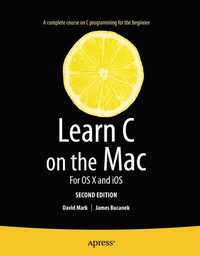
Learn C on the Mac
For OS X and iOS
2nd Edition
Published on 24. December 2012
Book
Paperback/Softback
XVIII, 508 pages
978-1-4302-4533-9 (ISBN)
Description
Considered a classic by an entire generation of Mac programmers, Dave Mark's Learn C on the Mac has been updated for you to include Mac OS X Mountain Lion and the latest iOS considerations.
Learn C on the Mac: For OS X and iOS, Second Edition is perfect for beginners learning to program. It includes contemporary OS X and iOS examples! This book also does the following:
Provides best practices for programming newbies
Presents all the basics with a pragmatic, Mac OS X and iOS -flavored approach
Includes updated source code which is fully compatible with latest Xcode
After reading this book, you'll be ready to program and build apps using the C language and Objective-C will become much easier for you to learn when you're ready to pick that up.
More details
Edition
2nd ed.
Language
English
Place of publication
Berkeley
United States
Target group
Popular/general
Edition type
Revised edition
Illustrations
XVIII, 508 p.
Dimensions
Height: 235 mm
Width: 191 mm
Thickness: 28 mm
Weight
938 gr
ISBN-13
978-1-4302-4533-9 (9781430245339)
DOI
10.1007/978-1-4302-4534-6
Schweitzer Classification
Other editions
Additional editions
E-Book
02/2013
2nd Edition
APress
€52.99
Available for download
Persons
Dave Mark is a longtime Mac developer and author who has written a number of books on Mac and iOS development, including Beginning iPhone 4 Development (Apress, 2010), More iPhone 3 Development (Apress, 2010), Learn C on the Mac (Apress, 2008), The Macintosh Programming Primer series (Addison-Wesley, 1992), and Ultimate Mac Programming (Wiley, 1995). Dave loves the water and spends as much time as possible on it, in it, or near it. He lives with his wife and three children in Virginia.
Content
Chapter 1: Go Get the Tools Chapter 2. Programming Basics Chapter 3: C Basics: Staements and Functions Chapter 4: C Basics: Variables and Operators Chapter 5: Debugging Chapter 6: Controlling Your Program's Flow Chapter 7: Pointers and Parameters Chapter 8: More Data Types Chapter 9: The Command Line Chapter 10: Designing Your Own Data Structures Chapter 11: Working with Files Chapter 12: Handling Errors Chapter 13: Advanced Topics Chapter 14: Where Do You Go from Here? Chapter 15: Answers to Exercises