

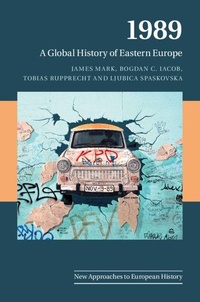
1989
A Global History of Eastern Europe
Published on 29. August 2019
Book
Hardback
380 pages
978-1-108-42700-5 (ISBN)
Description
The collapse of the Berlin Wall has come to represent the entry of an isolated region onto the global stage. On the contrary, this study argues that communist states had in fact long been shapers of an interconnecting world, with '1989' instead marking a choice by local elites about the form that globalisation should take. Published to coincide with the thirtieth anniversary of the 1989 revolutions, this work draws on material from local archives to international institutions to explore the place of Eastern Europe in the emergence, since the 1970s, of a new world order that combined neoliberal economics and liberal democracy with increasingly bordered civilisational, racial and religious identities. An original and wide-ranging history, it explores the importance of the region's links to the West, East Asia, Africa, and Latin America in this global transformation, reclaiming the era's other visions such as socialist democracy or authoritarian modernisation which had been lost in triumphalist histories of market liberalism.
Reviews / Votes
'This is a provocative volume that challenges the liberal Western account of the negotiated transition from Communism in 1989 by stressing the agency of East European reformers and intellectuals. It recontextualises the story as part of the global deradicalisation of socialism and interprets the region as an example of 'in-betweenness', at once part and opposite of the West.' Konrad H. Jarausch, University of North Carolina, Chapel Hill 'A remarkable scholarly achievement which compels us to rethink the Eastern Europe transition of 1989 in a global context, dispensing with a Western triumphalist view of the end of the Cold War. Through painstaking detail and incisive analysis, this shows us the ways in which East Europeans continue to navigate their own political paths.' Mary Neuburger, University of Texas, Austin 'Laying waste to all lingering cliches of the walled hermit kingdoms of socialist-era Eastern Europe, the authors restore the history of Cold War Eastern Europe to the world, depicting it as a region entangled in global supply chains and transnational lines of political influence long before 1989. The authors refuse simplistic narratives of convergence and help explain the contemporary challenges of nativist nationalism.' Quinn Slobodian, Wellesley College, Massachusetts 'This excellent book contributes to the recent trend in bringing together Eastern European and global history, and shows the fruitfulness of collective book writing.' Philipp Ther, Universitaet Wien '1989: A Global History of Eastern Europe offers a nuanced and sobering account of the global context of the fall of the Eastern Bloc and its role in the construction of post-Cold War Europe ... makes a unique and necessary contribution not just to the historiography of the revolutions of 1989, but also to our understanding of the rightward drift in contemporary Eastern Europe.' Nick Ostrum, EuropeNow 'A must-read for every historian who deals with Eastern Europe after 1945 and especially after 1968. It shows the importance of history for explaining contemporary situations and inspires historians to draw out their research up to the present and to intervene in the public sphere.' Lubos Studeny, Prague Economic and Social History Papers 'Using a global approach, this extraordinary book, which was written by four authors, who all teach history at the University of Exeter as specialists of different regions (James Mark/Central Europe, Bogdan C. Iacob/Eastern Europe, Tobias Rupprecht/Latin America, and Ljubica Spaskovska/former Yugoslavia), critiques and revises a number of popular aspects of this Eurocentric myth of 1989 ... an important contribution to our understanding of today's world.' Arpad von Klimo, H-Diplo 'This ambitious, rich, and necessary book is the first comprehensive scholarly synthesis of the global reach of Eastern Europe from late socialism in the 1970s to the postsocialist transition after 1989 through the illiberal turn following 2008. Cowritten by four specialists on Hungary, Romania, Yugoslavia, and the Soviet Union, 1989: A Global History of Eastern Europe is a model for collaborative work melding regional expertise in a genuinely comparative, transnational analysis.' Theodora Dragostinova, The American Historical Review '... rich, thought-provoking account of 1989. Without doubt, the monograph will spark academic discussions and will open new avenues for research on this hotly debated period. It thus will be on the recommended list for any scholar interested in the history of the region, its global context, and its ongoing reverberations.' Ruzha Smilova, Southeastern Europe '... 1989 is probably the best transregional history of 1989 one can read today ...' Judit Bodnar, Slavic ReviewMore details
Series
Language
English
Place of publication
Cambridge
United Kingdom
Target group
Professional and scholarly
College/higher education
Illustrations
Worked examples or Exercises
Dimensions
Height: 235 mm
Width: 157 mm
Thickness: 25 mm
Weight
703 gr
ISBN-13
978-1-108-42700-5 (9781108427005)
Copyright in bibliographic data and cover images is held by Nielsen Book Services Limited or by the publishers or by their respective licensors: all rights reserved.
Schweitzer Classification
Other editions
Additional editions
Book
08/2019
Cambridge University Press
€38.40
Shipment within 15-20 days
E-Book
08/2019
Cambridge University Press
€18.49
Available for download
E-Book
08/2019
Cambridge University Press
€20.99
Available for download
Persons
My name is James Mark. I am the author of the "Divine Mercy Chaplet - a Deep Meditations." I am 75 years old. My wife and I have 2 children and 5 grandchildren (one by adoption and one through marriage). I now live in a small rural town about 20 miles south of Joliet, Illinois. I attended high school and first year college in the Chicago Diocese's minor seminary. I left the seminary and graduated from College in Rural Southern Illinois. After graduation I spent 2 years in the Peace Corps in Malaysia on the Island of Borneo. My Peace Corps training was in Hawaii for three months. There I learned the Malay language, customs and about tuberculosis, a very common and deadly disease in Malaysia at that time. When I finally arrived in Malaysia I worked in hospitals and clinics. I worked in the lab identifying samples that may contain the tuberculosis germ or not. Later I went out into the field and helped vaccinate children against the disease. The cure for tuberculosis at that time required taking 3 medications for two years. Many times, people would not come to the clinic to get their monthly supply of meds, so I would drive on my motorcycle to the kampongs to make sure they had their meds. One time at the local school the science teacher had to leave so I filled in for about a month as well as doing my duties in the clinic when I returned to America, I attended Illinois State University where I earned a master's degree in Special Education. It was also where I met my wife, Donna. I taught in Sp.Ed. classrooms for 27 years before retiring. After retiring from teaching I started a small lawn mowing business and helped out at my local parish, Immaculate Conception. There I am a teacher of religious education, lector, Eucharistic Minister, and help with general maintenance of the parish from time to time.
Content
Acknowledgements; Introduction; 0.1 Going global; 0.2 The long transition and the making of transitional elites in global perspective; 0.3 A global history of the other '1989s'; 0.4 The end of the '1989' era?; 1. Globalisation; 1.1 From socialist internationalism to capitalist globalisation; 1.2 Debt and ideological re-orientation; 1.3 The choice of 'neoliberal' globalisation; 1.4 Authoritarian transformations?; 1.5 Transformation from within; 1.6 Conclusion; 2. Democratisation; 2.1 Reforming elites; 2.2 Opposition from the local to the global and back; 2.3 Alternatives to '1989': authoritarianism and violence; 2.4 Disciplining transition and democratic peace; 3. Europeanisation; 3.1 The early Cold War: a divided Europe; 3.2 Helsinki - re-bordering Europe?; 3.3 An anti-colonial Europe: critiquing Helsinki; 3.4 A prehistory of Fortress Europe: civilisational bordering in late socialism; 3.5 Eastern Europe, a buffer against Islam?; 3.6 After 1989: 'Fortress Europe'?; 3.7 Conclusion; 4. Self-determination; 4.1 The rise of anti-colonial self-determination; 4.2 The Soviet withdrawal; 4.3 Peace or violence; 4.4 Reverberations of Eastern European self-determination; 4.5 Conclusion; 5. Reverberations; 5.1 1989 as a new global script; 5.2 Instrumentalising 1989: the West and new forms of political conditionality; 5.3 'Taming' the left; 5.4 Interventionism and the '1989' myth; 5.5 Eastern Europeans and the export of the revolutionary idea; 5.6 From Cuba to China: rejecting '1989'; 5.7 Conclusion; 6. A world without '1989'; 6.1 Towards the West? Ambiguous convergence; 6.2 Who is the true Europe? The turn to divergence; 6.3 Beyond the EU: post-socialist global trajectories; 6.4 Conclusion.