

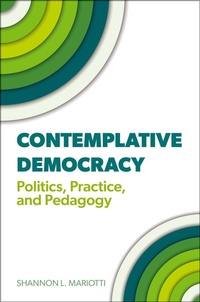
Contemplative Democracy
Politics, Practice, and Pedagogy
Published on 22. April 2025
Book
Hardback
312 pages
978-0-19-779558-3 (ISBN)
Description
Contemplative practices are increasingly mainstream in the United States. From meditation, mindfulness, and yoga, to writing, walking, and gardening, contemplative practices aim to cultivate embodied awareness, attunement, and attention. What is the political value of the attentional ecologies created by the "Mindfulness Revolution"?
In Contemplative Democracy, Shannon L. Mariotti explores how contemplative practices represent a form of world-building that is valuable for meaningful democracy and an overlooked form of ordinary political theory. As Mariotti shows, what appear to be mostly apolitical, self-cultivating activities--even ones that require withdrawal from society--can also make us more attuned to how we interact with the wider world in any given moment. Meditative practices can advance the goals of autonomy and community that are implied by the concept of democracy. Bringing disparate fields into dialogue, Mariotti highlights resonances between how theorists talk about meaningful democracy and how ordinary people talk about contemplative practice. Analyzing theorists, such as Jacques Ranciere and Gloria Anzaldua, alongside qualitative interviews, participant-observation, and a case study, this book integrates political theory--a discipline shaped by "The Enlightenment"--with meditative practices questing after other forms of "enlightenment."
Reimagining the work of political theory, employing feminist approaches, and with a focus on educational spaces and democratic modes of pedagogy, Mariotti examines contemplative practices as spaces where ordinary people do the work of democracy, creating new political imaginaries, finding new selves, and founding new states of being. Further, Contemplative Democracy is an inclusive, accessible, and embodied book that reveals how the larger body politic may be reshaped by the everyday work people do in their own bodies.
In Contemplative Democracy, Shannon L. Mariotti explores how contemplative practices represent a form of world-building that is valuable for meaningful democracy and an overlooked form of ordinary political theory. As Mariotti shows, what appear to be mostly apolitical, self-cultivating activities--even ones that require withdrawal from society--can also make us more attuned to how we interact with the wider world in any given moment. Meditative practices can advance the goals of autonomy and community that are implied by the concept of democracy. Bringing disparate fields into dialogue, Mariotti highlights resonances between how theorists talk about meaningful democracy and how ordinary people talk about contemplative practice. Analyzing theorists, such as Jacques Ranciere and Gloria Anzaldua, alongside qualitative interviews, participant-observation, and a case study, this book integrates political theory--a discipline shaped by "The Enlightenment"--with meditative practices questing after other forms of "enlightenment."
Reimagining the work of political theory, employing feminist approaches, and with a focus on educational spaces and democratic modes of pedagogy, Mariotti examines contemplative practices as spaces where ordinary people do the work of democracy, creating new political imaginaries, finding new selves, and founding new states of being. Further, Contemplative Democracy is an inclusive, accessible, and embodied book that reveals how the larger body politic may be reshaped by the everyday work people do in their own bodies.
More details
Language
English
Place of publication
New York
United States
Target group
Professional and scholarly
Product notice
sewn/stitched
Cloth over boards
Dimensions
Height: 240 mm
Width: 163 mm
Thickness: 32 mm
Weight
581 gr
ISBN-13
978-0-19-779558-3 (9780197795583)
Copyright in bibliographic data and cover images is held by Nielsen Book Services Limited or by the publishers or by their respective licensors: all rights reserved.
Schweitzer Classification
Other editions
Additional editions
E-Book
12/2024
OUP eBook
€70.49
Available for download
E-Book
12/2024
OUP eBook
€70.49
Available for download
Person
Shannon L. Mariotti is Professor of Political Science at Trinity University. Her scholarship focuses on democratic theory and practice, with a focus on the politics of everyday life in marginal spaces. She is the author of Adorno and Democracy: The American Years (2016), Thoreau's Democratic Withdrawal: Alienation, Participation, and Modernity (2010), and co-editor of A Political Companion to Marilynne Robinson (2016). Her current research focuses on the emerging area of "witch studies," analyzing folk-tales and fairy-tales as vernacular wisdom to present the witch as a political theorist who imagines alternative worlds. She is also co-editor of The Witch: A Reader in Feminist Political Theory (forthcoming 2026).
Content
Preface
Acknowledgments
Introduction: Contemplative Democracy: Political Theory and Practice
Part I Theorizing From The Ground up: A Case Study of the Circle School
1: A Contemplative Curriculum
2: A Cooperative Democracy
Part II Connecting Radical Democratic Theory with the Body
3: Zen and the Art of Democracy: Jacques Ranciere's Ignorant Schoolmaster and the Zen Master
4: Theodor Adorno's "Democratic Enlightenment" and Walking in a More-Than-Human World
5: Leaving "Home" as Democratic Practice: Radical Dharmas and Gloria Anzaldua's Borderlands Theory
Part III Educating Theory and Practice
6: Doing Democracy: Commoning, Care Work, Feminism, Abolitionism, and Decoloniality
Conclusion: Educating Political Theory
Epilogue: A Politics of Possibility
Appendix: Methodology
Notes
Bibliography
Index
Acknowledgments
Introduction: Contemplative Democracy: Political Theory and Practice
Part I Theorizing From The Ground up: A Case Study of the Circle School
1: A Contemplative Curriculum
2: A Cooperative Democracy
Part II Connecting Radical Democratic Theory with the Body
3: Zen and the Art of Democracy: Jacques Ranciere's Ignorant Schoolmaster and the Zen Master
4: Theodor Adorno's "Democratic Enlightenment" and Walking in a More-Than-Human World
5: Leaving "Home" as Democratic Practice: Radical Dharmas and Gloria Anzaldua's Borderlands Theory
Part III Educating Theory and Practice
6: Doing Democracy: Commoning, Care Work, Feminism, Abolitionism, and Decoloniality
Conclusion: Educating Political Theory
Epilogue: A Politics of Possibility
Appendix: Methodology
Notes
Bibliography
Index