

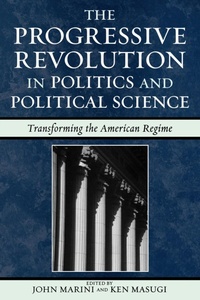
The Progressive Revolution in Politics and Political Science
Transforming the American Regime
Published on 30. June 2005
Book
Paperback/Softback
388 pages
978-0-7425-4974-6 (ISBN)
Description
We cannot understand our current political situation and the scholarship used to comprehend our politics without taking full account of the Progressive revolution of a century ago. This fundamental shift in studying the political world relegated the theory and practice of the Founders to an antiquated historical phase. By contrast, our contributors see beyond the horizon of Progressivism to take account of the Founders' moral and political premises. By doing so they make clear the broader context of current political science disputes, a fitting subject as American professional political science enters its second century.
The contributors to the volume specify the changes in the new world that Progressivism brought into being. Part I emphasizes the contrast between various Progressives and their doctrines, and the American Founding on political institutions including the presidency, political parties, and the courts; statesmen include Frederick Douglass, Theodore Roosevelt, Woodrow Wilson, and John Marshall. Part II emphasizes the radical nature of Progressivism in a variety of areas critical to the American constitutional government and self-understanding of the American mind. Subjects covered include social science, property rights, Darwinism, free speech, and political science as a liberal art. The essays provide intellectual guidance to political scientists and indicate to political practitioners the peculiar perspectives embedded in current political science.
Published in cooperation with The Claremont Institute.
The contributors to the volume specify the changes in the new world that Progressivism brought into being. Part I emphasizes the contrast between various Progressives and their doctrines, and the American Founding on political institutions including the presidency, political parties, and the courts; statesmen include Frederick Douglass, Theodore Roosevelt, Woodrow Wilson, and John Marshall. Part II emphasizes the radical nature of Progressivism in a variety of areas critical to the American constitutional government and self-understanding of the American mind. Subjects covered include social science, property rights, Darwinism, free speech, and political science as a liberal art. The essays provide intellectual guidance to political scientists and indicate to political practitioners the peculiar perspectives embedded in current political science.
Published in cooperation with The Claremont Institute.
Reviews / Votes
Recommendeddddd * Choice Reviews * If you want to know why the Constitution became a 'living' document, why the size and scope of government can't be limited, and how we got here, you must get it. -- Peter W. Schramm, Executive Director of the John M. Ashbrook Center for Public Affairs and a Professor of Political Science at Ashland University Edited by Claremont Institute senior fellows John Marini and Ken Masugi, The Progressive Revolution in Politics and Political Science brings together eleven essays to explain the conflict between classic natural right and historicism that has been at the core of the Western philosophic tradition, and which plays itself out in an American context as the conflict between our country's founding principles and the modern administrative state. John Marini, who perhaps more than anyone has plumbed the depths of Progressive thought and found its source in Hegelian historicism, provides a breathtakingly accurate account of the Progressive transformation of the American Minddd * Claremont Review of Books * Edited by Claremont Institute senior fellows John Marini and Ken Masugi, The Progressive Revolution in Politics and Political Science brings together eleven essays to explain the conflict between classic natural right and historicism that has been at the core of the Western philosophic tradition, and which plays itself out in an American context as the conflict between our country's founding principles and the modern administrative state. John Marini, who perhaps more than anyone has plumbed the depths of Progressive thought and found its source in Hegelian historicism, provides a breathtakingly accurate account of the Progressive transformation of the American Mind * Claremont Review of Books * Recommended * Choice Reviews *More details
Series
Language
English
Place of publication
United States
Publishing group
Bloomsbury Publishing Plc
Dimensions
Height: 229 mm
Width: 152 mm
Thickness: 23 mm
Weight
644 gr
ISBN-13
978-0-7425-4974-6 (9780742549746)
Copyright in bibliographic data and cover images is held by Nielsen Book Services Limited or by the publishers or by their respective licensors: all rights reserved.
Schweitzer Classification
Other editions
Additional editions

The Progressive Revolution in Politics and Political Science
Transforming the American Regime
E-Book
06/2005
1st Edition
Rowman & Littlefield Publishers
€55.99
Available for download
Persons
John Marini is a senior fellow at the Claremont Institute and associate professor of political science at the University of Nevada, Reno. He is the coeditor of The Imperial Congress: Crisis in the Separation of Powers (1989) and the author of The Politics of Budget Control: Congress, the Presidency, and the Growth of the Administrative State (1992).
Ken Masugi is director of the Center for Local Government at the Claremont Institute. He is the coauthor, coeditor, or editor of seven books on American politics and political thought.
Ken Masugi is director of the Center for Local Government at the Claremont Institute. He is the coauthor, coeditor, or editor of seven books on American politics and political thought.
Content
Part 1 Introduction
Part 2 Part I: The Progressive Critique of Constitutionalism
Chapter 3 Progressivism and the Transformation of American Government
Chapter 4 Theodore Roosevelt on Self-Government and the Administrative State
Chapter 5 Frederick Douglass' Natural Rights Constitutionalism: The Postwar, Pre-Progressive Period
Chapter 6 Regimes and Revolutions: Madison and Wilson on Parties in America
Chapter 7 Montesquieu, the Founders, and Woodrow Wilson: The Evolution of Rights and the Eclipse of Constitutionalism
Chapter 8 Marbury v. Madison and the Progressive Transformation of Judicial Power
Part 9 Part II: The Progressive Persuasion in Practice and Theory
Chapter 10 Progressivism, Modern Political Science, and the Transformation of American Constitutionalism
Chapter 11 Darwin's Public Policy: Nineteenth Century Science and the Rise of the American Welfare State
Chapter 12 Zoning and Progressive Political Theory
Chapter 13 Campaign Finance Reform: The Progressive Reconstruction of Free Speech
Chapter 14 Aimless Theorizing: The Progressive Legacy for Political Science
Part 15 About the Editors and Contributors
Part 2 Part I: The Progressive Critique of Constitutionalism
Chapter 3 Progressivism and the Transformation of American Government
Chapter 4 Theodore Roosevelt on Self-Government and the Administrative State
Chapter 5 Frederick Douglass' Natural Rights Constitutionalism: The Postwar, Pre-Progressive Period
Chapter 6 Regimes and Revolutions: Madison and Wilson on Parties in America
Chapter 7 Montesquieu, the Founders, and Woodrow Wilson: The Evolution of Rights and the Eclipse of Constitutionalism
Chapter 8 Marbury v. Madison and the Progressive Transformation of Judicial Power
Part 9 Part II: The Progressive Persuasion in Practice and Theory
Chapter 10 Progressivism, Modern Political Science, and the Transformation of American Constitutionalism
Chapter 11 Darwin's Public Policy: Nineteenth Century Science and the Rise of the American Welfare State
Chapter 12 Zoning and Progressive Political Theory
Chapter 13 Campaign Finance Reform: The Progressive Reconstruction of Free Speech
Chapter 14 Aimless Theorizing: The Progressive Legacy for Political Science
Part 15 About the Editors and Contributors