

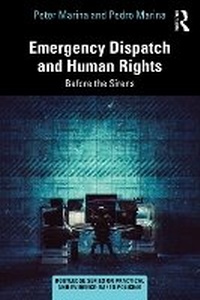
Emergency Dispatch and Human Rights
Before the Sirens
1st Edition
Will be published approx. on 14. October 2026
Book
Paperback/Softback
138 pages
978-1-032-95142-3 (ISBN)
Description
This comprehensive guide shows how to integrate human rights principles into the everyday work of law enforcement communication professionals. Drawing from extensive research and field experience, the book equips dispatchers and operators with strategies to navigate complex situations while upholding human rights standards. Readers will gain an understanding of human rights history and the history of dispatching, analyze relevant legal frameworks, explore the dynamics of power in policing, and learn practical strategies for applying human rights principles in communication with the public. This user-friendly book provides tangible tools for communication professionals to apply human rights principles in real-world scenarios, setting a new standard for ethical policing.
The book will be of interest to emergency service dispatchers, non-dispatch supervisors/managers, and students in criminal justice or emergency service programs, as well as those involved in policymaking, training, and implementation within policing organizations.
The book will be of interest to emergency service dispatchers, non-dispatch supervisors/managers, and students in criminal justice or emergency service programs, as well as those involved in policymaking, training, and implementation within policing organizations.
More details
Series
Language
English
Place of publication
London
United Kingdom
Publishing group
Taylor & Francis Ltd
Target group
College/higher education
Professional and scholarly
Professional Practice & Development, Professional Reference, Professional Training, and Undergraduate Advanced
Dimensions
Height: 229 mm
Width: 152 mm
ISBN-13
978-1-032-95142-3 (9781032951423)
Copyright in bibliographic data and cover images is held by Nielsen Book Services Limited or by the publishers or by their respective licensors: all rights reserved.
Schweitzer Classification
Other editions
Additional editions
Book
approx. 10/2026
1st Edition
Routledge
€191.50
Not yet published
Persons
Peter Marina is a New Orleans native, sociologist, and criminologist, and an Associate Professor of Sociology and Criminology. Trained at the New School for Social Research, Marina's scholarship focuses on urban ethnography, transgression, and social inequalities, with particular attention to human rights, policing, and communities living on society's margins. He is the author of Human Rights Policing, Down and Out in New Orleans, and several other books and articles. Marina's thinking examines power, resistance, and social control across diverse social worlds, from Pentecostal tongue-speaking churches and Caribbean ritual life to street performers and urban occultists.
Pedro Marina is a retired lieutenant with the New Orleans Police Department who served for more than thirty years in patrol, narcotics, robbery investigations, vice operations, and SWAT. A sociology graduate of the University of New Orleans, he held supervisory and command positions throughout New Orleans, including in the French Quarter, and received numerous commendations for exemplary service during his career. Lieutenant Marina lives in Lacombe, Louisiana, with his dog, Meggie.
Pedro Marina is a retired lieutenant with the New Orleans Police Department who served for more than thirty years in patrol, narcotics, robbery investigations, vice operations, and SWAT. A sociology graduate of the University of New Orleans, he held supervisory and command positions throughout New Orleans, including in the French Quarter, and received numerous commendations for exemplary service during his career. Lieutenant Marina lives in Lacombe, Louisiana, with his dog, Meggie.
Content
1. Human Rights Between Possession and Experience in Emergency Dispatch 2. Dispatcher Power, Dual-Subject Asymmetry, and Human Rights Practice 3. The Call Behind the Call: Sociological Listening and Context Recognition 4. Three People, One Call: Tri-Subject Asymmetry and Rights-Based Decision Making 5. Seven Calls: Case Scenarios on Bias, Language, Crisis, and Agency in Dispatch 6. The Long Game: Institutional Change and the Future of Dispatch Centers