

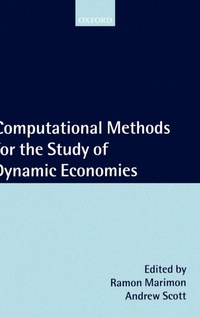
Computational Methods for the Study of Dynamic Economies
Published on 4. March 1999
Book
Hardback
292 pages
978-0-19-829497-9 (ISBN)
Description
Macroeconomics increasingly uses stochastic dynamic general equilibrium models to understand theoretical and policy issues. Unless very strong assumptions are made, understanding the properties of particular models requires solving the model using a computer. This volume brings together leading contributors in the field who explain in detail how to implement the computational techniques needed to solve dynamic economics models. A broad spread of techniques are covered, and their application in a wide range of subjects discussed. The book provides the basics of a toolkit which researchers and graduate students can use to solve and analyse their own theoretical models.
Reviews / Votes
an excellent introduction to computational methods for the study of stochastic rational expectations models. Leading researchers in the field cover the main numerical techniques currently applied in the computation of business cycle and growth models. Possibly the greatest merit of this volume is to provide a basis for graduate students from which they can start their own research. * Dr Burkhard Heer, KYKLOS *More details
Language
English
Place of publication
Oxford
United Kingdom
Target group
Professional and scholarly
Illustrations
numerous figures
Dimensions
Height: 240 mm
Width: 161 mm
Thickness: 21 mm
Weight
611 gr
ISBN-13
978-0-19-829497-9 (9780198294979)
Copyright in bibliographic data and cover images is held by Nielsen Book Services Limited or by the publishers or by their respective licensors: all rights reserved.
Schweitzer Classification
Other editions
Additional editions
Ramon Marimon | Andrew Scott
Computational Methods for the Study of Dynamic Economies
Book
10/2001
Oxford University Press
€70.57
Shipment within 15-20 days
Persons
Ramon Marimon is Professor at the European University Institute, Florence.
Andrew Scott is Associate Professor at the London Business School, and a Fellow of CEPR. A Fellow of All Souls College, Oxford, he has also been Visiting Professor at Harvard University.
Andrew Scott is Associate Professor at the London Business School, and a Fellow of CEPR. A Fellow of All Souls College, Oxford, he has also been Visiting Professor at Harvard University.
Content
1. Introduction ; 2. Linear Quadratic Approximations: An Introduction ; 3. A Toolkit for Analyzing Nonlinear Dynamic Stochastic Models Easily ; 4. Solving Nonlinear Rational Expectations Models by Eigenvalue-Eigenvector Decompositions ; Part II. Non-Linear Methods ; 6. Application of Weighted Residual Methods to Dynamic Economic Models ; 7. The Parametrized Expectations Approach: Some Practical Issues ; 8. Finite-Difference Methods for Continuous-Time Dynamic Programming ; Part III. Solving some dynamic economies ; 10. Computing Models of Social Security ; 11. Computation of Equilibria in Heterogenous Agent Economies