

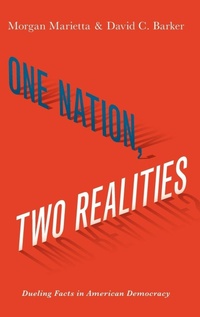
One Nation, Two Realities
Dueling Facts in American Democracy
Published on 9. May 2019
Book
Hardback
360 pages
978-0-19-067717-6 (ISBN)
Description
The deep divides that define politics in the United States are not restricted to policy or even cultural differences anymore. Americans no longer agree on basic questions of fact. Is climate change real? Does racism still determine who gets ahead? Is sexual orientation innate? Do immigration and free trade help or hurt the economy? Does gun control reduce violence? Are false convictions common?
Employing several years of original survey data and experiments, Marietta and Barker reach a number of enlightening and provocative conclusions: dueling fact perceptions are not so much a product of hyper-partisanship or media propaganda as they are of simple value differences and deepening distrust of authorities. These duels foster social contempt, even in the workplace, and they warp the electorate. The educated -- on both the right and the left -- carry the biggest guns and are the quickest to draw. And finally, fact-checking and other proposed remedies don't seem to holster too many weapons; they can even add bullets to the chamber. Marietta and Barker's pessimistic conclusions will challenge idealistic reformers.
Employing several years of original survey data and experiments, Marietta and Barker reach a number of enlightening and provocative conclusions: dueling fact perceptions are not so much a product of hyper-partisanship or media propaganda as they are of simple value differences and deepening distrust of authorities. These duels foster social contempt, even in the workplace, and they warp the electorate. The educated -- on both the right and the left -- carry the biggest guns and are the quickest to draw. And finally, fact-checking and other proposed remedies don't seem to holster too many weapons; they can even add bullets to the chamber. Marietta and Barker's pessimistic conclusions will challenge idealistic reformers.
Reviews / Votes
Rarely do they produce a work as carefully thought out as that which Morgan Marietta and David C. Barker present in One Nation, Two Realities...The book clearly contributes to multiple domains of research, including work on misperception, polarization, values, motivated reasoning, epistemology, and more. It is worth reading for students, researchers, and citizens concerned by divisions in American society and can provide much needed depth to public discussions of an ever-increasing problem. * Ethan C. Busby, Congress & the Presidency * Discussions of alternative facts, fake news, and post-truth abound in American society... Rarely do they produce a work as carefully thought out as that which Morgan Marietta and David C. Barker present in One Nation, Two Realities... The volume provides an impressive discussion on a crucial topic and one that digs deeply into many of the theoretical, philosophical, and empirical foundations of DFPs. The book clearly contributes to multiple domains of research, including work on misperception, polarization, values, motivated reasoning, epistemology, and more. It is worth reading for students, researchers, and citizens concerned by divisions in American society and can provide much needed depth to public discussions of an ever-increasing problem. * Congress & the Presidency * This rich and fascinating work examines the increasing prevalence of dueling fact perceptions among the American public. Couched in a wide-ranging discussion of epistemology, journalism, and social science, "One Nation, Two Realities" presents vital and sobering insights about the quality of American democracy. * Choice *More details
Language
English
Place of publication
New York
United States
Target group
Professional and scholarly
Dimensions
Height: 240 mm
Width: 161 mm
Thickness: 24 mm
Weight
705 gr
ISBN-13
978-0-19-067717-6 (9780190677176)
Copyright in bibliographic data and cover images is held by Nielsen Book Services Limited or by the publishers or by their respective licensors: all rights reserved.
Schweitzer Classification
Other editions
Additional editions
E-Book
03/2019
1st Edition
OUP eBook
€20.99
Available for download
E-Book
03/2019
1st Edition
OUP eBook
€20.99
Available for download
Persons
Morgan Marietta is Associate Professor of Political Science at the University of Massachusetts Lowell, where he studies the psychology of politics and writes about the political consequences of belief. He is the author of three previous books, The Politics of Sacred Rhetoric: Absolutist Appeals and Political Influence (Baylor University Press, 2012), A Citizen's Guide to American Ideology: Conservatism and Liberalism in Contemporary Politics (Routledge, 2011), and A Citizen's Guide to the Constitution and the Supreme Court: Constitutional Conflict in American Politics (Routledge, 2014).
David C. Barker is Professor of Government (American Politics) and Director of the Center for Congressional and Presidential Studies at American University. Previously, he was Director of the Institute for Social Research and CALSPEAKS Opinion Research at California State University, Sacramento (2012-2017), and Associate Professor of Political Science at University of Pittsburgh. He has served as principal investigator on more than 60 externally funded research projects, and he has published dozens of peer-reviewed journal articles in outlets such as the American Political Science Review, the Journal of Politics, Public Opinion Quarterly, and many others. His previous books include Rushed to Judgment: Talk Radio, Persuasion, and American Political Behavior (Columbia University Press, 2002) and Representing Red and Blue: How the Culture Wars Change the Way Citizens Speak and Politicians Listen (Oxford University Press, 2012).
David C. Barker is Professor of Government (American Politics) and Director of the Center for Congressional and Presidential Studies at American University. Previously, he was Director of the Institute for Social Research and CALSPEAKS Opinion Research at California State University, Sacramento (2012-2017), and Associate Professor of Political Science at University of Pittsburgh. He has served as principal investigator on more than 60 externally funded research projects, and he has published dozens of peer-reviewed journal articles in outlets such as the American Political Science Review, the Journal of Politics, Public Opinion Quarterly, and many others. His previous books include Rushed to Judgment: Talk Radio, Persuasion, and American Political Behavior (Columbia University Press, 2002) and Representing Red and Blue: How the Culture Wars Change the Way Citizens Speak and Politicians Listen (Oxford University Press, 2012).
Author
Assistant Professor of Political ScienceAssistant Professor of Political Science, University of Massachusetts Lowell
Professor of Government (American Politics) and Director of the Center for Congressional and Presidential StudiesProfessor of Government (American Politics) and Director of the Center for Congressional and Presidential Studies, American University
Content
Preface
1. Introduction: Truth & Trust
Part I Concepts
2. What Smarter People Have Said About Facts: Philosophical & Psychological Foundations
3. Dueling Facts in Political Science
4. Dueling Facts in American Politics
Part II Causes
5. Your Facts or Mine? The Psychology of Fact Perceptions
6. The Psychology of Fact Perceptions II: Value Projection
7. Polarized Leaders Versus Polarized Values
8. A Theory of Intuitive Epistemology
9. The Roots of Certainty: Sacred Values and Sacred Facts
Part III Consequences
10. The Democratic Consequences of Dueling Facts
11. Disdain & Disengagement: The Social Consequences of Dueling Fact Perceptions
Part IV Correctives
12. Political Knowledge and Fractured Perceptions: Education is Not the Answer
13. Let Facts Be Submitted to a Candid World: Fact-Checking as a Potential Solution
14. Citizen Reponses to Fact-Checking
15. Symmetry, Asymmetry, and Durability
Part V Conclusion
16. Conclusion: Facts & Values, Knowledge & Democracy
References
Appendix
1. Introduction: Truth & Trust
Part I Concepts
2. What Smarter People Have Said About Facts: Philosophical & Psychological Foundations
3. Dueling Facts in Political Science
4. Dueling Facts in American Politics
Part II Causes
5. Your Facts or Mine? The Psychology of Fact Perceptions
6. The Psychology of Fact Perceptions II: Value Projection
7. Polarized Leaders Versus Polarized Values
8. A Theory of Intuitive Epistemology
9. The Roots of Certainty: Sacred Values and Sacred Facts
Part III Consequences
10. The Democratic Consequences of Dueling Facts
11. Disdain & Disengagement: The Social Consequences of Dueling Fact Perceptions
Part IV Correctives
12. Political Knowledge and Fractured Perceptions: Education is Not the Answer
13. Let Facts Be Submitted to a Candid World: Fact-Checking as a Potential Solution
14. Citizen Reponses to Fact-Checking
15. Symmetry, Asymmetry, and Durability
Part V Conclusion
16. Conclusion: Facts & Values, Knowledge & Democracy
References
Appendix