

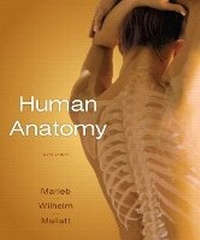
Human Anatomy with Practice Anatomy Lab 2.0
United States Edition
6th Edition
Published on 22. February 2010
Book
Mixed media product
880 pages
978-0-321-57090-1 (ISBN)
Description
Human Anatomy, Sixth Edition builds upon the clear and concise explanations of the best-selling Fifth Edition. A dramatically improved art and photo program, even clearer explanations and readability, and more integrated clinical coverage are all included. Recognized for helping you establish the framework needed for understanding how anatomical structure relates to function, the text's engaging descriptions now benefit from a brand-new art program that features vibrant, saturated colors as well as new side-by-side cadaver photos. New Focus figures have been added to help students grasp the most difficult topics in anatomy.
0321570901 / 9780321570901 Human Anatomy with Practice Anatomy Lab 2.0
Package components:
0321566335 / 9780321566331 Practice Anatomy Lab 2.0 CD-ROM -- CD-ROM
0321616111 / 9780321616111 Human --- Cloth Bound
080537373X / 9780805373738 Brief Atlas of the Human Body, A --- Paper Bound
0321570901 / 9780321570901 Human Anatomy with Practice Anatomy Lab 2.0
Package components:
0321566335 / 9780321566331 Practice Anatomy Lab 2.0 CD-ROM -- CD-ROM
0321616111 / 9780321616111 Human --- Cloth Bound
080537373X / 9780805373738 Brief Atlas of the Human Body, A --- Paper Bound
More details
Edition
6th edition
Language
English
Place of publication
United States
Publishing group
Pearson Education (US)
Target group
College/higher education
Dimensions
Height: 235 mm
Width: 282 mm
Thickness: 43 mm
Weight
2712 gr
ISBN-13
978-0-321-57090-1 (9780321570901)
Copyright in bibliographic data is held by Nielsen Book Services Limited or its licensors: all rights reserved.
Schweitzer Classification
Other editions
New editions
Elaine N. Marieb | Patricia Brady Wilhelm | Jon B. Mallatt
Human Anatomy, Media Update Plus MasteringA&P with eText -- Access Card Package
United States Edition
Book
03/2011
6th Edition
Pearson
€177.19
Article exhausted; check for reprint
Previous edition
Book
02/2007
5th Edition
Pearson Education (US)
€128.05
Article exhausted; check for reprint
Persons
For Elaine N. Marieb, taking the student's perspective into account has always been an integral part of her teaching style. Dr. Marieb began her teaching career at Springfield College, where she taught anatomy and physiology to physical education majors. She then joined the faculty of the Biological Science Division of Holyoke Community College after receiving her Ph.D. in zoology from the University of Massachusetts at Amherst.
While teaching at Holyoke Community College, where many of her students were pursuing nursing degrees, she developed a desire to better understand the relationship between the scientific study of the human body and the clinical aspects of the nursing practice. To that end, while continuing to teach full time, Dr. Marieb pursued her nursing education, which culminated in a Master of Science degree with a clinical specialization in gerontology from the University of Massachusetts. It is this experience, along with stories from the field-including those of former students, now in health careers-that has informed the development of the unique perspective and accessibility for which her texts and laboratory manuals are known.
In her ongoing commitment to students and her realization of the challenges they face, Dr. Marieb has given generously to provide opportunities for students to further their education. She contributes to the New Directions, New Careers Program at Holyoke Community College by providing several full-tuition scholarships each year for women returning to college after a hiatus or who are attending college for the first time and would otherwise be unable to continue with their studies without financial support. She funds the E. N. Marieb Science Research Awards at Mount Holyoke College, which promotes research by undergraduate science majors, and generously contributed to the University of Massachusetts at Amherst where she provided funding for reconstruction and instrumentation of a cutting-edge cytology research laboratory that bears her name.
In 1994, Dr. Marieb received the Benefactor Award from the National Council for Resource Development, American Association of Community Colleges, which recognizes her ongoing sponsorship of student scholarships, faculty teaching awards, and other academic contributions to Holyoke Community College. In May 2000, the science building at Holyoke Community College was named in her honor.
Additionally, while actively engaged as an author, Dr. Marieb serves as a consultant for the Benjamin Cummings Interactive Physiology (R) CD-ROM series, and is an active member of the Human Anatomy and Physiology Society (HAPS), the American Association for the Advancement of Science (AAAS), and Sigma Xi.
Patricia Brady Wilhelm received her Ph.D. in Biological and Medical Sciences from Brown University and is currently Professor of Biology at the Community College of Rhode Island. She has been teaching anatomy to undergraduates for over 12 years at Brown University, Rhode Island College, and the community College of Rhode Island. In 1991 she received the Presidential Award for Excellence in Graduate Teaching from Brown University.
Continuing to strive for excellence in teaching and learning, Dr. Wilhelm has been a leader at the Community College of Rhode Island in the uses of technology for teaching through the development of web-based course tools, on-line dissection videos, on-line student assessment tools, and cooperative learning strategies for the classroom. The driving factor behind these innovations is the desire to aid student learning by making course materials accessible and to make the study of anatomy an active and interactive process. She has also served as a consultant in training faculty from all three public institutions in Rhode Island (University of Rhode Island, Rhode Island College, and the Community College of Rhode Island) in the uses of technology in teaching, and continues to work on the development and use of multimedia tools for anatomy instruction.
In addition to teaching, Dr. Wilhelm has contributed to numerous anatomy and physiology publications. Dr. Wilhelm's research interests are: vertebrate functional morphology, biomehanics, and anatomy education. She is a member of Sigma Xi, the Human Anatomy and Physiology Society (HAPS), and the American Association of Anatomists.
Jon Mallatt earned his Ph.D. in Anatomy from the University of Chicago. Dr. Mallatt is currently an Associate Professor of Biological Sciences at Washington State University, where he has been teaching human anatomy to undergraduates of all backgrounds for 24 years. He is also a member of the department of Basic Medical Sciences, where he teaches courses in Histology and Anatomy of the Trunk in the WWAMI Medical Program. WWAMI honored him with their "Excellence in Teaching Award" in 1992, 1993, 1995, and 2000. Additionally Dr. Mallatt holds a position as adjunct Associate Professor in the department of Biological Structure at the University of Washington. His particular areas of expertise in the study of anatomy are histology, comparative anatomy, and anatomical drawing, although his research now focuses on the origin of vertebrate animals and molecular phylogeny. Dr. Mallatt is an accomplished researcher with 39 publications in the fields of anatomy and molecular phylogeny to his credit.
While teaching at Holyoke Community College, where many of her students were pursuing nursing degrees, she developed a desire to better understand the relationship between the scientific study of the human body and the clinical aspects of the nursing practice. To that end, while continuing to teach full time, Dr. Marieb pursued her nursing education, which culminated in a Master of Science degree with a clinical specialization in gerontology from the University of Massachusetts. It is this experience, along with stories from the field-including those of former students, now in health careers-that has informed the development of the unique perspective and accessibility for which her texts and laboratory manuals are known.
In her ongoing commitment to students and her realization of the challenges they face, Dr. Marieb has given generously to provide opportunities for students to further their education. She contributes to the New Directions, New Careers Program at Holyoke Community College by providing several full-tuition scholarships each year for women returning to college after a hiatus or who are attending college for the first time and would otherwise be unable to continue with their studies without financial support. She funds the E. N. Marieb Science Research Awards at Mount Holyoke College, which promotes research by undergraduate science majors, and generously contributed to the University of Massachusetts at Amherst where she provided funding for reconstruction and instrumentation of a cutting-edge cytology research laboratory that bears her name.
In 1994, Dr. Marieb received the Benefactor Award from the National Council for Resource Development, American Association of Community Colleges, which recognizes her ongoing sponsorship of student scholarships, faculty teaching awards, and other academic contributions to Holyoke Community College. In May 2000, the science building at Holyoke Community College was named in her honor.
Additionally, while actively engaged as an author, Dr. Marieb serves as a consultant for the Benjamin Cummings Interactive Physiology (R) CD-ROM series, and is an active member of the Human Anatomy and Physiology Society (HAPS), the American Association for the Advancement of Science (AAAS), and Sigma Xi.
Patricia Brady Wilhelm received her Ph.D. in Biological and Medical Sciences from Brown University and is currently Professor of Biology at the Community College of Rhode Island. She has been teaching anatomy to undergraduates for over 12 years at Brown University, Rhode Island College, and the community College of Rhode Island. In 1991 she received the Presidential Award for Excellence in Graduate Teaching from Brown University.
Continuing to strive for excellence in teaching and learning, Dr. Wilhelm has been a leader at the Community College of Rhode Island in the uses of technology for teaching through the development of web-based course tools, on-line dissection videos, on-line student assessment tools, and cooperative learning strategies for the classroom. The driving factor behind these innovations is the desire to aid student learning by making course materials accessible and to make the study of anatomy an active and interactive process. She has also served as a consultant in training faculty from all three public institutions in Rhode Island (University of Rhode Island, Rhode Island College, and the Community College of Rhode Island) in the uses of technology in teaching, and continues to work on the development and use of multimedia tools for anatomy instruction.
In addition to teaching, Dr. Wilhelm has contributed to numerous anatomy and physiology publications. Dr. Wilhelm's research interests are: vertebrate functional morphology, biomehanics, and anatomy education. She is a member of Sigma Xi, the Human Anatomy and Physiology Society (HAPS), and the American Association of Anatomists.
Jon Mallatt earned his Ph.D. in Anatomy from the University of Chicago. Dr. Mallatt is currently an Associate Professor of Biological Sciences at Washington State University, where he has been teaching human anatomy to undergraduates of all backgrounds for 24 years. He is also a member of the department of Basic Medical Sciences, where he teaches courses in Histology and Anatomy of the Trunk in the WWAMI Medical Program. WWAMI honored him with their "Excellence in Teaching Award" in 1992, 1993, 1995, and 2000. Additionally Dr. Mallatt holds a position as adjunct Associate Professor in the department of Biological Structure at the University of Washington. His particular areas of expertise in the study of anatomy are histology, comparative anatomy, and anatomical drawing, although his research now focuses on the origin of vertebrate animals and molecular phylogeny. Dr. Mallatt is an accomplished researcher with 39 publications in the fields of anatomy and molecular phylogeny to his credit.
Content
1. The Human Body: An Orientation
2. Cells: The Living Units
3. Basic Embryology
4. Tissues
5. The Integumentary System
6. Bones and Skeletal Tissues
7. Bones, Part I: The Axial Skeleton
8. Bones, Part II: The Appendicular Skeleton
9. Joints
10. Skeletal Muscle Tissue
11. Muscles of the Body
12. Fundamentals of the Nervous System and Nervous Tissue
13. The Central Nervous System
14. The Peripheral Nervous System
15. The Autonomic Nervous System and Visceral Sensory Neurons
16. The Special Senses
17. The Endocrine System
18. Blood
19. The Heart and Cardiac Muscle Tissue
20. Blood Vessels and Smooth Muscle Tissue
21. The Lymphatic and Immune Systems
22. The Respiratory System
23. The Digestive System
24. The Urinary System
25. The Reproductive System
2. Cells: The Living Units
3. Basic Embryology
4. Tissues
5. The Integumentary System
6. Bones and Skeletal Tissues
7. Bones, Part I: The Axial Skeleton
8. Bones, Part II: The Appendicular Skeleton
9. Joints
10. Skeletal Muscle Tissue
11. Muscles of the Body
12. Fundamentals of the Nervous System and Nervous Tissue
13. The Central Nervous System
14. The Peripheral Nervous System
15. The Autonomic Nervous System and Visceral Sensory Neurons
16. The Special Senses
17. The Endocrine System
18. Blood
19. The Heart and Cardiac Muscle Tissue
20. Blood Vessels and Smooth Muscle Tissue
21. The Lymphatic and Immune Systems
22. The Respiratory System
23. The Digestive System
24. The Urinary System
25. The Reproductive System