

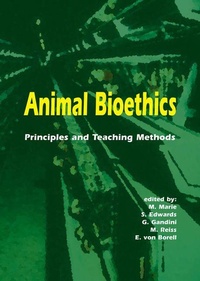
Animal bioethics
Principles and teaching methods
Published on 30. May 2005
Book
Paperback/Softback
360 pages
978-90-76998-58-9 (ISBN)
Description
"Nowadays there are widespread ethical concerns about animal production and our treatment of animals. This book is the first to specifically examine these issues from an educational perspective. With 19 chapters written by 31 authors experienced in this field and coming from 11 European countries, this book will be of great value to veterinary, agronomy and science students and teachers. It will also be of use for everyone interested in developing moral reasoning and communication skills relative to ethics, whether animal centred or in a broader sense.
The first part of the book is devoted to in-depth analyses of historical, philosophical, religious and cultural perspectives as well as of the driving forces in action. This enables readers to develop a good understanding of the ethical principles related to human-animal relationships, and their dynamics.
In the second part, teaching objectives, strategies and methods are analysed, resulting in a conceptual framework for education in this area. Concrete suggestions are given to be applied in teaching, training and communication. This provides a basis for curricula development, including appropriate principles, content and examples. A detailed syllabus is proposed in the case of animal welfare, including its rationale and extensive sources of information. The methods proposed, in their varying degrees of complexity involve active processes, mainly founded on case studies and problem-based learning. This will contribute to a necessary sharing of experience and the spreading of good practice."
The first part of the book is devoted to in-depth analyses of historical, philosophical, religious and cultural perspectives as well as of the driving forces in action. This enables readers to develop a good understanding of the ethical principles related to human-animal relationships, and their dynamics.
In the second part, teaching objectives, strategies and methods are analysed, resulting in a conceptual framework for education in this area. Concrete suggestions are given to be applied in teaching, training and communication. This provides a basis for curricula development, including appropriate principles, content and examples. A detailed syllabus is proposed in the case of animal welfare, including its rationale and extensive sources of information. The methods proposed, in their varying degrees of complexity involve active processes, mainly founded on case studies and problem-based learning. This will contribute to a necessary sharing of experience and the spreading of good practice."
More details
Language
English
Place of publication
Netherlands
Target group
Professional and scholarly
Product notice
Paperback (trade)
Unsewn / adhesive bound
Dimensions
Height: 241 mm
Width: 163 mm
Thickness: 13 mm
Weight
680 gr
ISBN-13
978-90-76998-58-9 (9789076998589)
Copyright in bibliographic data and cover images is held by Nielsen Book Services Limited or by the publishers or by their respective licensors: all rights reserved.
Schweitzer Classification
Content
A mirror of myself? Monist and dualist views of animals 15; Monica Libell; Abstract 15; 1. Introduction 15; 2. Monists and dualists 17; 3. The victory of the dualist position 19; 4. Animal similarities 20; 5. Natural scientific monism - ethical dualism 21; 6. Monist ethicists 23; 7. The defeat of humanist ethics 25; 8. Concluding remarks 27; References 28; Religious resources for animal ethics? 29; Benjamin Taubald; Abstract 29; 1. Introduction 29; 2. Western culture, religious traditions, and the destruction of the environment 30; 3. The Judeo-Christian heritage 32; 4. Christian transformation of Hellenistic thinking 37; 5. The modern transformation of philosophy 42; 6. Integrating the tradition? 45; References 47; Ethics, morals and law relative to animals 49; John Hodges; Abstract 49; 1. Introduction 49; 2. Moral standards, ethical norms of behaviour and culture in human society 51; 3. Origin of ethics, culture and values in Western society 54; 4. Domestic animals in relation to morality, ethics and law 59; 5. The status of animals in the 21st century 63; 6. The role of humanity in the community of life 69; 7. Conclusion 71; References 72. The animal issue: diversity in values and thoughts 75; Vincent Pompe; Abstract 75; 1. Introduction 75; 2. The emergence of zoocentrism 77; 3. Anthropocentric counterattack 79; 4. Animal welfare and the moral status 83; 5. Moral deliberation 86; 6. Working with diversity 89; References 90; Animal integrity 93; Henk Verhoog; Abstract 93; 1. Introduction 93; 2. Integrity and zoocentric animal ethics 94; 3. Integrity and biocentric ethical theories 97; 4. Perception of animals in daily life and in science 101; 5. Aesthetics and ethics 105; References 107; The stockperson as a social partner to the animal? A stake for animal welfare 109; X. Boivin and P. Le Neindre; Abstract 109; 1. Introduction 109; 2. Fear of people, ease of handling, animal welfare, production and product quality 111; 3. An example of research work: a study of beef cattle docility 113; 4. Good tools for good workers 114; 5. Good workers for good animals: the importance of the psychological characteristics of the stockperson 115; 6. Using the genetic variability for selecting the animals 116; 7. The importance of considering the human-animal interactions as a part of an inter-individual relationship 117; 8. The stockperson as a social partner for the farm animals? 118; 9. Some scientific concepts and facts 118; 10. Existence of sensitive periods to human contact in the farm ungulates' life 120. 11. The importance of the social network in the development of the human-animal relationship 120; 12. Conclusion 123; References 124; Associations are changing public opinion and breeding methods to improve animal well being 129; Anne Vonesch; Abstract 129; 1. Introduction 130; 2. Farm animals' distress: a challenge for communication 131; 3. Consumer Associations in Alsace: from food safety to ethics 132; 4. Environmental protection associations: from biodiversity to well-being 138; 5. Animal protection associations: from pity to competence 141; 6. Farm animal welfare experts: from commercialising life to changing the system 147; 7. Education for ethics: from zootechnics to the practice of wellbeing 150; References 150; Trade regulations, market requirements and social pressures effects on introducing animal friendly livestock production systems 153; Tadeusz Kuczynski and Stefan Mann; Abstract 153; 1. Introduction 154; 2. Animal welfare 154; 3. Conclusions 168; References 169; The human-animal relationship in higher scientific education and its ethical implications 173; Caroline Vieuille and Arnaud Aubert; Abstract 173; 1. Introduction 174; 2. Place afforded to ethical questions 174; 3. Perception of animal 176; 4. The conflicting place of ethics 178; 5. Conclusion 181; References 182. Teaching animal bioethics: pedagogic objectives 185; Michael J. Reiss; Abstract 185; 1. Introduction 185; 2. Why should students on agricultural and veterinary higher education courses study ethics? 186; 3. What sort of ethics should students on agricultural and veterinary higher education courses study? 187; 4. How might ethics be taught to students on agricultural and veterinary higher education courses? 195; 5. Conclusion 197; References 197; Teaching professional ethics: more than moral cognition alone 199; Vincent Pompe; Abstract 199; 1. From justification to implementation 199; 2. The fabric of moral behaviour 201; 3. The difficulty of teaching ethics 206; 4. Taking teaching animal ethics seriously 208; References 209; Teaching animal welfare to veterinary students 211; Xavier Manteca, Donald M Broom, Ute Knierim, Jaume Fatjo, Linda Keeling and Antonio Velarde; Abstract 211; 1. Basic principles 212; 2. Farm animal housing and husbandry 216; 3. Transport and slaughter of farm animals 221; 4. Companion animals 223; 5. Laboratory animals 226; 6. Wildlife 230; References 232; Teaching ethics to agricultural and veterinary students: experiences from Denmark 241; T. Dich, T. Hansen, S.B. Christiansen, Pernille Kaltoft and P. Sandoe; Abstract 241; 1. Introduction 241. 2. The societal need for agriculturalists and veterinarians to understand ethics 242; 3. The experience of running a course in bioethics for students of agricultural science and agricultural economics 244; 4. The experience of running a course in animal ethics for veterinary students 247; 5. A new course: Introductory philosophy of science for agricultural science, agricultural economics, and biotechnology students 252; 6. What is needed to set up interdisciplinary ethics courses? 253; References 254; What is your conception of ethics? A questionnaire for engineer and science students 255; Laurent Rollet and Michel Marie; Abstract 255; 1. Introduction 255; 2. Description of the questionnaire 257; 3. Use of the questionnaire in the classroom 266; Acknowledgements 277; References 277; An introduction to Problem-Based Learning and its application to an animal bioethics curriculum 279; Alison J. Hanlon; Abstract 279; 1. Introduction 280; 2. The problem 280; 3. The PBL model 281; 4. The facilitator 282; 5. The tutorial process 284; 6. The tutorial group 285; 7. Summary 290; Acknowledgements 290; References 291; The construction and application of cases in bioethics education 293; Tjard de Cock Buning and Ellen ter Gast; Abstract 293; 1. Introduction 293; 2. Practical skills and theoretical background 295. 3. Phases in the educational process 296; 4. Educational goals 299; 5. Different types of cases: illustrative procedures and games 300; Acknowledgement 308; The ethical matrix: a framework for teaching ethics to bioscience students 309; Ben Mepham; Abstract 309; 1. Introduction 310; 2. The theoretical background 310; 3. An Ethical Matrix 311; 4. Aims and limitations 312; 5. Application of the Ethical Matrix to the case of bovine somatotrophin 313; 6. Competent moral judges 320; 7. Worldviews 321; 8. Conclusions 322; References 322; The use of the reflective equilibrium method of moral reasoning in teaching animal and veterinary ethics 325; Bart Rutgers and Robert Heeger; Abstract 325; 1. Introduction 325; 2. Course in animal and veterinary ethics 327; 3. The reflective equilibrium method of moral reasoning 327; 4. Reasoning about a concrete moral problem 330; 5. Moral thinking and clinical thinking 337; References 338; Index - Animal bioethics: cases, situations 341; Index - Teaching objectives, strategies, methods 343; Index - Philosophical schools, concepts, authors 345.