

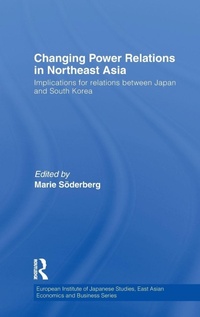
Changing Power Relations in Northeast Asia
Implications for Relations between Japan and South Korea
1st Edition
Published on 1. December 2010
Book
Hardback
204 pages
978-0-415-58747-1 (ISBN)
Description
This book analyses the Japanese-South Korean relationship from various angles including politics, security, economics, culture and immigration. In a sense the two countries are natural partners. Both are democratic societies, they are economically strong and are the only two Asian countries that are members of the OECD. Both have security treaties with the USA, they share security concerns when it comes to the North Korean nuclear threat as well as the rise of China, which at the same time has become the largest trading partner for both. Japan and South Korea also share similar values, customs, cultures and languages. All this would make it logical for them to have a strong cooperative bilateral relationship. Yet this is still not the case. The contributors to this book examine how the relationship is affected by the changing power relations in Northeast Asia and find a most complex situation.
Understanding how Japan and Korea interact is central for anyone that wants to understand the politics of East Asia. This volume will be of huge interest to students and scholars of Asian politics, as well as those interested in political science and peace and conflict resolution more generally.
Marie Soederberg is Professor and Director of the European Institute of Japanese Studies, Sweden.
Understanding how Japan and Korea interact is central for anyone that wants to understand the politics of East Asia. This volume will be of huge interest to students and scholars of Asian politics, as well as those interested in political science and peace and conflict resolution more generally.
Marie Soederberg is Professor and Director of the European Institute of Japanese Studies, Sweden.
Reviews / Votes
"Marie Soderberg's edited volume is likely to become the standard reference for the study of contemporary Japan - South Korea relations... Soderberg's book is the most up to date and accurate analysis of Japan - South Korea relations in the post-cold war era marked by the rise of China and relative decline of the United States and by regional integration." - Lam Peng Er, National University of Singapore; Journal of Japanese Studies 39.1, 2013."...a volume filled with insight and sensitivity to a most complex relationship." - Robert Bedeski, Pacific Affairs: Volume 85, No. 1 - March 2012
More details
Series
Language
English
Place of publication
London
United Kingdom
Publishing group
Taylor & Francis Ltd
Target group
College/higher education
Illustrations
4 s/w Abbildungen, 4 s/w Zeichnungen, 4 s/w Tabellen
4 Tables, black and white; 4 Line drawings, black and white; 4 Illustrations, black and white
Dimensions
Height: 240 mm
Width: 161 mm
Thickness: 16 mm
Weight
482 gr
ISBN-13
978-0-415-58747-1 (9780415587471)
Copyright in bibliographic data and cover images is held by Nielsen Book Services Limited or by the publishers or by their respective licensors: all rights reserved.
Schweitzer Classification
Other editions
Additional editions
Marie Soderberg
Changing Power Relations in Northeast Asia
Implications for Relations between Japan and South Korea
Book
05/2013
1st Edition
Routledge
€83.30
Shipment within 15-20 days
Marie Soderberg
Changing Power Relations in Northeast Asia
Implications for Relations between Japan and South Korea
E-Book
03/2011
1st Edition
Routledge
€77.99
Available for download
Marie Soderberg
Changing Power Relations in Northeast Asia
Implications for Relations between Japan and South Korea
E-Book
03/2011
1st Edition
Routledge
€77.99
Available for download
Person
Marie Soederberg is Professor and Director of the European Institute of Japanese Studies, Sweden.
Content
1. Introduction: Japan-South Korea relations at a crossroads, Marie Soederberg 2. How can we cope with historical disputes? The Japanese and South Korean experience, Kan Kimura 3. A whirlpool of historical controversies in widening waters of cooperation, Cheol Hee Park 4. Japan and the two Koreas: the foreign policy power of domestic politics, T. J. Pempel 5. Historical memory versus democratic reassurance: the security relationship between Japan and South Korea, Paul Midford 6. Hallyu: new politico-cultural discourse in East Asia? Ingyu Oh 7. Lingering memory problems: compromising hearts and resentful resistance, Mikyoung Kim 8. Substituting multilateralism, guiding trilateralism: the Japan-ROK Investment Agreement in the growing East Asian regionalism, Yoichiro Sato 9. The struggle for a decent life in Japan: the Korean minority adapting to changing legal and political conditions, Marie Soederberg 10. A multilayered analysis of Japan-South Korea relations, Marie Soederberg