

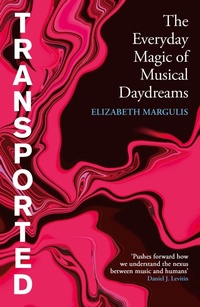
Transported
The Everyday Magic of Musical Daydreams
Will be published approx. on 11. June 2026
Book
Hardback
240 pages
978-1-83643-173-2 (ISBN)
Description
Music: it's not only the soundtrack to our lives, but shapes who we are - conjuring memories, emotions, dreams, fantasies
'Elegant and accessible.' Daniel J. Levitin, author of This Is Your Brain on Music
But why is it so evocative? There's no logical reason why a rousing, percussive tune should invoke swashbuckling pirates, or a slow melody on the flute remind you of a summer day from childhood. And yet, as research shows, it consistently does - and what's more, if you hear pirates, others likely hear pirates as well.
For all that listening to music can feel like an intensely subjective experience, it holds objective, measurable power over the way our brains function. Exploring the strange and magical science of music perception, musician and psychologist Elizabeth Margulis examines the nature of 'musical daydreams'. From the intense link between music and memory (music is more likely to prompt Proustian-style flashbacks than food, madeleines or otherwise) to why you keep returning to the music you loved at sixteen - and for that matter, the music your parents loved at sixteen - Transported reveals the compelling new science behind why music is so integral to who we are.
'Timely... there couldn't be a better moment to explore the power of music to free our minds, inspire our imaginations, and awaken lost memories.' Renee Fleming
'Fascinating... Her book is the message in a bottle, urging us to connect more deeply with our inattention.' Wall Street Journal
'Elegant and accessible.' Daniel J. Levitin, author of This Is Your Brain on Music
But why is it so evocative? There's no logical reason why a rousing, percussive tune should invoke swashbuckling pirates, or a slow melody on the flute remind you of a summer day from childhood. And yet, as research shows, it consistently does - and what's more, if you hear pirates, others likely hear pirates as well.
For all that listening to music can feel like an intensely subjective experience, it holds objective, measurable power over the way our brains function. Exploring the strange and magical science of music perception, musician and psychologist Elizabeth Margulis examines the nature of 'musical daydreams'. From the intense link between music and memory (music is more likely to prompt Proustian-style flashbacks than food, madeleines or otherwise) to why you keep returning to the music you loved at sixteen - and for that matter, the music your parents loved at sixteen - Transported reveals the compelling new science behind why music is so integral to who we are.
'Timely... there couldn't be a better moment to explore the power of music to free our minds, inspire our imaginations, and awaken lost memories.' Renee Fleming
'Fascinating... Her book is the message in a bottle, urging us to connect more deeply with our inattention.' Wall Street Journal
Reviews / Votes
'Transported pushes forward how we understand the nexus between music and humans...Even better, Margulis's writing is at the same time elegant and accessible.' -Daniel J. Levitin, author of This Is Your Brain on Music 'Fascinating... Her book is the message in a bottle, urging us to connect more deeply with our inattention... What emerges in our musical daydreams might be something to hold on to. It might be ourselves.' -Wall Street Journal 'This vivid and insightful book provides an entirely new perspective on music's power to evoke scenes and stories in our imagination... Margulis brightly illuminates a valuable aspect of musical experience that we are just beginning to understand.' -Aniruddh Patel, author of Music, Language and the Brain 'Transported is fascinating and timely. In today's landscape of screens, algorithms, and anxiety, there couldn't be a better moment to explore the power of music to free our minds, inspire our imaginations, and awaken lost memories. The science behind these effects, explained so coherently in the book, has huge implications for healthcare; and it is woven seamlessly into real-world accounts with feeling and humour.' -Renee Fleming 'A fascinating exploration of the mysterious and important connection between music and daydreams, and a deeply enjoyable path toward understanding what imbues music with its undeniable power.' -Bela Fleck, 17-time Grammy Award-winning musician 'Margulis writes in an easy, conversational style, never solemnly scholarly, and raises as many enticing questions as she answers. Moving deftly between the subjective experience of those listening to music and the brain activity of those same subjects, she considers how the mind makes metaphors and how various senses influence each other. The book is sure to make readers ponder their own encounters with music. A refreshingly original look at an ordinary phenomenon.' -Kirkus 'With striking intellectual range and an inviting voice, Elizabeth Margulis reframes everyday music listening as a subject of rigorous scientific inquiry. Bringing together insights across disciplines with a balance of precision and accessibility, she broadens our understanding of music's capacity to foster creativity and nurture wellbeing.' -Assal Habibi, director of USC Center for Music, Brain, and Society 'Anyone interested in music and how it affects us will enjoy this engaging and informative study.' -BooklistMore details
Language
English
Place of publication
London
United Kingdom
Dimensions
Height: 234 mm
Width: 153 mm
Thickness: 22 mm
ISBN-13
978-1-83643-173-2 (9781836431732)
Copyright in bibliographic data and cover images is held by Nielsen Book Services Limited or by the publishers or by their respective licensors: all rights reserved.
Schweitzer Classification
Person
Elizabeth Margulis is Professor of Music, with affiliate appointments in Psychology and Neuroscience, at Princeton University, where she directs the Music Cognition Lab. Her research has been featured on Netflix's Music: Explained and NPR's All Things Considered, alongside the New York Times and BBC. She is the author of On Repeat and The Psychology of Music, which has been translated into six languages.