

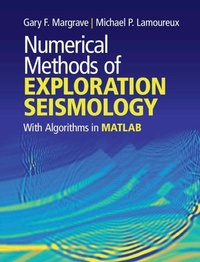
Numerical Methods of Exploration Seismology
With Algorithms in MATLAB (R)
Published on 10. January 2019
Book
Hardback
450 pages
978-1-107-17014-8 (ISBN)
Description
Exploration seismology uses seismic imaging to form detailed images of the Earth's interior, enabling the location of likely petroleum targets. Due to the size of seismic datasets, sophisticated numerical algorithms are required. This book provides a technical guide to the essential algorithms and computational aspects of data processing, covering the theory and methods of seismic imaging. The first part introduces an extensive online library of MATLAB (R) seismic data processing codes maintained by the CREWES project at the University of Calgary. Later chapters then focus on digital signal theory and relevant aspects of wave propagation and seismic modelling, followed by deconvolution and seismic migration methods. Presenting a rigorous explanation of how to construct seismic images, it provides readers with practical tools and codes to pursue research projects and analyses. It is ideal for advanced students and researchers in applied geophysics, and for practicing exploration geoscientists in the oil and gas industry.
Reviews / Votes
'This book is a masterpiece in scope and content. It explains the essential algorithms and computational aspects of data processing, covering the theory and methods of seismic imaging. A particularly outstanding feature is that it gives useful methods and tools to pursue research projects and analyses - representing the way that things should be taught in the computer age. For this reason, it should be adopted in the undergraduate curriculum and will be a wonderful resource for graduate students and researchers in applied geophysics. Practicing geoscientists will also welcome this book as it will make their daily tasks easier and more productive.' Enders Robinson, Columbia University, New York City 'The authors are to be commended for putting together this valuable resource which will instantly be highly useful to many geophysicists in the academic and industrial communities. The book is a pleasing and unusual mixture of rigorous geophysical signal processing theory and practical concepts, algorithms and code snippets. The MATLAB library functions and scripts that are provided or available for download will prove indispensable to all readers.' Peter Cary, Chief Geophysicist, TGS Canada '... Numerical Methods of Exploration Seismology and its elegant MATLAB codes are a must for explorationists' bookshelves.' Sven Treitel, The Leading EdgeMore details
Language
English
Place of publication
Cambridge
United Kingdom
Target group
Professional and scholarly
Illustrations
59 Halftones, black and white; 132 Line drawings, black and white
Dimensions
Height: 260 mm
Width: 208 mm
Thickness: 29 mm
Weight
1197 gr
ISBN-13
978-1-107-17014-8 (9781107170148)
Copyright in bibliographic data and cover images is held by Nielsen Book Services Limited or by the publishers or by their respective licensors: all rights reserved.
Schweitzer Classification
Other editions
Additional editions
Gary F. Margrave | Michael P. Lamoureux
Numerical Methods of Exploration Seismology
With Algorithms in MATLAB (R)
E-Book
01/2019
Cambridge University Press
€70.99
Available for download
E-Book
01/2019
Cambridge University Press
€58.99
Available for download
Persons
Gary F. Margrave has extensive experience with seismic data in both the corporate and academic worlds. His career began with fifteen years at Chevron, before twenty years as a Professor of Geophysics at the University of Calgary, where he taught courses on which this book is based. He then spent two years as Senior Geophysical Advisor at Devon Energy. He is now retired but still pursuing a vigorous research program. Michael P. Lamoureux is a Professor of Mathematics at the University of Calgary, with a research focus on functional analysis and its application to physics, signal processing, and imaging. He has a keen interest in developing advanced mathematical methods for use in real industrial settings.
Content
Preface; 1. Introduction to MATLAB and seismic data; 2. Signal theory - continuous; 3. Signal theory - discrete; 4. Wave propagation and seismic modelling; 5. Deconvolution - the estimation of reflectivity; 6. Velocity measures and ray tracing; 7. Elementary migration methods; References; Index.