

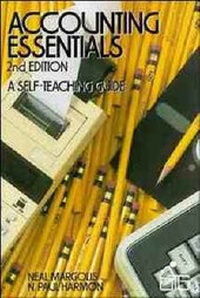
Accounting Essentials
Published on 21. October 1985
Book
Paperback/Softback
336 pages
978-0-471-82721-4 (ISBN)
Description
This self-teaching guide to basic record-keeping procedures is designed to help individuals learn how to protect assets and manage inventory and payroll. Designed to allow individals to work at their own pace, it provides a step-by-step outline of how to manage a typical accounting cycle, from initial transaction through to the final preparation of summary statements. It also teaches how to journalize transactions, post to ledgers and summarize information in periodic financial statements by filling in sample documents, ledger sheets and financial statements, as well as how to apply these skills to specialized situations, such as merchandise accounting, payroll accounting, accounting for inventory and controlling assets. This revised edition features updated information on tax rates, taxable payroll income for FICA and an appendix section on computer-assisted common accounting transactions.
More details
Series
Edition
2nd Edition
Language
English
Place of publication
New York
United States
Publishing group
John Wiley and Sons Ltd
Target group
College/higher education
Dimensions
Height: 252 mm
Width: 177 mm
Thickness: 18 mm
Weight
626 gr
ISBN-13
978-0-471-82721-4 (9780471827214)
Copyright in bibliographic data and cover images is held by Nielsen Book Services Limited or by the publishers or by their respective licensors: all rights reserved.
Schweitzer Classification
Persons
NEAL MARGOLIS and PAUL HARMON are independent management consultants.
Content
Fundamental Concepts of Bookkeeping and Accounting.
Business Transactions.
The Accounting Cycle I: From Transaction to Trail Balance.
The Accounting Cycle II: Adjusting the Ledger and PreparingFinancial Statements.
The Accounting Cycle III: Closing the Books.
Special Journals and Subsidiary Ledgers.
Inventory.
Internal Controls.
Payroll Accounting.
Evaluating Financial Statements.
Index.
Business Transactions.
The Accounting Cycle I: From Transaction to Trail Balance.
The Accounting Cycle II: Adjusting the Ledger and PreparingFinancial Statements.
The Accounting Cycle III: Closing the Books.
Special Journals and Subsidiary Ledgers.
Inventory.
Internal Controls.
Payroll Accounting.
Evaluating Financial Statements.
Index.