

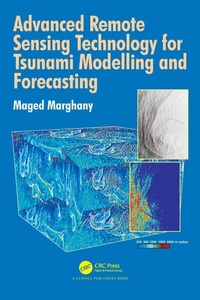
Advanced Remote Sensing Technology for Tsunami Modelling and Forecasting
1st Edition
Published on 5. July 2018
Book
Hardback
316 pages
978-0-8153-8639-1 (ISBN)
Description
The innovation in space technologies has generated a new method for observing and monitoring tsunamis from space. Most tsunami remote sensing studies focus on using classical image processing tools or conventional edge detection procedures. However, these methods do not use modern physics, applied mathematics, signal communication, remote sensing data and innovative space technologies. This book equips readers to understand how to monitor tsunamis from space with remote sensing technology art to create a better alarm warning system.
More details
Language
English
Place of publication
Bosa Roca
United States
Publishing group
Taylor & Francis Inc
Target group
College/higher education
Illustrations
20 s/w Tabellen, 277 s/w Abbildungen, 86 s/w Zeichnungen, 8 farbige Zeichnungen, 8 farbige Abbildungen, 191 s/w Photographien bzw. Rasterbilder
20 Tables, black and white; 8 Line drawings, color; 86 Line drawings, black and white; 191 Halftones, black and white; 8 Illustrations, color; 277 Illustrations, black and white
Dimensions
Height: 260 mm
Width: 183 mm
Thickness: 22 mm
Weight
792 gr
ISBN-13
978-0-8153-8639-1 (9780815386391)
Copyright in bibliographic data and cover images is held by Nielsen Book Services Limited or by the publishers or by their respective licensors: all rights reserved.
Schweitzer Classification
Other editions
Additional editions
Book
03/2021
1st Edition
CRC Press
€97.30
Shipment within 15-20 days
E-Book
07/2018
1st Edition
CRC Press
€67.49
Available for download
E-Book
07/2018
1st Edition
CRC Press
€67.49
Available for download
Person
Maged Marghany has a Ph.D. in Environmental Remote Sensing from the University Putra Malaysia where he now works as a researcher. He has conducted extensive research on the application of SAR data to coastal studies. He has been leading several projects related to the application of SAR to Malaysian coastal waters funded by Ministry of Science and Technology, Malaysia (MOSTE). His research is directed towards the use of SAR data for modeling shoreline changes and developing a new approach for forecasting oil slick trajectory movements. He has taught extensively and published over 200 papers on the topic.
Content
Principles of Tsunami. Tsunami Generation Mechanisms. Tsunami of Sumatra-Andaman Earthquake 26 December 2004. Novel Theories of Tsunami Generation Mechanisms. Modification of the Earth 's Rotation by 2004 Earthquakes. Principles of Optical Remote Sensing for Tsunami Observation. Potential of Optical Remote Sensing Satellite for Monitoring Tsunami. Modelling Shoreline Change Rates due to the Tsunami Impact. Modelling of Tsunami Impacts On Physical Properties of Water Using Modis Data: A Study Case of Aceh, Indonesia. Genetic Algorithm for Simulation of Tsunami Impacts on Water Mass Variations Using MODIS Satellite Data. Three-Dimensional Tsunami Wave Simulation from Quickbird Satellite Data. Four-Dimensional Hologram Interferometry of Tsunami Waves from Quickbird Satellite Data. Principles of Synthetic Aperture Radar. Detection of Internal Wave from Synthetic Aperture Radar Post Tsunami. Altimeter Satellite Data Observed Tsunami Spreading. Schroedinger Theory for Future Tsunami Forecasting in Malacca Straits, Indian Ocean, Red Sea and Nile River.