

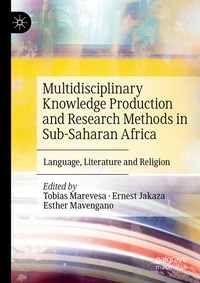
Multidisciplinary Knowledge Production and Research Methods in Sub-Saharan Africa
Description
Reviews / Votes
"Overcoming inherited disciplinary silos and invented subject uniqueness, this is a timely and strategic volume that invites scholars to cross over and engage in shared knowledge production with their neighbours. Contributors from diverse disciplines have taken time to reflect on the urgency of multidisciplinarity. They challenge disciplinary soliloquies and monologues, while promoting research methods that traverse wider fields. I warmly welcome this greatly needed publication." (Professor Ezra Chitando, University of Zimbabwe, Zimbabwe)"Now than ever before, multidisciplinary research has gained momentum and attracted substantial research funding in higher education institutions. Therefore, the current compendium Multidisciplinary Knowledge Production and Research Methods in Sub-Saharan Africa is well-timed as it covers contemporary topics in a multidisciplinary approach. The book takes an academic shift from the traditional single-disciplinary approach which has beencriticized for the mundane compartmentalization of knowledge which tends to restrict thought. On the contrary, here is an inspiring multidisciplinary book that allows you, for instance, to use cognitive linguistics in the reading of literary and biblical texts, to elaborate collective intelligence in the wake of COVID-19, apply the postcolonial and feminist theories in research, and appreciate decolonisation in Africa. This volume proffers the reader a wholesome array of everyday issues packaged in an inspiring multidisciplinary approach - issues in Philosophy, African Languages and Literature, the New Testament, Communication and Linguistics, for instance. In addition, what makes this book unique and an authentic multidisciplinary project is that it is a product of a constellation of researchers from diverse disciplines and backgrounds. The authors demonstrate a novel way of breaking the boundaries of traditional disciplines in the creation and dissemination of new knowledge. A must read multidisciplinary volume that should be a companion of every student, lecturer and researcher at tertiary level!" (Professor Jairos Kangira - University of Namibia; Honorary Professor, Cardiff University, Wales (UK))
"The book, Multidisciplinary Knowledge Production and Research Methods is a timeous epistemological intervention in the discipline of research, tackling complex issues denoting to research methodology. It could not have come at a better time than now when calls for the Global South in general and Africa in particular to generate ethno-based knowledge suiting and interpreting our own dictates have grown louder. More importantly, the text animates academic debates pertaining the pursuit of multi-disciplinary approaches and in the process putting an end to the long-held existence of academic silos that have sustained isolation and dearth of cross-pollination and fertilisation of knowledge across disciplines in Africa. To their credit, the editors did a sterling jobof assembling an intellectually well-nourished text that develops an important thesis with verve. Multidisciplinary Knowledge Production and Research Methods in Sub-Saharan Africa marks an epoch in our continent in knowledge management systems as over the years we have been grappling with extra-terrestrial ideas that do not fully stimulate our cognitive imaginations nor trigger our intellectual innovations." (Dr Alexander Rusero, Research fellow, Institute for Pan-African Thought and Conversation (IPACT), University of Johannesburg, South Africa)
More details
Other editions
Additional editions
Persons
Tobias Marevesa
is Research Fellow at the Research Institute for Theology and Religion, UNISA, South Africa.
Ernest Jakaza is a Senior Lecturer in the Department of Media, Communication, Film and Theatre Arts at Midlands State University, Zimbabwe and Research Fellow at the University of South Africa (UNISA), South Africa. .
Esther Mavengano is a lecturer who teaches Linguistics and Literature in the Department of English and Media Studies, Faculty of Arts at Great Zimbabwe University in Masvingo, Zimbabwe. She is a Research Fellow at the Research Institute for Theology and Religion, College of Human Sciences, UNISA, South Africa, and also a von Humboldt Postdoctoral Research Fellow at TU (Techische Universistat Dresden) Institute of English and American Studies, Department of English, Germany.
Content
1. New directions in multidisciplinary knowledge production in sub-Saharan Africa: An introduction.- 2. From 'sitting on the fence' to rhizomatic thinking: An Appraisal of the heuristic 'lines of flight' in multi/inter disciplinary contemporary stylistics.- 3. Rupturing the traditional thought in search of novel heuristic voyages in New Testament studies. New reflections on Narratological methodology.- 4. Postcolonial African feminist research agenda: African women theologians' search for liberating paradigms in oral and written religious and cultural texts.- 5. Discipline, decolonisation and agency.- 6. (Re) thinking and (re)theorising 'multi' and its futures in academic discourse studies.- 7. 'Collective Intelligence' a precursor for multidisciplinary research in Africa: An Appreciative Inquiry Perspective.- 8. Multi-disciplinary Era and shifting methodological pathways in New Testament Studies: A Stylistic paradigm.- 9. Decentring research in African Universities.- 10. ".Get out, you seer! Go back to the Land of Judah. Earn your bread there and do your prophesying there" (Amos 7:12). Deflecting Traditional Disciplinary Boundaries in Biblical Studies.- 11. Methodological and epistemological misconceptions about Mixed Methods Approach amongst university students.- 12. Packaging new wine into old wineskins: Possibilities and challenges of using virtual Ethnography in knowledge production in Zimbabwe.- 13. An interdisciplinary research approach: opportunities and challenges from a Zimbabwean perspective.- 14. Researching Religious Indigenous Knowledge in Zimbabwe: Methodological Issues for African Scholars.- 15. Old Methods and New Methods in sub-Saharan Africa: The Recap.