

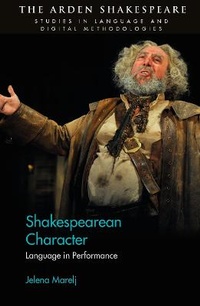
Shakespearean Character
Language in Performance
Published on 24. January 2019
Book
Hardback
264 pages
978-1-350-06138-5 (ISBN)
Description
Why do we continue to experience many of Shakespeare's dramatic characters as real people with personal histories, individual personalities, and psychological depth? What is it that makes Falstaff seem to jump off the page, and what gives Hamlet his complexity? Shakespearean Character: Language in Performance examines how the extraordinary lifelikeness of some of Shakespeare's most enigmatic and self-conscious characters is produced through language.
Using theories drawn from linguistic pragmatics, this book claims that our impression of characters as real people is an effect arising from characters' pragmatic use of language in combination with the historical and textual meanings that Shakespeare conveys to his audience by dramatic and meta-dramatic means. Challenging the notion of interiority attributed to Shakespeare's characters by many contemporary critics, theatre professionals, and audiences, the book demonstrates that dramatic characters possess anteriority which gives us the impression that they exist outside of- and prior to- the play-texts as real people.
Jelena Marelj's study examines five linguistically self-conscious characters drawn from the genres of history, tragedy and comedy, which continue to be subjects of extensive critical debate: Falstaff, Cleopatra, Henry V, Katherine from The Taming of the Shrew, and Hamlet. She shows that by inferring Shakespeare's intentions through his characters' verbal exchanges and the discourses of the play, the audience becomes emotionally involved with or repulsed by characters and it is this emotional response that makes these characters strikingly memorable and intimately human. Shakespearean Character will equip readers for further work on the genealogy of Shakespearean character, including minor characters, stock characters, and allegorical characters.
Using theories drawn from linguistic pragmatics, this book claims that our impression of characters as real people is an effect arising from characters' pragmatic use of language in combination with the historical and textual meanings that Shakespeare conveys to his audience by dramatic and meta-dramatic means. Challenging the notion of interiority attributed to Shakespeare's characters by many contemporary critics, theatre professionals, and audiences, the book demonstrates that dramatic characters possess anteriority which gives us the impression that they exist outside of- and prior to- the play-texts as real people.
Jelena Marelj's study examines five linguistically self-conscious characters drawn from the genres of history, tragedy and comedy, which continue to be subjects of extensive critical debate: Falstaff, Cleopatra, Henry V, Katherine from The Taming of the Shrew, and Hamlet. She shows that by inferring Shakespeare's intentions through his characters' verbal exchanges and the discourses of the play, the audience becomes emotionally involved with or repulsed by characters and it is this emotional response that makes these characters strikingly memorable and intimately human. Shakespearean Character will equip readers for further work on the genealogy of Shakespearean character, including minor characters, stock characters, and allegorical characters.
Reviews / Votes
[S]mart and insightful. * Theatre Journal *More details
Series
Language
English
Place of publication
London
United Kingdom
Publishing group
Bloomsbury Publishing PLC
Target group
College/higher education
Dimensions
Height: 198 mm
Width: 129 mm
Weight
386 gr
ISBN-13
978-1-350-06138-5 (9781350061385)
Copyright in bibliographic data and cover images is held by Nielsen Book Services Limited or by the publishers or by their respective licensors: all rights reserved.
Schweitzer Classification
Other editions
Additional editions
E-Book
01/2019
1st Edition
The Arden Shakespeare
€28.49
Available for download
Persons
Jelena Marelj holds a Ph.D. in English Literature from Queen's University (Kingston, Ontario), with a specialization in early modern literature. She is currently an adjunct professor in the School of Communications and Literary Studies at Sheridan College in Oakville, Ontario, Canada, where she has been teaching since 2014.
Content
Introduction: Re-characterizing Dramatic Shakespearean Character
Chapter 1: Falstaff's Roundness and Gricean Implicature
Chapter 2: 'Rare Egyptian': Reported Speech and Cleopatra's Sexual Charisma
Chapter 3: The Actor-Character's Tricks: Katherine's Performative Power in The Taming of the Shrew
Chapter 4: Revisiting the 'Rabbit-Duck': Pragma-Rhetoric and Henry V's Moral Ambivalence
Coda: Nobody There: Hamlet's Interiority and Pragmatic Failure
Notes
Bibliography
Index
Chapter 1: Falstaff's Roundness and Gricean Implicature
Chapter 2: 'Rare Egyptian': Reported Speech and Cleopatra's Sexual Charisma
Chapter 3: The Actor-Character's Tricks: Katherine's Performative Power in The Taming of the Shrew
Chapter 4: Revisiting the 'Rabbit-Duck': Pragma-Rhetoric and Henry V's Moral Ambivalence
Coda: Nobody There: Hamlet's Interiority and Pragmatic Failure
Notes
Bibliography
Index