

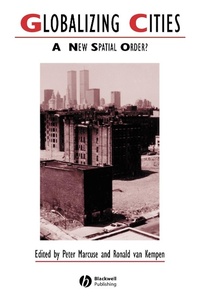
Globalizing Cities
A New Spatial Order?
1st Edition
Published on 17. December 1999
Book
Paperback/Softback
340 pages
978-0-631-21290-4 (ISBN)
Description
This exciting collection of original essays provides students and professionals with an international and comparative examination of changes in global cities, revealing a growing pattern of social and spatial division or polarization.
Reviews / Votes
"This book is a welcome addition to the rapidly growing literature on global cities ... The individual contributors remain closely on-message and the editors are to be commended for providing a very clear statement of the central argument and for distilling the arguments into a comprehensive and convincing conclusion...The specialised nature of the topic, and the fact that this volume will be of most interest to research and final-year students of urban studies rather than to first-or second-year undergraduates. Among such an audience, it merits a wide readership." David Clark, Coventry University"This is a highly valuable book, combining theoretical arguments with detailed empirical work. This book broadens the scholarly discussion of global cities and offers important insights into the interpretation of local and global processes in a wide range of settings." H-Urban by Mark D. Bjelland, Department of Geography, Gustavus Adolphus College, Minnesota.
"Globalizing cities, a new spatial order? is a welcome addition to a growing scholarly literature on the processes of globalization ... this volume is a substantial contribution to what is perhaps one of the most important issues confronting the future of cities." Progress in Development Studies
"These excellent essays focus primarily on recent changes in the spatial organization of selected large metropolitan areas ... By concentrating on the details, the authors have liberated us from the glosses of the global cities literature and prepared us to revise our generalizations. The debate they have opened will engage us for at least the next decade." European Planning Studies
More details
Series
Language
English
Place of publication
Hoboken
United Kingdom
Publishing group
John Wiley and Sons Ltd
Target group
College/higher education
Professional and scholarly
Product notice
Paperback (trade)
Unsewn / adhesive bound
Dimensions
Height: 229 mm
Width: 152 mm
Thickness: 18 mm
Weight
494 gr
ISBN-13
978-0-631-21290-4 (9780631212904)
Copyright in bibliographic data and cover images is held by Nielsen Book Services Limited or by the publishers or by their respective licensors: all rights reserved.
Schweitzer Classification
Other editions
Additional editions
E-Book
07/2011
Wiley-Blackwell
€24.99
Available for download
E-Book
09/2008
Wiley-Blackwell
€24.99
Available for download
Book
01/2000
Blackwell Publishers
€102.89
Article exhausted; check different version
Persons
Peter Marcuse is Professor of Urban Planning at Columbia University in New York City. He has also taught at the University of California at Los Angeles, as well as universities in Johannesburg, Weimar, and Sao Paulo. He has been President of the Los Angeles City Planning Commission, and a member of a Community Board in New York City. A lawyer as well as planner, he has written widely on comparative housing and planning issues. Ronald van Kempen is Associate Professor of urban geography at the Urban Research Centre Utrecht at Utrecht University. His current research focuses on the links between spatial segregation, social exclusion and the development of cities. He has published widely on these subjects. He is a member of the editorial board of the Journal of Housing and the Built Environment.
Content
List of Figures vii
List of Maps viii
List of Tables x
List of Contributors xii
Series Editors' Preface xv
Preface xvii
1 Introduction 1
Peter Marcuse and Ronald van Kempen
2 The Unavoidable Continuities of the City 22
Robert A. Beauregard and Anne Haila
3 From the Metropolis to Globalization: The Dialectics of Race and Urban Form 37
William W. Goldsmith
4 From Colonial City to Globalizing City? The Far-fromcomplete Spatial Transformation of Calcutta 56
Sanjoy Chakravorty
5 Rio de Janeiro: Emerging Dualization in a Historically Unequal City 78
Luiz Cesar de Queiroz Ribeiro and Edward E. Telles
6 Singapore: the Changing Residential Landscape in a Winner City 95
Leo van Grunsven
7 Tokyo: Patterns of Familiarity and Partitions of Difference 127
Paul Waley
8 Still a Global City: The Racial and Ethnic Segmentation of New York 158
John R. Logan
9 Brussels: Post-Fordist Polarization in a Fordist Spatial Canvas 186
Christian Kesteloot
10 The Imprint of the Post-Fordist Transition on Australian Cities 211
Blair Badcock
11 The Globalization of Frankfurt am Main: Core, Periphery and Social Conflict 228
Roger Keil and Klaus Ronneberger
12 Conclusion: A Changed Spatial Order 249
Peter Marcuse and Ronald van Kempen
List of References 276
Index 302
List of Maps viii
List of Tables x
List of Contributors xii
Series Editors' Preface xv
Preface xvii
1 Introduction 1
Peter Marcuse and Ronald van Kempen
2 The Unavoidable Continuities of the City 22
Robert A. Beauregard and Anne Haila
3 From the Metropolis to Globalization: The Dialectics of Race and Urban Form 37
William W. Goldsmith
4 From Colonial City to Globalizing City? The Far-fromcomplete Spatial Transformation of Calcutta 56
Sanjoy Chakravorty
5 Rio de Janeiro: Emerging Dualization in a Historically Unequal City 78
Luiz Cesar de Queiroz Ribeiro and Edward E. Telles
6 Singapore: the Changing Residential Landscape in a Winner City 95
Leo van Grunsven
7 Tokyo: Patterns of Familiarity and Partitions of Difference 127
Paul Waley
8 Still a Global City: The Racial and Ethnic Segmentation of New York 158
John R. Logan
9 Brussels: Post-Fordist Polarization in a Fordist Spatial Canvas 186
Christian Kesteloot
10 The Imprint of the Post-Fordist Transition on Australian Cities 211
Blair Badcock
11 The Globalization of Frankfurt am Main: Core, Periphery and Social Conflict 228
Roger Keil and Klaus Ronneberger
12 Conclusion: A Changed Spatial Order 249
Peter Marcuse and Ronald van Kempen
List of References 276
Index 302