

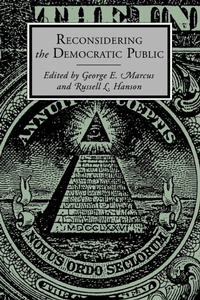
Reconsidering the Democratic Public
Will be published approx. on 15. September 1993
Book
Paperback/Softback
496 pages
978-0-271-00927-8 (ISBN)
Description
This book offers a re-examination of the evidence about citizens' capacity for self-governance and what it means for the future of democratic politics, from both empirical and normative perspectives.
Are ordinary citizens capable of governing themselves? For more than three decades, social scientists have accumulated evidence of the undemocratic propensities of many ordinary citizens. This has caused some to worry about the stability of existing democratic institutions, while others argue that the institutions themselves are the problem: politics needs to be democratized further, giving citizens more opportunities to practice democratic politics and acquire democratic values.
The thirty-three contributors to this volume enter this debate with new evidence on citizens' capacity for deliberative politics. They argue that previous methods of investigation significantly underestimate people's ability to govern themselves, and that the prospects for democracy are better than conventional wisdom suggests. Realization of these prospects will depend on citizens grasping the interplay of emotions and reason in political life, creating new opportunities for citizen deliberation, and reinvigorating the institutions of representative government. Theories of democracy in turn will have to accommodate this changing reality as citizens show themselves to be self-determining in their political activities.
Are ordinary citizens capable of governing themselves? For more than three decades, social scientists have accumulated evidence of the undemocratic propensities of many ordinary citizens. This has caused some to worry about the stability of existing democratic institutions, while others argue that the institutions themselves are the problem: politics needs to be democratized further, giving citizens more opportunities to practice democratic politics and acquire democratic values.
The thirty-three contributors to this volume enter this debate with new evidence on citizens' capacity for deliberative politics. They argue that previous methods of investigation significantly underestimate people's ability to govern themselves, and that the prospects for democracy are better than conventional wisdom suggests. Realization of these prospects will depend on citizens grasping the interplay of emotions and reason in political life, creating new opportunities for citizen deliberation, and reinvigorating the institutions of representative government. Theories of democracy in turn will have to accommodate this changing reality as citizens show themselves to be self-determining in their political activities.
Reviews / Votes
"Political science has the bad habit of trying to keep normative theory and empirical research in separate compartments. This book shows that interesting and important things can happen when you bring democratic theory and the study of democratic politics together. Experiments like this could help revitalize the discipline. And the heartening substantive news is that democracy may be a more viable form of government, that the people may be more likely to govern themselves wisely and well, than political science has sometimes suggested."-Charles W. Anderson, University of Wisconsin
More details
Language
English
Place of publication
Pennsylvania
United States
Target group
College/higher education
Professional and scholarly
Product notice
Paperback (trade)
Illustrations
3 Charts
Dimensions
Height: 229 mm
Width: 152 mm
Thickness: 29 mm
Weight
801 gr
ISBN-13
978-0-271-00927-8 (9780271009278)
Copyright in bibliographic data and cover images is held by Nielsen Book Services Limited or by the publishers or by their respective licensors: all rights reserved.
Schweitzer Classification
Persons
George E. Marcus is Professor of Political Science at Williams College and co-author of Political Tolerance and American Democracy (1982).
Russell L. Hanson is Associate Professor of Political Science at Indiana University and author of The Democratic Imagination in America (1985).
Russell L. Hanson is Associate Professor of Political Science at Indiana University and author of The Democratic Imagination in America (1985).