

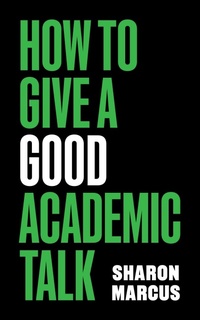
How to Give a Good Academic Talk
Will be published approx. on 1. December 2026
Book
Hardback
168 pages
978-0-691-24930-8 (ISBN)
Description
An essential guide to giving effective and engaging talks for academics at all career stages, across the humanities, sciences, and social sciences
This book is for anyone in academia who will ever have to give a talk-which is just about everyone in academia. Presenting research is one of the most important tasks academics undertake, but few receive formal training in effective public speaking. In How to Give a Good Academic Talk, Sharon Marcus fills this gap, offering a practical, research-informed guide to an activity that can challenge even seasoned scholars. Marcus, who has given many academic talks in her career-and listened to even more-blends insights from learning and cognitive science, communications, rhetoric, and performance theory with her own seasoned judgment and firsthand observation to provide a pragmatic repertoire of dos and don'ts.
Each chapter addresses a central component of successful presentations, illustrated with examples drawn from a wide variety of academic talks, many available online. Marcus's cross-disciplinary perspective allows her to identify elements that all good academic talks have in common, while remaining attentive to field-specific norms. She defines what an academic talk is and isn't, and identifies its most important and challenging task: engaging the audience. How to Give a Good Academic Talk covers the beginnings and endings of talks, Q&A sessions, the design and use of slides, delivery, rehearsals, video conferencing platforms-and even offers wardrobe advice. Marcus's essential guide equips academics to communicate their ideas with confidence, precision, and intellectual generosity.
This book is for anyone in academia who will ever have to give a talk-which is just about everyone in academia. Presenting research is one of the most important tasks academics undertake, but few receive formal training in effective public speaking. In How to Give a Good Academic Talk, Sharon Marcus fills this gap, offering a practical, research-informed guide to an activity that can challenge even seasoned scholars. Marcus, who has given many academic talks in her career-and listened to even more-blends insights from learning and cognitive science, communications, rhetoric, and performance theory with her own seasoned judgment and firsthand observation to provide a pragmatic repertoire of dos and don'ts.
Each chapter addresses a central component of successful presentations, illustrated with examples drawn from a wide variety of academic talks, many available online. Marcus's cross-disciplinary perspective allows her to identify elements that all good academic talks have in common, while remaining attentive to field-specific norms. She defines what an academic talk is and isn't, and identifies its most important and challenging task: engaging the audience. How to Give a Good Academic Talk covers the beginnings and endings of talks, Q&A sessions, the design and use of slides, delivery, rehearsals, video conferencing platforms-and even offers wardrobe advice. Marcus's essential guide equips academics to communicate their ideas with confidence, precision, and intellectual generosity.
More details
Series
Language
English
Place of publication
New Jersey
United States
Target group
College/higher education
Professional and scholarly
Product notice
Trade binding
Illustrations
8 b/w illus.
Dimensions
Height: 203 mm
Width: 127 mm
ISBN-13
978-0-691-24930-8 (9780691249308)
Copyright in bibliographic data and cover images is held by Nielsen Book Services Limited or by the publishers or by their respective licensors: all rights reserved.
Schweitzer Classification
Person
Sharon Marcus is the Orlando Harriman Professor of English and Comparative Literature at Columbia University. She is the author of Apartment Stories, Between Women (Princeton), and The Drama of Celebrity (Princeton) and is a founding editor of Public Books. Her writing has appeared in The New York Times Book Review, The Wall Street Journal, The London Review of Books, and other publications.