

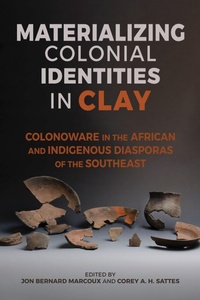
Materializing Colonial Identities in Clay
Colonoware in the African and Indigenous Diasporas of the Southeast
Published on 31. May 2024
Book
Paperback/Softback
296 pages
978-0-8173-6146-4 (ISBN)
Description
In Materializing Colonial Identities in Clay, Jon Bernard Marcoux, Corey A. H. Sattes, and contributors examine colonoware to explore the active roles that African Americans and Indigenous people played in constructing southern colonial culture and part of their shared history with Europeans.
Colonoware was most likely produced by African and Indigenous potters and used by all colonial groups for cooking, serving, and storing food. It formed the foundation of colonial foodways in many settlements across the southeastern United States. Even so, compared with other ceramics from this period, less has been understood about its production and use because of the lack of documentation. This collection of essays fills this gap with valuable, recent archaeological data from which much may be surmised about the interaction among Europeans, Indigenous, and Africans, especially within the contexts of the African and Indigenous slave trade and plantation systems.
The chapters represent the full range of colonoware research: from the beginning to the end of its production, from urban to rural contexts, and from its intraregional variation in the Lowcountry to the broad patterns of colonialism across the early American Southeast. The book summarizes current approaches in colonoware research and how these may bridge the gaps between broader colonial American studies, Indigenous studies, and African Diaspora studies.
A concluding discussion contextualizes the chapters through the perspectives of intersectionality and Black feminist theory, drawing attention to the gendered and racialized meanings embodied in colonoware, and considering how colonialism and slavery have shaped these cultural dimensions and archaeologists' study of them.
Colonoware was most likely produced by African and Indigenous potters and used by all colonial groups for cooking, serving, and storing food. It formed the foundation of colonial foodways in many settlements across the southeastern United States. Even so, compared with other ceramics from this period, less has been understood about its production and use because of the lack of documentation. This collection of essays fills this gap with valuable, recent archaeological data from which much may be surmised about the interaction among Europeans, Indigenous, and Africans, especially within the contexts of the African and Indigenous slave trade and plantation systems.
The chapters represent the full range of colonoware research: from the beginning to the end of its production, from urban to rural contexts, and from its intraregional variation in the Lowcountry to the broad patterns of colonialism across the early American Southeast. The book summarizes current approaches in colonoware research and how these may bridge the gaps between broader colonial American studies, Indigenous studies, and African Diaspora studies.
A concluding discussion contextualizes the chapters through the perspectives of intersectionality and Black feminist theory, drawing attention to the gendered and racialized meanings embodied in colonoware, and considering how colonialism and slavery have shaped these cultural dimensions and archaeologists' study of them.
Reviews / Votes
"Materializing Colonial Identities in Clay speaks to the diverse historical contexts and material forms of colonoware and highlights the ways in which colonoware was used by all peoples of the Southeast in ongoing cultural negotiations. The multisited approach taken by many authors is absolutely essential in moving forward our understanding of colonoware, colonialism, and its legacies."-Barbara Heath, author of Hidden Lives: The Archaeology of Slave Life at Thomas Jefferson's Poplar Forest"Much more than a book about pottery, this volume employs colonoware as a tool for exploring the complex cultural negotiations taking place in the historic Southeast. This volume deftly weaves together the many threads of colonoware research to date, offering new models for material culture analyses in such contexts. An insightful work of this kind has been long overdue."-Lindsay Bloch is editor of Southeastern Archaeology and Principal for Tempered Archaeological Services, LLC.
More details
Series
Language
English
Place of publication
Alabama
United States
Target group
Professional and scholarly
Illustrations
33 b&w figures - 9 maps
Dimensions
Height: 152 mm
Width: 228 mm
Thickness: 27 mm
Weight
462 gr
ISBN-13
978-0-8173-6146-4 (9780817361464)
Copyright in bibliographic data and cover images is held by Nielsen Book Services Limited or by the publishers or by their respective licensors: all rights reserved.
Schweitzer Classification
Other editions
Additional editions

Unknown | Jon Bernard Marcoux | Corey A. H. Sattes
Materializing Colonial Identities in Clay
Colonoware in the African and Indigenous Diasporas of the Southeast
E-Book
04/2024
1st Edition
University of Alabama Press
€101.99
Available for download
Persons
Jon Bernard Marcoux is associate professor, chair of the archaeology curriculum, and director of the Research Laboratories of Archaeology at the University of North Carolina at Chapel Hill. He is author of Pox, Empire, Shackles, and Hides: The Townsend Site, 1670-1715.
Corey Sattes is the Curator of Archaeological Collections at Monticello, Thomas Jefferson Foundation.
Corey Sattes is the Curator of Archaeological Collections at Monticello, Thomas Jefferson Foundation.