

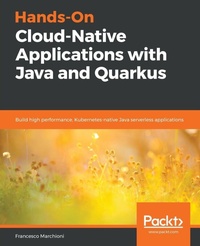
Hands-On Cloud-Native Applications with Java and Quarkus
Build high performance, Kubernetes-native Java serverless applications
Published on 13. December 2019
Book
Paperback/Softback
314 pages
978-1-83882-147-0 (ISBN)
Description
Build robust and reliable Java applications that works on modern infrastructure, such as containers and cloud, using the new features in Quarkus 1.0
Key Features
Build apps with faster boot time and low RSS memory using the latest Quarkus 1.0 features
Seamlessly integrate imperative and reactive programming models to build modern Java applications
Discover effective solutions for running Java on serverless apps, microservices, containers, FaaS, and the cloud
Book DescriptionQuarkus is a new Kubernetes-native framework that allows Java developers to combine the power of containers, microservices, and cloud-native to build reliable applications. The book is a development guide that will teach you how to build Java-native applications using Quarkus and GraalVM.
We start by learning about the basic concepts of a cloud-native application and its advantages over standard enterprise applications. Then we will quickly move on to application development, by installing the tooling required to build our first application on Quarkus. Next, we'll learn how to create a container-native image of our application and execute it in a Platform-as-a-Service environment such as Minishift. Later, we will build a complete real-world application that will use REST and the Contexts and Dependency injection stack with a web frontend. We will also learn how to add database persistence to our application using PostgreSQL. We will learn how to work with various APIs available to Quarkus such as Camel, Eclipse MicroProfile, and Spring DI. Towards the end, we will learn advanced development techniques such as securing applications, application configuration, and working with non-blocking programming models using Vert.x.
By the end of this book, you will be proficient with all the components of Quarkus and develop-blazing fast applications leveraging modern technology infrastructure.
What you will learn
Build a native application using Quarkus and GraalVM
Secure your applications using Elytron and the MicroProfile JWT extension
Manage data persistence with Quarkus using PostgreSQL
Use a non-blocking programming model with Quarkus
Learn how to get Camel and Infinispan working in native mode
Deploy an application in a Kubernetes-native environment using Minishift
Discover Reactive Programming with Vert.x
Who this book is forThe book is for Java developers and software architects who are interested in learning a promising microservice architecture for building reliable and robust applications. Knowledge of Java, Spring Framework, and REST APIs is assumed.
Key Features
Build apps with faster boot time and low RSS memory using the latest Quarkus 1.0 features
Seamlessly integrate imperative and reactive programming models to build modern Java applications
Discover effective solutions for running Java on serverless apps, microservices, containers, FaaS, and the cloud
Book DescriptionQuarkus is a new Kubernetes-native framework that allows Java developers to combine the power of containers, microservices, and cloud-native to build reliable applications. The book is a development guide that will teach you how to build Java-native applications using Quarkus and GraalVM.
We start by learning about the basic concepts of a cloud-native application and its advantages over standard enterprise applications. Then we will quickly move on to application development, by installing the tooling required to build our first application on Quarkus. Next, we'll learn how to create a container-native image of our application and execute it in a Platform-as-a-Service environment such as Minishift. Later, we will build a complete real-world application that will use REST and the Contexts and Dependency injection stack with a web frontend. We will also learn how to add database persistence to our application using PostgreSQL. We will learn how to work with various APIs available to Quarkus such as Camel, Eclipse MicroProfile, and Spring DI. Towards the end, we will learn advanced development techniques such as securing applications, application configuration, and working with non-blocking programming models using Vert.x.
By the end of this book, you will be proficient with all the components of Quarkus and develop-blazing fast applications leveraging modern technology infrastructure.
What you will learn
Build a native application using Quarkus and GraalVM
Secure your applications using Elytron and the MicroProfile JWT extension
Manage data persistence with Quarkus using PostgreSQL
Use a non-blocking programming model with Quarkus
Learn how to get Camel and Infinispan working in native mode
Deploy an application in a Kubernetes-native environment using Minishift
Discover Reactive Programming with Vert.x
Who this book is forThe book is for Java developers and software architects who are interested in learning a promising microservice architecture for building reliable and robust applications. Knowledge of Java, Spring Framework, and REST APIs is assumed.
More details
Language
English
Place of publication
Birmingham
United Kingdom
Dimensions
Height: 235 mm
Width: 191 mm
Thickness: 18 mm
Weight
590 gr
ISBN-13
978-1-83882-147-0 (9781838821470)
Copyright in bibliographic data and cover images is held by Nielsen Book Services Limited or by the publishers or by their respective licensors: all rights reserved.
Schweitzer Classification
Other editions
Additional editions
Francesco Marchioni
Hands-On Cloud-Native Applications with Java and Quarkus
Build high performance, Kubernetes-native Java serverless applications
E-Book
06/2024
1st Edition
Packt Publishing Limited
€23.49
Available for download
Persons
Francesco Marchioni is a Red Hat Certified JBoss Administrator (RHCJA) and Sun Certified Enterprise Architect (SCEA) working at Red Hat in Rome, Italy. He started learning Java in 1997, and since then he has followed all the newest application program interfaces released by Sun. In 2000, he joined the JBoss community, when the application server was running the 2.X release. He has spent years as a software consultant, where he has enabled many successful software migrations from vendor platforms to open source products, such as JBoss AS, fulfilling the tight budget requirements necessitated by the current economy. Over the last 10 years, he has authored many technical articles for O'Reilly Media and has run an IT portal focused on JBoss products.
Content
Table of Contents
Introduction to Quarkus Core Concepts
Developing Your First Application with Quarkus
Creating a Container Image of Your Application
Adding Web Interfaces to Quarkus Services
Managing Data Persistence with Quarkus
Building Applications Using the MicroProfile API
Securing Applications
Advanced Application Development
Unifying Imperative and Reactive with Vert.x
Reactive Messaging with Quarkus
Introduction to Quarkus Core Concepts
Developing Your First Application with Quarkus
Creating a Container Image of Your Application
Adding Web Interfaces to Quarkus Services
Managing Data Persistence with Quarkus
Building Applications Using the MicroProfile API
Securing Applications
Advanced Application Development
Unifying Imperative and Reactive with Vert.x
Reactive Messaging with Quarkus