

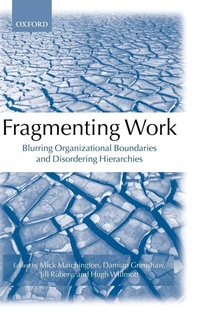
Fragmenting Work
Blurring Organizational Boundaries and Disordering Hierarchies
Published on 16. September 2004
Book
Hardback
336 pages
978-0-19-926223-6 (ISBN)
Description
This major new book examines the way in which employment is managed across organizational boundaries. It analyses how public-private partnerships, franchises, agencies and other forms of inter-firm contractual relations impact on work and employment and the experiences of those working in these increasingly significant forms of organization. it draws upon research undertaken in eight separate networks comprising over 50 organizations to explore the fragmentating effects of contemporary changes in the organization of work and employment relationships. It considers the consequences of increased eliance upon inter-organizational mechanisms for producing goods and especially for delivering services. It argues that established analyses continue to rely too heavily upon a mocel of the single employing organization whereas today the situation is often more complex and confused. Public-private 'partnerships' are one high profile example of this phenomenon but private enterprises are
also developing new relations with their clients and customers that impinge upon the nature of the employment relationship. Established hierarchical forms are becoming disordered, with consequences for career patterns, training and skills, pay structures, disciplinary practice, worker voice, and the gendered division of labor. The findings of the study raise questions about the governance of such complex organizational forms, the appropriateness of current institutions for addressing this complexity, and the challenge of harnessing of employee commitment in circumstances where human resource practices are shaped by organizations other than the legal employer. Using an analytical schema of three dimensions (institutional, organizational, employment) and four themes (power, risk, identity, trust), the authors adopt an inter-disciplinary perspective to address these complex and critically important practical, policy and theoretical concerns. Fragmenting Work will be vital reading for all
those wishing to understand the contemporary realities of work and employment.
also developing new relations with their clients and customers that impinge upon the nature of the employment relationship. Established hierarchical forms are becoming disordered, with consequences for career patterns, training and skills, pay structures, disciplinary practice, worker voice, and the gendered division of labor. The findings of the study raise questions about the governance of such complex organizational forms, the appropriateness of current institutions for addressing this complexity, and the challenge of harnessing of employee commitment in circumstances where human resource practices are shaped by organizations other than the legal employer. Using an analytical schema of three dimensions (institutional, organizational, employment) and four themes (power, risk, identity, trust), the authors adopt an inter-disciplinary perspective to address these complex and critically important practical, policy and theoretical concerns. Fragmenting Work will be vital reading for all
those wishing to understand the contemporary realities of work and employment.
More details
Language
English
Place of publication
Oxford
United Kingdom
Target group
Professional and scholarly
Illustrations
Boxes, Tables, and Figures
Dimensions
Height: 240 mm
Width: 161 mm
Thickness: 23 mm
Weight
669 gr
ISBN-13
978-0-19-926223-6 (9780199262236)
Copyright in bibliographic data and cover images is held by Nielsen Book Services Limited or by the publishers or by their respective licensors: all rights reserved.
Schweitzer Classification
Other editions
Additional editions
Mick Marchington | Damian Grimshaw | Jill Rubery
Fragmenting Work
Blurring Organizational Boundaries and Disordering Hierarchies
Book
09/2004
Oxford University Press
€63.14
Shipment within 15-20 days
Persons
Mick Marchington is Professor of Human Resource Management at the Manchester School of Management, University of Manchester.
Damian Grimshaw is a Senior Lecturer in Employment Studies at the Manchester School of Management, University of Manchester, and co-author of Managing Employment: The New Realities of Work (OUP 2002).
Jill Rubery is Professor of Comparative Employment Systems at the Manchester School of Management, University of Manchester, and co-author of Managing Employment: The New Realities of Work (OUP 2002) and Employer Strategy and the Labour Market (OUP 1994).
Hugh Willmott is Diageo Porfessor of Management Studies at the Judge Institute of Management Studies, University of Cambridge.
Damian Grimshaw is a Senior Lecturer in Employment Studies at the Manchester School of Management, University of Manchester, and co-author of Managing Employment: The New Realities of Work (OUP 2002).
Jill Rubery is Professor of Comparative Employment Systems at the Manchester School of Management, University of Manchester, and co-author of Managing Employment: The New Realities of Work (OUP 2002) and Employer Strategy and the Labour Market (OUP 1994).
Hugh Willmott is Diageo Porfessor of Management Studies at the Judge Institute of Management Studies, University of Cambridge.
Editor
Professor of Human Resource Management, the Manchester School of Management, UMIST
Senior Lecturer in Management, the Manchester School of Management, UMIST
Professor of Comparative Employment Systems, the Manchester School of Management, UMIST
Diageo Professor of Management Studies, the Judge Institute of Management Studies, University of Cambridge
Content
1. Introduction: Fragmenting Work Across Organizational Boundaries ; 2. Inter-Organizational Networks: Trust, Power, and the Employment Relationship ; 3. Blurring the Boundaries to the Employment Relationship: From Single to Multi-Employer Relationships ; 4. The Strategic Management of Contracting in the Private Sector ; 5. Public-Private Contracting: Performance, Power, and Change at Work ; 6. The Role of Boundary-Spanning Agents in Inter-Organizational Contracting ; 7. Employment Policy and Practice: Crossing Borders and Disordering Hierarchies ; 8. Commitment and Identity Across Organizational Boundaries ; 9. Changing Boundaries, Shaping Skills: The Fragmented Organizational Form and Employee Skills ; 10. Gender and New Organizational Forms ; 11. Prospects for Worker Voice Across Organizational Boundaries ; 12. Conclusion: Redrawing Boundaries: Reflections on Practice and Policy