

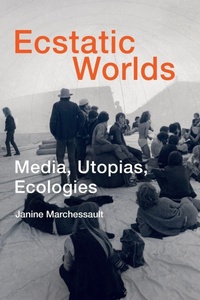
Ecstatic Worlds
Media, Utopias, Ecologies
Published on 31. October 2023
Book
Paperback/Softback
368 pages
978-0-262-54974-5 (ISBN)
Description
When media translate the world to the world: twentieth-century utopian projects including Edward Steichen's “Family of Man,” Jacques Cousteau's underwater films, and Buckminster Fuller's geoscope.
Postwar artists and architects have used photography, film, and other media to imagine and record the world as a wonder of collaborative entanglement—to translate the world for the world. In this book, Janine Marchessault examines a series of utopian media events that opened up and expanded the cosmos, creating ecstatic collective experiences for spectators and participants. Marchessault shows that Edward Steichen’s 1955 “Family of Man” photography exhibition, for example, and Jacques Cousteau’s 1956 underwater film Le monde du silence (The Silent World) both gave viewers a sense of the earth as a shared ecology. The Festival of Britain (1951)—in particular its Telekinema (a combination of 3D film and television) and its Live Architecture exhibition—along with Expo 67’s cinema experiments and media city created an awareness of multiple worlds. Toronto’s alternative microcinema CineCycle, Agnès Varda’s 2000 film Les glaneurs et la glaneuse, and Buckminster Fuller’s World Game (geoscope), representing ecologies of images and resources, encouraged planetary thinking. The transspecies communication platform the Dolphin Embassy, devised by the Ant Farm architecture collaborative, extends this planetary perspective toward other species; and Finnish artist Erkki Kurenniemi’s “Death of the Planet” projects a postanthropocentric future. Drawing on sources that range from the Scottish town planner Patrick Geddes to the French phenomenologist Maurice Merleau-Ponty, Marchessault argues that each of these media experiments represents an engagement with connectivity and collectivity through media that will help us imagine a new form of global humanism.
Postwar artists and architects have used photography, film, and other media to imagine and record the world as a wonder of collaborative entanglement—to translate the world for the world. In this book, Janine Marchessault examines a series of utopian media events that opened up and expanded the cosmos, creating ecstatic collective experiences for spectators and participants. Marchessault shows that Edward Steichen’s 1955 “Family of Man” photography exhibition, for example, and Jacques Cousteau’s 1956 underwater film Le monde du silence (The Silent World) both gave viewers a sense of the earth as a shared ecology. The Festival of Britain (1951)—in particular its Telekinema (a combination of 3D film and television) and its Live Architecture exhibition—along with Expo 67’s cinema experiments and media city created an awareness of multiple worlds. Toronto’s alternative microcinema CineCycle, Agnès Varda’s 2000 film Les glaneurs et la glaneuse, and Buckminster Fuller’s World Game (geoscope), representing ecologies of images and resources, encouraged planetary thinking. The transspecies communication platform the Dolphin Embassy, devised by the Ant Farm architecture collaborative, extends this planetary perspective toward other species; and Finnish artist Erkki Kurenniemi’s “Death of the Planet” projects a postanthropocentric future. Drawing on sources that range from the Scottish town planner Patrick Geddes to the French phenomenologist Maurice Merleau-Ponty, Marchessault argues that each of these media experiments represents an engagement with connectivity and collectivity through media that will help us imagine a new form of global humanism.
More details
Series
Language
English
Place of publication
Cambridge (Massachusetts)
United States
Publishing group
MIT Press Ltd
Target group
Professional and scholarly
Interest Age: From 18 years
Product notice
Paperback (trade)
Illustrations
51 B&W ILLUS.
Dimensions
Height: 229 mm
Width: 152 mm
Thickness: 22 mm
Weight
594 gr
ISBN-13
978-0-262-54974-5 (9780262549745)
Copyright in bibliographic data and cover images is held by Nielsen Book Services Limited or by the publishers or by their respective licensors: all rights reserved.
Schweitzer Classification
Other editions
Additional editions
E-Book
08/2017
MIT Press
€38.99
Available for download
Person
Janine Marchessault is Professor of Cinema and Media Studies in the Department of Cinema and Media Arts at York University in Toronto.
Content
Series Foreword vii
Acknowledgments ix
Introduction 1
Part I: Earth 19
1 Anonymous Reality and Redemption in “The Family of Man” 21
2 Invisible Ecologies: Cousteau’s Cameras and Ocean Wonders 53
Part II: Worlds 85
3 T Is for Telekinema: Projecting Future Worlds at the Festival of Britain 87
4 Terre des Hommes / Man and His World: Expo 67 as Global Media Experiment 127
Part III: Planet 159
5 Inflatable Media: Film Festivals, Microcinemas, and Ephemeral Media 165
6 Dolphins in Space, Planetary Thinking 205
Epilogue: An Ecological Approach to Media Studies 249
Notes 267
Bibliography 317
Index 341
Acknowledgments ix
Introduction 1
Part I: Earth 19
1 Anonymous Reality and Redemption in “The Family of Man” 21
2 Invisible Ecologies: Cousteau’s Cameras and Ocean Wonders 53
Part II: Worlds 85
3 T Is for Telekinema: Projecting Future Worlds at the Festival of Britain 87
4 Terre des Hommes / Man and His World: Expo 67 as Global Media Experiment 127
Part III: Planet 159
5 Inflatable Media: Film Festivals, Microcinemas, and Ephemeral Media 165
6 Dolphins in Space, Planetary Thinking 205
Epilogue: An Ecological Approach to Media Studies 249
Notes 267
Bibliography 317
Index 341