

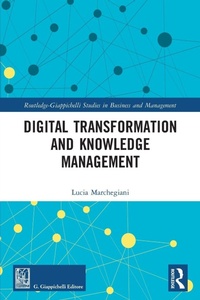
Digital Transformation and Knowledge Management
1st Edition
Published on 26. September 2022
Book
Paperback/Softback
220 pages
978-0-367-71223-5 (ISBN)
Description
Knowledge capital is at the core of the socio-economic global system. Profit and not-for profit firms, institutions, and organizations, in general, face unique opportunities and threats related to knowledge management. Digital technologies and digital transformation offer a wide array of opportunities for value creation. At the same time, organizations need to foster newer, faster, and more dynamic ways of mobilizing and managing knowledge. Emerging trends, such as artificial intelligence, collective intelligence, agile methodologies, open innovation, and co-creation enable new business models and managerial paradigms that need to be understood and conceptualized.
This book offers an extensive overview of the most recent trends in knowledge management and the most advanced theoretical approaches, while, at the same time, providing a wide array of case studies and evidence-based knowledge management practices. It takes into account the interrelation between ICT and knowledge management challenges, in terms of human/non-human interactions, which requires extraordinary organizational change and renewal. Further, the book presents an up-to-date examination of and guidance for the implementation of knowledge management in an era of unprecedented human/non-human interaction.
The book conveys the results of more than a decade of research and applied experience in the field of knowledge management carried out by the author.
It is intended not only for students and academics but also for managers and practitioners who are interested in deepening their understanding of knowledge and learning.
This book offers an extensive overview of the most recent trends in knowledge management and the most advanced theoretical approaches, while, at the same time, providing a wide array of case studies and evidence-based knowledge management practices. It takes into account the interrelation between ICT and knowledge management challenges, in terms of human/non-human interactions, which requires extraordinary organizational change and renewal. Further, the book presents an up-to-date examination of and guidance for the implementation of knowledge management in an era of unprecedented human/non-human interaction.
The book conveys the results of more than a decade of research and applied experience in the field of knowledge management carried out by the author.
It is intended not only for students and academics but also for managers and practitioners who are interested in deepening their understanding of knowledge and learning.
More details
Series
Language
English
Place of publication
London
United Kingdom
Publishing group
Taylor & Francis Ltd
Target group
College/higher education
Postgraduate and Undergraduate
Illustrations
34 s/w Zeichnungen, 6 s/w Tabellen, 35 s/w Abbildungen, 1 s/w Photographie bzw. Rasterbild
6 Tables, black and white; 34 Line drawings, black and white; 1 Halftones, black and white; 35 Illustrations, black and white
Dimensions
Height: 234 mm
Width: 156 mm
Thickness: 12 mm
Weight
342 gr
ISBN-13
978-0-367-71223-5 (9780367712235)
Copyright in bibliographic data and cover images is held by Nielsen Book Services Limited or by the publishers or by their respective licensors: all rights reserved.
Schweitzer Classification
Other editions
Additional editions
Lucia Marchegiani
Digital Transformation and Knowledge Management
Book
03/2021
1st Edition
Routledge
€206.20
Shipment within 15-20 days
Lucia Marchegiani
Digital Transformation and Knowledge Management
E-Book
03/2021
1st Edition
Routledge
€59.49
Available for download
Lucia Marchegiani
Digital Transformation and Knowledge Management
E-Book
03/2021
1st Edition
Routledge
€59.49
Available for download
Person
Lucia Marchegiani is Associate Professor of Organization and Human Resources Management at Roma Tre University, Italy.
Content
Introduction 1. Origins and evolutions of KM 2. Why is knowledge the strategic asset? 3. Knowledge and (digital) learning organizations 4. Km and digital transformation in contexts Conclusions References