

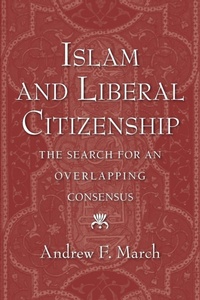
Islam and Liberal Citizenship
The Search for an Overlapping Consensus
Published on 7. July 2011
Book
Paperback/Softback
360 pages
978-0-19-983858-5 (ISBN)
Description
How can Muslims be both good citizens of liberal democracies and good Muslims? This is among the most pressing questions of our time, particularly in contemporary Europe. Some argue that Muslims have no tradition of separation of church and state and therefore can't participate in secular, pluralist society. At the other extreme, some Muslims argue that it is the duty of all believers to resist Western forms of government and to impose Islamic law. Andrew F. March is seeking to find a middle way between these poles. Is there, he asks, a tradition that is both consistent with orthodox Sunni Islam that is also compatible with modern liberal democracy? He begins with Rawls's theory that liberal societies rely for stability on an ''overlapping consensus'' between a public conception of justice and popular religious doctrines and asks what kinds of demands liberal societies place on citizens, and particularly on Muslims. March then offers a thorough examination of Islamic sources and current trends in Islamic thought to see whether there can indeed be a consensus. March finds that the answer is an emphatic ''yes.'' He demonstrates that there are very strong and authentically Islamic arguments for accepting the demands of citizenship in a liberal democracy, many of them found even in medieval works of Islamic jurisprudence. In fact, he shows, it is precisely the fact that Rawlsian political liberalism makes no claims to metaphysical truth that makes it appealing to Muslims.
Reviews / Votes
March puts forward a historically expansive scholarly tour de force on the question of the compatibility of Islamic law with the demands of liberal citizenship in the context in which Muslims are living as a minority in a non-Muslim state...the book is an absolutely indispensible addition. * Journal of Religion * As well as those in good governance generally, I recommend this excellent work for those studying political science, inter-religious relations, or Islamic studies, particularly at higher tertiary level. * American Journal of Islamic Social Sciences *More details
Language
English
Place of publication
New York
United States
Target group
College/higher education
Dimensions
Height: 234 mm
Width: 156 mm
Thickness: 20 mm
Weight
550 gr
ISBN-13
978-0-19-983858-5 (9780199838585)
Copyright in bibliographic data and cover images is held by Nielsen Book Services Limited or by the publishers or by their respective licensors: all rights reserved.
Schweitzer Classification
Other editions
Additional editions
Book
04/2009
Oxford University Press Inc
€120.30
Shipment within 15-20 days
E-Book
03/2009
1st Edition
OUP eBook
€19.99
Available for download
E-Book
03/2009
1st Edition
OUP eBook
€24.99
Available for download
Person
Andrew F. March is Associate Professor of Political Science at Yale University
Content
Introduction: Moral Conflict, Political Liberalism, and Islamic Ethics ; Part I: Justificatory Comparative Political Theory: The Search for Overlapping Consensus through "Conjecture," ; 1. Purposes: The Place of Justificatory Comparative Political Theory ; 2. Methods: The Ethics of Comparative Ethics ; Part II: Islam and Liberal Citizenship: Patterns of Moral Disagreement and Principled Reconciliation ; 3. Islamic Objections to Citizenship in Non-Muslim Liberal Democracies ; 4. Identifying Equilibrium: An Ideal-Typical Islamic Doctrine of Citizenship ; Part III: Islamic Affirmations of Liberal Citizenship ; 5. Residence in a Non-Muslim State ; 6. Loyalty to a Non-Muslim State ; 7. Recognition of Non-Muslims and Moral Pluralism ; 8. Solidarity with Non-Muslims ; Conclusion: Tradition and Creativity in Grounding Moral Obligation to Non-Muslims ; Notes ; Bibliography ; Index