

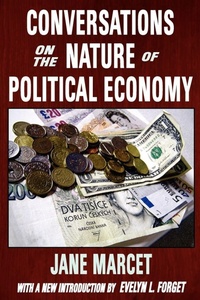
Conversations on the Nature of Political Economy
1st Edition
Published on 15. June 2009
Book
Paperback/Softback
462 pages
978-1-4128-1010-4 (ISBN)
Description
Jane Marcet is not writing for the working classes, but for women and men of the educated classes of the nineteenth century. She draws her principles and materials from the writings of the great masters who have written about political economy, particularly Adam Smith, Th omas Robert Malthus, Jean-Baptise Say, Jean Charles Luonard de Sismondi, and David Ricardo.
Marcet consolidates the ideas of bankers as well as professional political economists. She makes their ideas accessible, not only to the young people she identifi es as her audience in the book's preface, but also to the middle classes--political actors and business people. She challenges the English classical school to take seriously the ideas of continental economists by inserting those ideas into a popular book.
Marcet maintains distance from some of the central tenets of classical economics, but engages in conversation with its masters. Sometimes she accepts criticism of their ideas, but at other times she keeps her own counsel. The ideas of the masters will be immediately identifi able to those for whom political economy is not new, although a few of their more abstruse questions and controversies have been omitted. When the soundness of a doctrine appears well established, Marcet presents it conscientiously. Evelyn L. Forget's well written introduction describes the life and background of the author as well as the book's history, bringing this timeless classic into the twenty- first century.
Marcet consolidates the ideas of bankers as well as professional political economists. She makes their ideas accessible, not only to the young people she identifi es as her audience in the book's preface, but also to the middle classes--political actors and business people. She challenges the English classical school to take seriously the ideas of continental economists by inserting those ideas into a popular book.
Marcet maintains distance from some of the central tenets of classical economics, but engages in conversation with its masters. Sometimes she accepts criticism of their ideas, but at other times she keeps her own counsel. The ideas of the masters will be immediately identifi able to those for whom political economy is not new, although a few of their more abstruse questions and controversies have been omitted. When the soundness of a doctrine appears well established, Marcet presents it conscientiously. Evelyn L. Forget's well written introduction describes the life and background of the author as well as the book's history, bringing this timeless classic into the twenty- first century.
More details
Language
English
Place of publication
New York
United States
Publishing group
Taylor & Francis Inc
Target group
College/higher education
Professional and scholarly
Dimensions
Height: 229 mm
Width: 152 mm
Thickness: 25 mm
Weight
664 gr
ISBN-13
978-1-4128-1010-4 (9781412810104)
Copyright in bibliographic data and cover images is held by Nielsen Book Services Limited or by the publishers or by their respective licensors: all rights reserved.
Schweitzer Classification
Other editions
Additional editions
Jane Marcet
Conversations on the Nature of Political Economy
Book
10/2017
1st Edition
Routledge
€207.10
Shipment within 10-20 days
Jane Marcet
Conversations on the Nature of Political Economy
E-Book
07/2017
Routledge
€69.99
Available for download
Jane Marcet
Conversations on the Nature of Political Economy
E-Book
07/2017
Routledge
€69.99
Available for download
Person
Jane Marcet (1769-1858) was born in London and educated at home in the fields of mathematics, astronomy, and philosophy. She married Alexander Marcet and came in contact with numerous professional scientists. She went on to write books in an astonishing range of areas including chemistry, botany, economics, and religion. Evelyn L. Forget is professor in the Department of Community Health Sciences at the University of Manitoba. Some of her books include Social Economics of Jean-Baptiste Say and Reflections on the Classical Canon in Economics. She is also the editor of the Journal of the History of Economic Thought.
Content
Conversation I; Conversation II; Conversation III; Conversation IV; Conversation V; Conversation VI; Conversation VII; Conversation VIII; Conversation IX; Conversation X; Conversation XI; Conversation XII; Conversation XIII; Conversation XIV; Conversation XV; Conversation XVI; Conversation XVII; Conversation XVIII; Conversation XIX; Conversation XX; Conversation XXI; Conversation XXII