

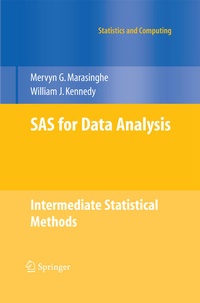
SAS for Data Analysis
Intermediate Statistical Methods
Published on 31. October 2014
Book
Paperback/Softback
XII, 558 pages
978-1-4899-8772-3 (ISBN)
Description
This book is intended for use as the textbook in a second course in applied statistics that covers topics in multiple regression and analysis of variance at an intermediate level. Generally, students enrolled in such courses are p- marily graduate majors or advanced undergraduate students from a variety of disciplines. These students typically have taken an introductory-level s- tistical methods course that requires the use a software system such as SAS for performing statistical analysis. Thus students are expected to have an - derstanding of basic concepts of statistical inference such as estimation and hypothesis testing. Understandably, adequate time is not available in a ?rst course in stat- tical methods to cover the use of a software system adequately in the amount of time available for instruction. The aim of this book is to teach how to use the SAS system for data analysis. The SAS language is introduced at a level of sophistication not found in most introductory SAS books. Important features such as SAS data step programming, pointers, and line-hold spe- ?ers are described in detail. The powerful graphics support available in SAS is emphasized throughout, and many worked SAS program examples contain graphic components.
Reviews / Votes
From the reviews: "The authors have presented an exceptionally detailed and complete guide to using SAS to read and process data, make tables and plots, and fit linear models with fixed, random, or mixtures of fixed and random components. All procedures are illustrated with numerous data examples, and both the SAS commands and the output are explained in meticulous detail. And as one would expect, all of the data and SAS code used in the book may be downloaded from a website... for a student who needs to learn the details of using SAS to process data and fit classical linear models, this book would make an excellent choice." (Dirk F Moore, Journal of Biopharmaceutical Statistics (JBS), Issue #5, 2009) "The authors provide an easily readable introduction into the SAS language, some of its basic statistical methods, and many applications for statistical linear modeling...Very helpful are the many exercises in each chapter which make this book valuable for teaching at universities and colleges... As of today, almost all test examples and data sets are available from the Web page accompanying the book." (Wolfgang M. Hartman, Journal of Statistical Software, Vol. 28, October 2008) "The authors have presented an exceptionally detailed and complete guide to using SAS to read and process data, make tables and plots, and fit linear models with fixed, random, or mixtures of fixed and random components. A ll procedures are illustrated with numerous data examples, and both the SAS commands and the output are explained in meticulous detail. And as one would expect, all of the data and SAS code used in the book may be downloaded from a website. ... But for a student who needs to learn the details of using SAS to process data and fit classical linear models, this book would make an excellent choice. " (Dirk F. Moore, Journal of Biopharmaceutical Statistics, 2009, Issue 5) "Many universities offer graduate courses in applied statistics where the emphasis is on regression and design of experiments. These courses typically attache individuals from a wide array of disciplines with the purpose being to equip students with some of the essentials of data analysis. Typically students have been exposed to one or more point-and-click statistical software packages along the way in their statistical training but their exposure to programming-sophisticated packages such as R and SAS is at best, limited. The authors of this text clearly have a great deal of experience teaching these types of applied statistics courses as they have put together a fine text. ...The text is carefully written and well organized. The introduction to the SAS language is one of the best that I am aware of. ...Owners of this book will be happy to have it on their shelf." (The American Statistician, May 2010, Vol. 64, No. 2) "This book illustrates how to use the SAS system for data analysis. ... The book can be used as a textbook in an applied statistics course that covers the topics in multiple regression and analysis of variance and requires the use of SAS for performing statistical analysis. It can also be used as a reference by researchers and data analysts in the academic setting or industry for conducting statistical analysis using SAS." (Weiming Ke, Technometrics, Vol. 53 (1), February, 2011)More details
Series
Edition
2008 ed.
Language
English
Place of publication
New York
United States
Target group
Professional and scholarly
Professional/practitioner
Illustrations
XII, 558 p. With 100 SAS Programs.
Dimensions
Height: 235 mm
Width: 155 mm
Thickness: 31 mm
Weight
855 gr
ISBN-13
978-1-4899-8772-3 (9781489987723)
DOI
10.1007/978-0-387-77372-8
Schweitzer Classification
Other editions
Additional editions
E-Book
12/2008
1st Edition
Springer
€69.54
Available for download
Book
08/2008
Springer
€64.19
Article exhausted; check for reprint
Persons
Mervyn G. Marasinghe, PhD, is Associate Professor Emeritus of Statistics at Iowa State University, where he has taught courses in statistical methods and statistical computing. He has taught a data analysis course based on SAS for over 35 years and offered workshops and short-courses on various aspects of SAS including traditional SAS programming, SAS Enterprise Guide, SAS Enterprise Miner, and JMP for many years to both university audiences and non-academic participants.
Kenneth J. Koehler, PhD, is University Professor of Statistics at Iowa State University, where he teaches courses in statistical methodology at both graduate and undergraduate levels and primarily uses SAS to supplement his teaching.
Content
to the SAS Language.- More on SAS Programming and Some Applications.- Statistical Graphics Using SAS/GRAPH.- Statistical Analysis of Regression Models.- Analysis of Variance Models.- Analysis of Variance: Random and Mixed Effects Models.